
NCERT · Class 9 Social Science · First edition September 2026
Class 9 Social Science Part 2 PDF: Understanding Society, All 6 Chapters
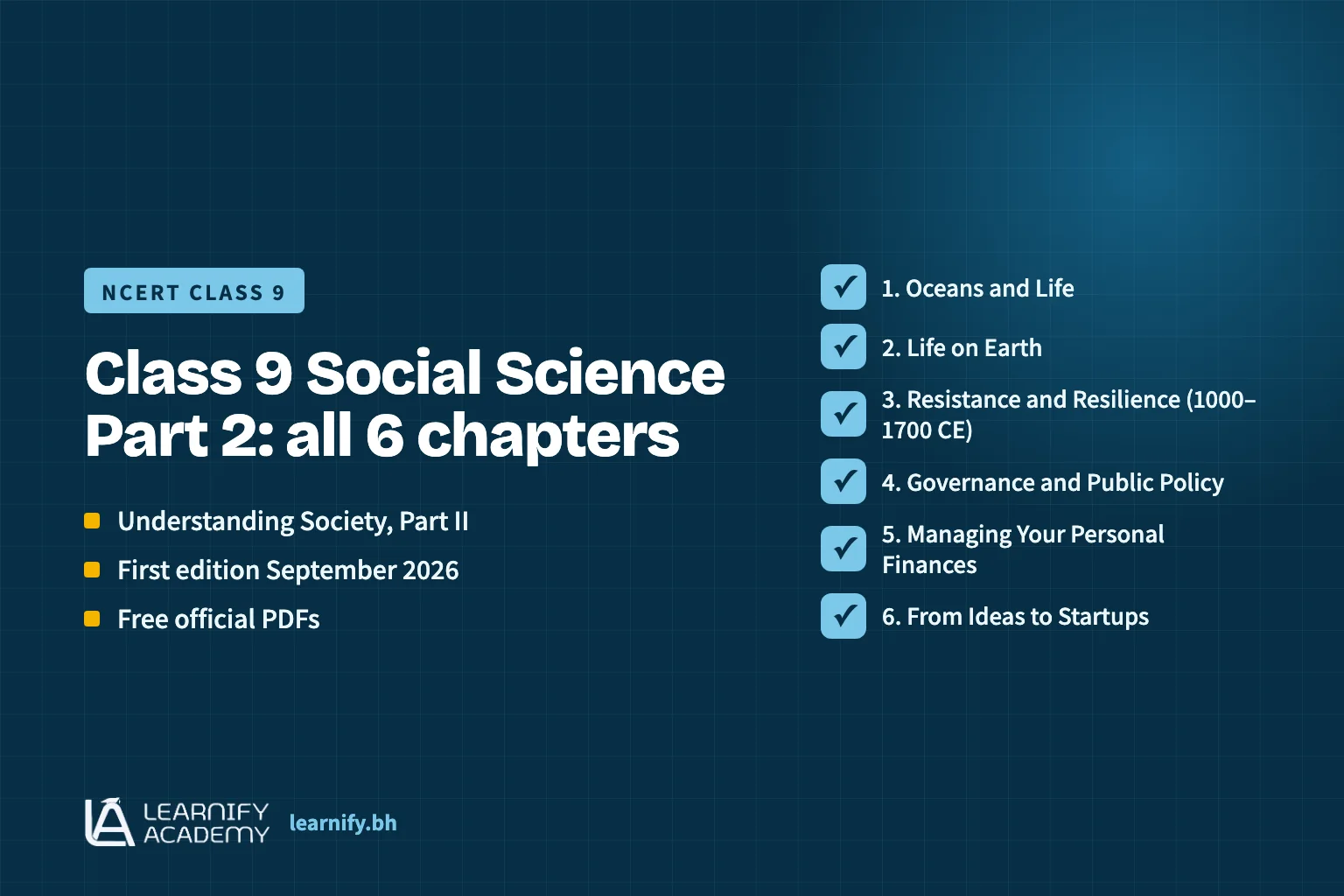
Class 9 Social Science Part 2 (Class 9 SST Part 2) is NCERT’s Understanding Society: India and Beyond, Part II, the second half of the new textbook for 2026–27, first published in September 2026. It has six chapters: two of Geography, one of History, one of Political Science and two of Economics. Download each chapter as an official PDF from ncert.nic.in, or the whole of Part 2 as one ZIP file, and see what every chapter covers.
Class 9 SST Part 2 at a glance
- Book Understanding Society: India and Beyond, Part II
- Class 9 (Class IX, Grade 9), Social Science (SST)
- Medium English (Hindi not yet on NCERT’s website)
- Chapters 6 (Geography 2, History 1, Political Science 1, Economics 2)
- Pages 149
- First edition September 2026
- ISBN 978-93-5729-279-5
- On NCERT’s website Yes (checked 15 November 2026)
Class 9 SST Part 2 PDF: all 6 chapters (English medium)
In book order (some schools call them lessons 1 to 6). Each link opens the official NCERT PDF on ncert.nic.in; nothing is re-hosted, so the files are always NCERT’s latest.
On this page: Chapter PDFs · Chapter names and contents · Chapter-wise notes · Syllabus · Part 1 vs Part 2 · FAQ
- Chapter 1: Oceans and Life (Geography) Download PDF (14.5 MB)
- Chapter 2: Life on Earth (Geography) Download PDF (18.3 MB)
- Chapter 3: Resistance and Resilience (1000–1700 CE) (History) Download PDF (6.6 MB)
- Chapter 4: Governance and Public Policy (Political Science) Download PDF (3.5 MB)
- Chapter 5: Managing Your Personal Finances (Economics) Download PDF (2.0 MB)
- Chapter 6: From Ideas to Startups (Economics) Download PDF (7.5 MB)
Download the complete Understanding Society Part 2
Class 9 Social Science Part 2 chapter names and contents
The book’s contents (index), with page numbers from NCERT’s contents page. The one-line summaries are ours, based on each chapter’s opening questions and closing summary.
| Chapter | Subject | What it covers | Book pages |
|---|---|---|---|
| 1. Oceans and Life | Geography | Oceans carry trade and travel and regulate climate. | 1–20 |
| 2. Life on Earth | Geography | Biomes are large regions with their own climate, plants and animals. | 21–44 |
| 3. Resistance and Resilience (1000–1700 CE) | History | Between 1000 and 1700 CE, kingdoms and communities endured through resistance (war, alliances, diplomacy) and resilience (culture, shared beliefs, community support and economic strength). | 45–80 |
| 4. Governance and Public Policy | Political Science | Governance is the process of making, carrying out and monitoring decisions for people’s welfare; government is the set of institutions that does it. | 81–106 |
| 5. Managing Your Personal Finances | Economics | Good money habits built early give security and independence. | 107–124 |
| 6. From Ideas to Startups | Economics | Entrepreneurship turns ideas into action by spotting opportunities, taking risks and creating value. | 125–149 |

Class 9 Social Science · all 15 chapters
Dates, terms and big ideas, sorted before the exam.
Geography, History, Political Science and Economics from both parts of the book, ready as cards in Morywise. Each card comes back just before you’d forget it, so revision takes minutes, not late nights.
Get Morywise free on the App Store
For iPhone (iOS 18 or later). The app costs nothing to download.
Class 9 SST Part 2 notes: chapter-wise key ideas and key terms
Short revision notes for each chapter. Every chapter opens with a few “Big Questions” and ends with a summary and a “Questions and activities” section; here is what each one sets out to answer, in our words, with the terms to know before a test.
Chapter 1: Oceans and Life, Class 9 (Geography): notes and PDF
Questions it answers:
- Why the shape of the ocean floor matters?
- How waves, tides and currents affect life and climate?
- Why maritime zones matter to a country?
- How to use ocean resources sustainably?
- How early warning systems protect people from tsunamis and cyclones?
Key ideas: Oceans carry trade and travel and regulate climate. The ocean floor has a continental shelf, ridges, trenches and seamounts. Waves, tides and currents shape fishing, navigation and weather, and international rules divide the sea into zones and settle disputes.
Key terms: Continental shelf, Ocean trench, Tides and currents, Territorial waters, Exclusive Economic Zone (EEZ), High seas, Tsunami early warning. Download the Oceans and Life chapter PDF. Practise with the “Questions and activities” at the end of the chapter.
Chapter 2: Life on Earth, Class 9 (Geography): notes and PDF
Questions it answers:
- How landforms and climate shape life?
- How humans and other living things depend on each other?
- Why conservation matters and how we can help?
Key ideas: Biomes are large regions with their own climate, plants and animals. People adapt to them, and traditional practices and today’s laws help conserve them. Forests support many occupations, from hunting to ecotourism, and population pressure brings problems such as human–wildlife conflict.
Key terms: Biome, Biosphere reserve, Ecotourism, Forest dwellers, Human–wildlife conflict, Conservation laws. Download the Life on Earth chapter PDF. Practise with the “Questions and activities” at the end of the chapter.
Chapter 3: Resistance and Resilience (1000–1700 CE), Class 9 (History): notes and PDF
Questions it answers:
- How Indian rulers used resistance and alliances to defend their lands?
- What made kingdoms and communities resilient?
- How the Bhakti tradition built solidarity?
- How farming, trade and commerce kept the economy strong?
Key ideas: Between 1000 and 1700 CE, kingdoms and communities endured through resistance (war, alliances, diplomacy) and resilience (culture, shared beliefs, community support and economic strength). The Bhakti tradition used local languages and community participation to keep traditions alive.
Key terms: Resistance, Resilience, Alliances and confederacies, Bhakti tradition, Forts and fortifications, Agriculture and trade. Download the Resistance and Resilience (1000–1700 CE) chapter PDF. Practise with the “Questions and activities” at the end of the chapter.
Chapter 4: Governance and Public Policy, Class 9 (Political Science): notes and PDF
Questions it answers:
- What governance is and how its meaning has changed?
- What public policy is and how it affects daily life?
- The stages of making and carrying out a policy
- Who shapes policy?
- How citizens strengthen good governance?
Key ideas: Governance is the process of making, carrying out and monitoring decisions for people’s welfare; government is the set of institutions that does it. Good governance rests on participation, transparency, accountability, the rule of law, responsiveness and efficiency. India’s ideas of governance run from Sabha and Samiti, Ram Rajya and Rajadharma to today’s constitutional democracy.
Key terms: Governance vs government, Good governance, Public policy, Policy cycle, Accountability and transparency, Citizen participation. Download the Governance and Public Policy chapter PDF. Practise with the “Questions and activities” at the end of the chapter.
Chapter 5: Managing Your Personal Finances, Class 9 (Economics): notes and PDF
Questions it answers:
- What personal finance is and why it matters?
- The pillars of personal finance
- Common ways to save and invest
- How to protect savings and assets?
- What income tax is?
Key ideas: Good money habits built early give security and independence. Personal finance rests on five pillars: income, budgeting, saving, investing and protection. Investments differ in risk and return, insurance protects against losses, and income tax pays for public services.
Key terms: Budget, Saving and investing, Risk and return, Inflation, Insurance, Income tax. Download the Managing Your Personal Finances chapter PDF. Practise with the “Questions and activities” at the end of the chapter.
Chapter 6: From Ideas to Startups, Class 9 (Economics): notes and PDF
Questions it answers:
- How entrepreneurship affects society and the economy?
- The main functional areas of a business
- How to write a business plan?
Key ideas: Entrepreneurship turns ideas into action by spotting opportunities, taking risks and creating value. A business plan is the roadmap, every business runs on management and operations, finance, people and marketing, and revenue, expenses, profit and cash flow show how it is doing. Failure is part of learning, and startups create jobs and innovation.
Key terms: Entrepreneur, Startup, Business plan, Revenue, expenses and profit, Cash flow, Marketing and sales. Download the From Ideas to Startups chapter PDF. Practise with the “Questions and activities” at the end of the chapter.
Class 9 SST Part 2 syllabus: CBSE curriculum vs the final NCERT book
CBSE’s Class IX Social Science curriculum for 2026–27 lists the Part 2 themes it expected, with teaching hours. NCERT’s final Part 2 book, published later, keeps four of them, replaces one and moves one to Class 10:
| CBSE 2026–27 curriculum (Part 2) | Hours | In the NCERT Part 2 book |
|---|---|---|
| Oceans and Life | 7 | Chapter 1, same title |
| Life on Earth | 7 | Chapter 2, same title |
| Resistance and Resilience (1000 CE–1700 CE) | 9 | Chapter 3, same title |
| India and the World-I (1900 BCE–1200 CE) | 8 | Not in Part 2: NCERT says this chapter has moved to Grade 10 |
| Authority | 10 | Replaced by Chapter 4, Governance and Public Policy |
| From Ideas to Startups | 8 | Chapter 6, same title |
| Smart Ways to Manage Your Finances | 6 | Chapter 5, Managing Your Personal Finances |
Study from the NCERT book, and follow your school’s list of chapters for each exam: schools set Class 9 exams, and CBSE may issue an updated curriculum to match the final book.
Part 1 and Part 2: how the book is split
Understanding Society: India and Beyond is one Class 9 Social Science course in two volumes. Unlike Ganita Manjari, each part numbers its chapters from 1.
| Part 1 | Part 2 | |
|---|---|---|
| Chapters | 9 | 6 |
| Subjects | Introduction, then Geography, History, Political Science and Economics (2 each) | Geography 2, History 1, Political Science 1, Economics 2 |
| Topics | Earth’s surface, atmosphere and climate, early humans and early states, democracy and elections, choice and markets | Oceans, biomes and conservation, 1000–1700 CE, governance and public policy, personal finance, entrepreneurship |
| Download | Part 1 chapter PDFs | Part 2 chapter PDFs |
FAQ
Class 9 Social Science Part 2: common questions
Is Class 9 Social Science Part 2 released? What is the release date?
Yes, it is released. NCERT’s Understanding Society: India and Beyond, Part II has a first edition dated September 2026, and news reports said printed copies went on sale from 29 September 2026. It was not yet on NCERT’s textbook website on 1 October 2026 and was there when we checked on 15 November 2026. All six chapter PDFs and the full-book ZIP are on this page.
What is the name of the Class 9 SST Part 2 book?
Understanding Society: India and Beyond, Social Science Textbook for Grade 9, Part II, published by NCERT (ISBN 978-93-5729-279-5). Part 1 has the same title. It is one integrated book, not separate History, Geography, Civics and Economics books.
What are the chapter names in Class 9 SST Part 2?
There are six chapters: Chapter 1, Oceans and Life; Chapter 2, Life on Earth; Chapter 3, Resistance and Resilience (1000–1700 CE); Chapter 4, Governance and Public Policy; Chapter 5, Managing Your Personal Finances; and Chapter 6, From Ideas to Startups.
Which subjects are in Social Science Part 2?
Geography (Oceans and Life, Life on Earth), History (Resistance and Resilience, 1000–1700 CE), Political Science (Governance and Public Policy) and Economics (Managing Your Personal Finances, From Ideas to Startups).
What is the Class 9 SST Part 2 syllabus?
The six chapters of this book. CBSE’s 2026–27 curriculum, written earlier, listed seven Part 2 themes; NCERT’s final book replaced Authority with Governance and Public Policy and moved India and the World-I to Class 10. See the syllabus comparison and follow your school’s chapter list for each exam.
What happened to the chapters Authority and India and the World?
NCERT’s foreword says Governance and Public Policy is in place of the chapter Authority that had been planned, and that India and the World Part 1 has been shifted to Grade 10. CBSE’s 2026–27 curriculum, written earlier, still lists both.
Is the Class 9 Social Science Part 2 PDF free and official?
Yes. Every link on this page opens the PDF directly from NCERT’s own server (ncert.nic.in), free, with no login. Avoid PDFs shared on social media: NCERT has warned about a fake copy of the Class 9 Social Science book circulating online.
Is Class 9 SST Part 2 available in Hindi medium (कक्षा 9 सामाजिक विज्ञान भाग 2 पाठ्यपुस्तक पीडीएफ)?
Not yet. On 15 November 2026 NCERT’s website had the English-medium edition only. We will add the Hindi-medium Part 2 to this page when NCERT publishes it.
What is the price (MRP) of the printed Class 9 SST Part 2 book?
We do not list a price because we have not seen an official NCERT price for this title, and NCERT’s published price lists do not include it yet. The MRP is printed on the book; printed copies are sold through NCERT’s outlets and authorised sellers. The PDFs on this page are free.
Where are the notes and question answers for Class 9 SST Part 2?
Our chapter-wise notes give each chapter’s key ideas and key terms. The questions are in the “Questions and activities” section at the end of each chapter PDF: read the chapter first, then answer in full sentences using the key terms; your teacher’s notes show the format your school expects.
Can CBSE students in the Gulf use Part 2?
Yes. The PDFs download from anywhere, and CBSE schools in the UAE, Saudi Arabia, Qatar, Kuwait, Oman and Bahrain follow the same Class 9 curriculum and NCERT books as schools in India.