
CBSE guide · 2026–27
CBSE Class 12 Maths syllabus 2026–27: units and marks
Six units, one 80-mark board paper and 20 marks of internal assessment. Here is the official CBSE Class 12 Maths syllabus for 2026–27, with chapters, the paper pattern and the prescribed NCERT books.
At a glance
- Subject Mathematics (code 041)
- Board paper 80 marks, 3 hours
- Internal assessment 20 marks
- Biggest unit Calculus, 35 marks
- 2026–27 sample paper 38 questions in five sections
- Textbooks NCERT Mathematics Part I and Part II
Quick answer
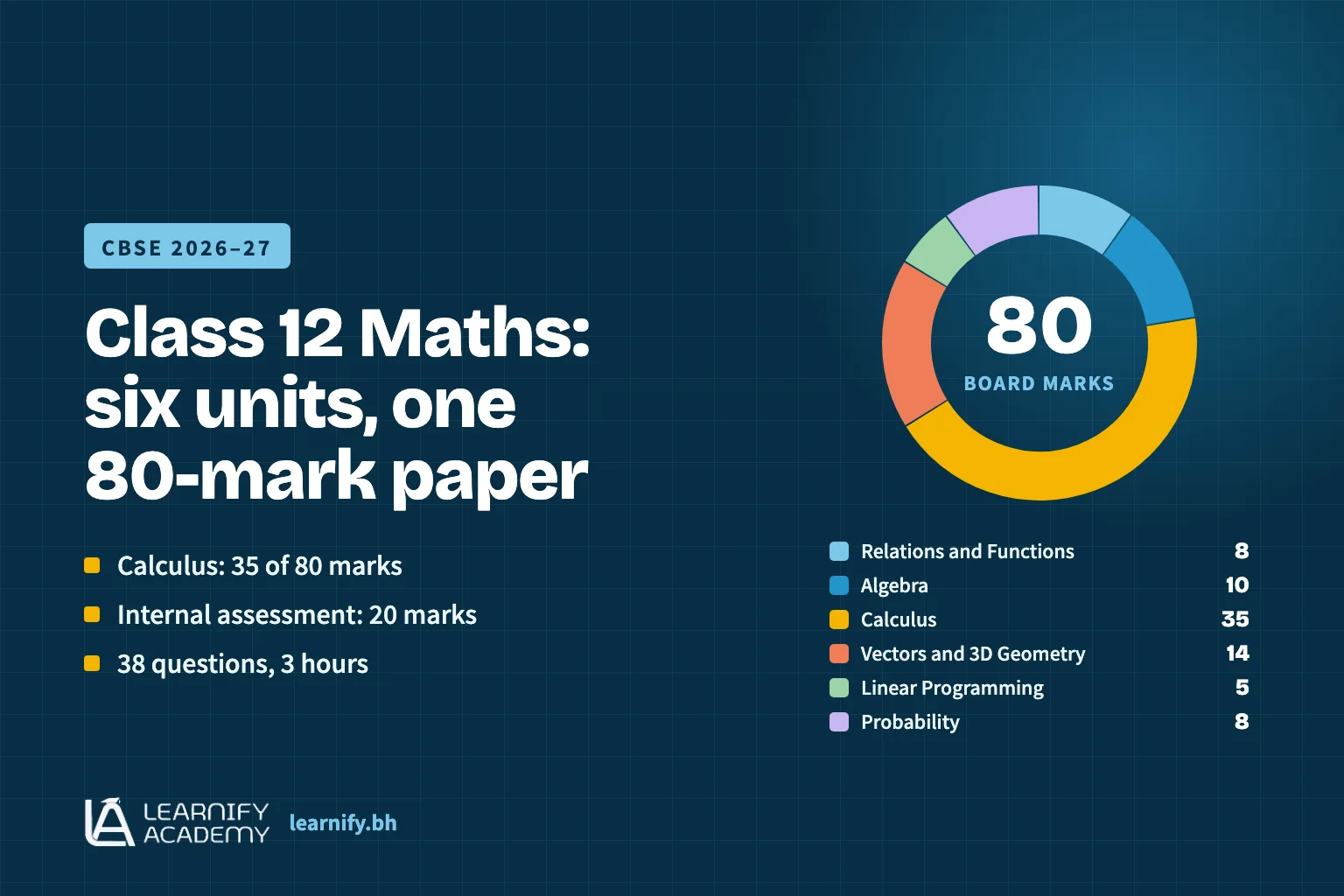
The CBSE Class 12 Maths syllabus for 2026–27 (subject code 041) has six units, tested in one three-hour, 80-mark paper: Relations and Functions 8, Algebra 10, Calculus 35, Vectors and Three-dimensional Geometry 14, Linear Programming 5 and Probability 8. Schools add 20 marks of internal assessment from periodic tests and maths activities.
What is in the CBSE Class 12 Maths syllabus 2026–27?
The CBSE Class 12 Maths syllabus 2026–27 has six units and 13 chapters, tested in one three-hour board paper of 80 marks, with a further 20 marks of internal assessment awarded by the school. It comes from CBSE’s official Mathematics (code 041) curriculum for Classes XI–XII, which CBSE released for the 2026–27 session on 1 April 2026. The board examination covers the entire Class 12 syllabus.
CBSE asks every affiliated school to follow the prescribed curriculum strictly, so the units and marks below apply in exactly the same way to CBSE students in Bahrain and across the GCC as they do in India.
Parents who looked at last year’s syllabus will find the same content. Apart from the year labels, the 2026–27 Maths document matches the 2025–26 version, and CBSE’s notice on the 2026–27 sample papers says there is no change in the question paper design or assessment pattern this session.
How many marks does each unit carry in Class 12 Maths?
Calculus carries the most marks by far: 35 of the 80 marks in the board paper. The full course structure for 2026–27 is below.
| Unit | Unit name | Marks |
|---|---|---|
| I | Relations and Functions | 8 |
| II | Algebra | 10 |
| III | Calculus | 35 |
| IV | Vectors and Three-dimensional Geometry | 14 |
| V | Linear Programming | 5 |
| VI | Probability | 8 |
| Board paper (3 hours) | 80 | |
| Internal assessment | 20 | |
| Subject total | 100 |
In other words, Calculus alone is worth more than two-fifths of the board paper, and Calculus together with Vectors and Three-dimensional Geometry accounts for 49 of the 80 marks. Linear Programming, at 5 marks, is the smallest unit.
The 2026–27 document gives marks for each unit but does not list teaching periods. Within a unit, CBSE sets no chapter-wise weightage and asks that all chapters be covered, so a lighter unit is not an optional one.
Which chapters are in each unit of the Class 12 Maths syllabus?
The six units contain 13 chapters, and these match the 13 chapters of NCERT’s two-part Class 12 Mathematics textbook.
| Unit | Chapters in the CBSE syllabus | NCERT book and chapter |
|---|---|---|
| I. Relations and Functions | Relations and Functions; Inverse Trigonometric Functions | Part I, chapters 1–2 |
| II. Algebra | Matrices; Determinants | Part I, chapters 3–4 |
| III. Calculus | Continuity and Differentiability; Applications of Derivatives; Integrals; Application of the Integrals; Differential Equations | Part I, chapters 5–6; Part II, chapters 7–9 |
| IV. Vectors and Three-dimensional Geometry | Vectors; Three-dimensional Geometry | Part II, chapters 10–11 |
| V. Linear Programming | Linear Programming | Part II, chapter 12 |
| VI. Probability | Probability | Part II, chapter 13 |
Limits worth knowing within the chapters
The detailed syllabus also fixes the depth of several topics. These are the limits students most often ask about:
- Matrices: the examples of non-commuting matrices, and of non-zero matrices whose product is the zero matrix, are restricted to square matrices of order 2, and all matrices have real entries.
- Determinants: up to 3 × 3 matrices, including solving systems of linear equations in two or three variables (with a unique solution) using the inverse of a matrix.
- Application of the Integrals: areas under simple curves, especially lines, circles, parabolas and ellipses in standard form only.
- Differential Equations: separation of variables, homogeneous equations of first order and first degree, and linear equations of the type dy/dx + py = q.
- Linear Programming: the graphical method for problems in two variables, with up to three non-trivial constraints.
- Probability: conditional probability, the multiplication theorem, independent events, total probability and Bayes’ theorem.
How is the 20-mark internal assessment in Class 12 Maths awarded?
The 20 internal marks are split equally: 10 for periodic tests and 10 for maths activities, both assessed in school rather than in the board paper.
| Component | Marks | What it involves |
|---|---|---|
| Periodic tests | 10 | Pen-and-paper tests set by the subject teacher; the best two of three count |
| Activity work and record | 5 | Any 10 activities from the NCERT Laboratory Manual, recorded through the year |
| Year-end activity test | 3 | Assessment of an activity performed in a year-end test |
| Viva-voce | 2 | Oral questions on the activity work |
CBSE suggests a timetable for the periodic tests (PT-I in July–August, PT-II in November and PT-III in December–January) but says schools may hold them as convenient. Each test is converted to 10 marks, and the average of the best two becomes the final periodic test mark. The curriculum also asks schools to share each test result with students and parents.
What is the Class 12 Maths question paper pattern for 2026–27?
The 2026–27 sample paper has 38 compulsory questions in five sections, for 80 marks in three hours. CBSE published it on 21 September 2026 and confirmed that the question paper design and assessment pattern have not changed for this session.
| Section | Questions | Type | Marks |
|---|---|---|---|
| A | Q1–20 | 18 multiple choice and 2 assertion-reason questions, 1 mark each | 20 |
| B | Q21–25 | Very short answer, 2 marks each | 10 |
| C | Q26–31 | Short answer, 3 marks each | 18 |
| D | Q32–35 | Long answer, 5 marks each | 20 |
| E | Q36–38 | Case study based, 4 marks each | 12 |
| Total | 38 questions | 80 |
There is no overall choice. Internal choice is given in two questions in Section B, three in Section C, two in Section D and one sub-part in each of two Section E questions. In Section E, the first two case studies have sub-parts worth 1, 1 and 2 marks, and the third has two sub-parts of 2 marks each. Calculators are not allowed.
What type of thinking does the Maths paper test?
More than half the paper, 44 of the 80 marks, tests remembering and understanding, while the remaining 36 marks test applying, analysing, evaluating and creating.
| Type of question | Marks | Weightage |
|---|---|---|
| Remembering and understanding | 44 | 55% |
| Applying | 20 | 25% |
| Analysing, evaluating and creating | 16 | 20% |
| Total | 80 | 100% |
The design also states that 33% internal choice is given in all sections, and that paper setters may vary individual papers as long as these overall weightages stay the same.
Which NCERT books are prescribed for Class 12 Maths?
CBSE prescribes NCERT’s Class 12 Mathematics textbook in two parts, along with NCERT’s exemplar problems and laboratory manual.
- Mathematics Part I, Textbook for Class XII (NCERT): chapters 1–6, from Relations and Functions to Application of Derivatives.
- Mathematics Part II, Textbook for Class XII (NCERT): chapters 7–13, from Integrals to Probability.
- Mathematics Exemplar Problems for Class XII (NCERT): extra problems for practice.
- Mathematics Lab Manual, Class XII (NCERT): the source of the 10 activities used for internal assessment.
NCERT’s current printing of both Class 12 Maths textbooks is marked “Reprint 2026-27”. The books are linked from our NCERT Class 12 textbooks page.
How can students plan the year around these marks?
Use the marks to decide where to spend time, not what to skip. Calculus deserves the longest stretch of practice because it carries 35 marks across five chapters, and the NCERT books build it in order, from continuity and derivatives in Part I to integrals and differential equations in Part II.
Linear Programming and Probability are single-chapter units, but CBSE asks for every chapter to be covered, so they still need planned time. Keeping the activity file up to date from the first term also protects the 10 activity marks in internal assessment.
Families in Bahrain who want structured support with Class 12 Maths can find details on our maths tuition page.
FAQ
Questions parents ask
How many marks is Calculus in CBSE Class 12 Maths 2026–27?
Calculus carries 35 of the 80 board marks in 2026–27, the largest share of any unit. It has five chapters: Continuity and Differentiability, Applications of Derivatives, Integrals, Application of the Integrals and Differential Equations. CBSE does not fix marks for individual chapters and asks schools to cover all of them, so students should prepare every Calculus chapter rather than guess which will carry more.
Has the CBSE Class 12 Maths syllabus changed for 2026–27?
No. Apart from the year labels, the 2026–27 Mathematics curriculum matches the 2025–26 document, with the same six units, unit marks and 13 chapters. CBSE’s notification of 21 September 2026 also says there is no change in the question paper design and assessment pattern for 2026–27, and that the passing criteria remain the same as in 2025–26.
How many questions are there in the Class 12 Maths board paper?
The 2026–27 sample paper has 38 questions in five sections: 20 one-mark questions in Section A (18 multiple choice and 2 assertion-reason), five 2-mark questions in Section B, six 3-mark questions in Section C, four 5-mark questions in Section D and three 4-mark case studies in Section E. All questions are compulsory, with internal choice in some.
Are calculators allowed in the CBSE Class 12 Maths exam?
No. The general instructions of CBSE’s 2026–27 Class 12 Mathematics sample paper state that the use of calculators is not allowed. Students should therefore practise arithmetic with fractions, surds and decimals by hand throughout the year, so that long Calculus and Probability questions do not become slow in the exam hall.
Is Applied Mathematics the same as Class 12 Maths?
No. Applied Mathematics (code 241) is a separate subject from Mathematics (code 041), with its own syllabus, and CBSE’s scheme of studies says a student cannot take both together. Both carry 80 theory marks and 20 internal assessment marks. This guide covers only Mathematics 041, the subject whose units and chapters are listed above.
When is the CBSE Class 12 Maths board exam in 2027?
The 2026–27 curriculum and sample paper do not give exam dates. CBSE announces the Class 12 date sheet separately on its main website, cbse.gov.in, so rely on that notice rather than dates repeated on social media. The syllabus and marks in this guide apply to the board examination for the 2026–27 session.
Which NCERT books should my child use for Class 12 Maths?
CBSE prescribes NCERT Mathematics Part I (chapters 1–6) and Part II (chapters 7–13) for Class 12, plus NCERT’s Exemplar Problems for Class XII and the Class XII Lab Manual. The lab manual matters for internal assessment, because the 10 activities each student completes during the year are chosen from it.
Sources
Official documents used for this article, checked on 24 September 2026. CBSE and NCERT can update them during the year, so confirm important dates and rules on cbse.gov.in or cbseacademic.nic.in before acting.
- CBSE Curriculum 2026–27 (Classes IX–XII), CBSE Academic
- CBSE Mathematics (041) curriculum, Classes XI–XII, 2026–27
- CBSE Introduction to Secondary Curriculum Part 2 (Classes XI–XII), 2026–27
- CBSE Circular Acad-14/2026: Release of CBSE Curriculum for 2026–27
- CBSE Notification (21 September 2026): Sample Question Papers for Classes X and XII, 2026–27
- CBSE Class XII Sample Question Papers and Marking Schemes, 2026–27
- CBSE Class XII Mathematics Sample Question Paper, 2026–27
- CBSE Mathematics (041) curriculum, Classes XI–XII, 2025–26 (for comparison)
- NCERT Mathematics Part I, Class XII: prelims and contents (Reprint 2026-27)
- NCERT Mathematics Part II, Class XII: prelims and contents (Reprint 2026-27)
Want expert help this school year?
Learnify Academy teaches CBSE students in person in Riffa and Segaya, Bahrain. Your child’s first class is free.