
CBSE guide · 2026–27
CBSE Class 12 Chemistry syllabus 2026–27: unit weightage
Ten units, a 70-mark theory paper and 30 practical marks. Here is the official CBSE Class 12 Chemistry syllabus for 2026–27, with unit weightage, the four topics assessed only formatively and the paper pattern.
At a glance
- Subject Chemistry (code 043)
- Theory paper 70 marks, 3 hours
- Practical exam 30 marks
- Top unit Electrochemistry, 9 marks
- Assessed only formatively 4 topics, including Surface Chemistry
- 2026–27 sample paper 33 questions in five sections
Quick answer
The CBSE Class 12 Chemistry syllabus for 2026–27 (code 043) has ten units in a 70-mark theory paper. Electrochemistry carries the most marks (9), followed by Aldehydes, Ketones and Carboxylic Acids (8); five units carry 7 marks and three carry 6. Practicals add 30 marks, and four further topics are assessed only formatively.
What is in the CBSE Class 12 Chemistry syllabus 2026–27?
The CBSE Class 12 Chemistry syllabus 2026–27 has ten units, examined in a three-hour theory paper of 70 marks, plus a 30-mark practical examination. It is set out in CBSE’s Chemistry (code 043) curriculum for Classes XI–XII, released for the 2026–27 session on 1 April 2026, and the board examination covers the entire Class 12 syllabus.
CBSE asks every affiliated school to follow the prescribed curriculum strictly, so the same weightage applies to CBSE students in Bahrain and the wider GCC as in India.
The unit marks are the same as in 2025–26, but two things in the document are new. The topics under each unit now follow the section headings of the NCERT textbooks, and a note lists four topics that are included in the syllabus but assessed only formatively.
What is the unit-wise weightage in Class 12 Chemistry 2026–27?
Electrochemistry carries the most marks, 9 out of 70, and no unit carries fewer than 6. The official course structure is below, with the NCERT book in which each unit appears.
| Unit | Title | Marks | NCERT book |
|---|---|---|---|
| 1 | Solutions | 7 | Part I |
| 2 | Electrochemistry | 9 | Part I |
| 3 | Chemical Kinetics | 7 | Part I |
| 4 | d- and f-Block Elements | 7 | Part I |
| 5 | Coordination Compounds | 7 | Part I |
| 6 | Haloalkanes and Haloarenes | 6 | Part II |
| 7 | Alcohols, Phenols and Ethers | 6 | Part II |
| 8 | Aldehydes, Ketones and Carboxylic Acids | 8 | Part II |
| 9 | Amines | 6 | Part II |
| 10 | Biomolecules | 7 | Part II |
| Theory total | 70 |
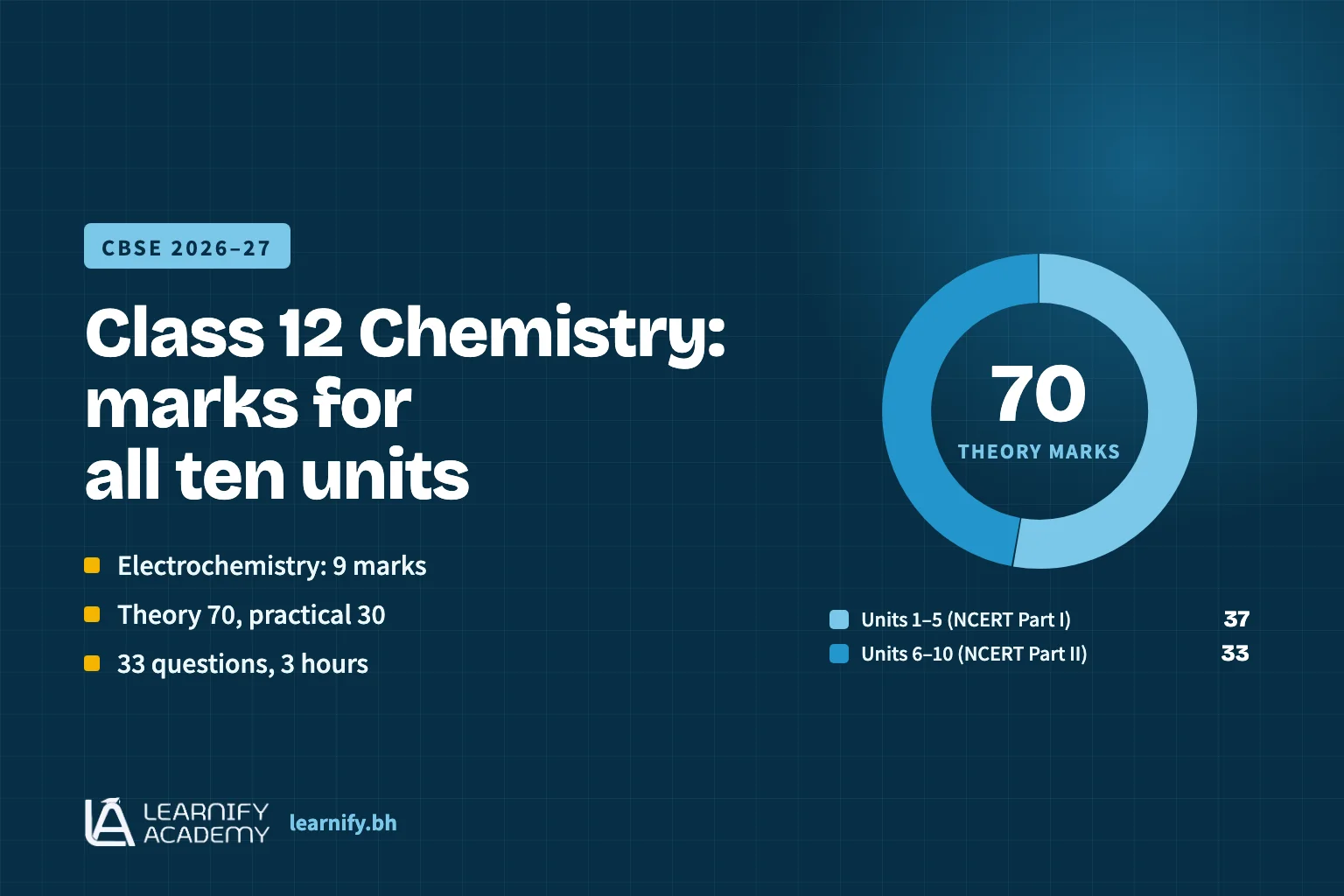
The five units in NCERT Part I carry 37 marks and the five in Part II carry 33, so neither book can be left until the end of the year. With every unit worth between 6 and 9 marks, no unit is small enough to skip safely.
CBSE’s general curriculum document says the board examination tests according to the weightage given to each unit. The Chemistry question paper design adds that no chapter-wise weightage is provided and that all chapters must be covered.
What topics does each Chemistry unit cover?
In 2026–27 the topics listed under each unit closely follow the section headings of the NCERT Class 12 Chemistry books, so the NCERT contents pages work as a checklist.
| Unit | Topics listed |
|---|---|
| 1. Solutions | Types of solutions, concentration, solubility, vapour pressure, ideal and non-ideal solutions, colligative properties and molar mass, abnormal molecular masses |
| 2. Electrochemistry | Electrochemical and galvanic cells, Nernst equation, conductance of electrolytic solutions, electrolytic cells and electrolysis, batteries, fuel cells, corrosion |
| 3. Chemical Kinetics | Rate of reaction, factors influencing rate, integrated rate equations, temperature dependence, collision theory |
| 4. d- and f-Block Elements | Position in the periodic table, electronic configuration, general properties of transition elements, important compounds, lanthanoids, actinoids, applications |
| 5. Coordination Compounds | Werner’s theory, key terms, nomenclature, isomerism, bonding, bonding in metal carbonyls, importance and applications |
| 6. Haloalkanes and Haloarenes | Classification, nomenclature, nature of the C-X bond, preparation, physical properties, chemical reactions, polyhalogen compounds |
| 7. Alcohols, Phenols and Ethers | Classification, nomenclature, structures of functional groups, alcohols and phenols, commercially important alcohols, ethers |
| 8. Aldehydes, Ketones and Carboxylic Acids | Nomenclature and structure, preparation, physical properties, chemical reactions and uses of aldehydes, ketones and carboxylic acids |
| 9. Amines | Structure, classification, nomenclature, preparation, properties and reactions of amines; preparation, reactions and importance of diazonium salts |
| 10. Biomolecules | Carbohydrates, proteins, enzymes, vitamins, nucleic acids, hormones |
Which Chemistry topics are assessed only formatively in 2026–27?
Four topics are included in the Class 12 syllabus but assessed only formatively: CBSE says they are there to reinforce understanding without adding to summative assessments, and they are not among the ten units that carry theory marks.
- Surface Chemistry: adsorption, colloids and emulsions.
- General Principles and Processes of Isolation of Elements: concentration, oxidation, reduction, the electrolytic method and refining.
- Polymers: polymerisation, homopolymers and copolymers.
- Chemistry in Everyday Life: chemicals in medicines and chemicals in food.
CBSE says schools can integrate these topics with existing chapters, and the curriculum encloses the relevant NCERT material for reference. This note did not appear in the Class XII section of the 2025–26 Chemistry curriculum. Surface chemistry still appears in the Class 12 practical syllabus, through preparing sols, dialysis and emulsifying agents, so students may meet it in the laboratory.
How are the 30 practical marks split in Class 12 Chemistry?
Volumetric analysis and salt analysis carry the most practical marks, 8 each, out of 30.
| Component | Marks |
|---|---|
| Volumetric analysis | 8 |
| Salt analysis | 8 |
| Content-based experiment | 6 |
| Project work | 4 |
| Class record and viva | 4 |
| Total | 30 |
The practical syllabus covers surface chemistry, chemical kinetics, thermochemistry, electrochemistry, chromatography, preparing inorganic and organic compounds, tests for functional groups, tests for carbohydrates, fats and proteins, KMnO4 titrations against oxalic acid and ferrous ammonium sulphate, and identifying one cation and one anion in a salt (insoluble salts excluded). For the project, students can pick a suggested topic, such as the quantity of casein in different milk samples, or another investigation of about 10 periods of work approved by the teacher.
Students with a visual impairment follow a two-hour, 30-mark scheme: 5 marks for identifying apparatus, 10 for a written test, 5 for the practical record and 10 for the viva.
What is the Class 12 Chemistry question paper pattern for 2026–27?
The 2026–27 Chemistry sample paper has 33 compulsory questions in five sections, for 70 marks in three hours, and CBSE’s notice of 21 September 2026 says the paper design and assessment pattern are unchanged this session.
| Section | Questions | Type | Marks |
|---|---|---|---|
| A | Q1–16 | Multiple choice, 1 mark each (Q13–16 are assertion-reason) | 16 |
| B | Q17–21 | Very short answer, 2 marks each | 10 |
| C | Q22–28 | Short answer, 3 marks each | 21 |
| D | Q29–30 | Case-based or data-based, 4 marks each | 8 |
| E | Q31–33 | Long answer, 5 marks each | 15 |
| Total | 33 questions | 70 |
Log tables and calculators are not allowed. The paper also gives a separate question for visually impaired candidates in place of questions with visual inputs.
What skills does the Chemistry theory paper test?
Forty per cent of the theory marks test remembering and understanding; the other 60% test applying, analysing, evaluating and creating.
| Domain | Marks | Percentage |
|---|---|---|
| Remembering and understanding | 28 | 40% |
| Applying | 21 | 30% |
| Analysing, evaluating and creating | 21 | 30% |
| Total | 70 | 100% |
There is no overall choice in the paper, but 33% internal choice is given in all sections.
Which NCERT books are prescribed for Class 12 Chemistry?
CBSE prescribes NCERT Chemistry Part I and Part II for Class XII, together with NCERT’s Manual of Microscale Chemistry Laboratory Kit.
- Chemistry Part I, Class XII (NCERT): Units 1–5, from Solutions to Coordination Compounds.
- Chemistry Part II, Class XII (NCERT): Units 6–10, from Haloalkanes and Haloarenes to Biomolecules.
- Manual of Microscale Chemistry Laboratory Kit (NCERT): for practical work.
NCERT’s current printing of both Class 12 Chemistry books is marked “Reprint 2026-27”, and the books are linked from our NCERT Class 12 textbooks page.
How should students plan Chemistry revision around the weightage?
Plan by marks, but give every unit a place in the timetable. Electrochemistry (9 marks) and Aldehydes, Ketones and Carboxylic Acids (8 marks) deserve the most practice, yet even the lightest units carry 6 marks each, which is more than a single 5-mark long answer is worth.
Because practicals carry 30 marks, keep the record file and project up to date through the year, and treat volumetric analysis and salt analysis, worth 16 marks together, as skills to practise in every lab session rather than just before the exam. Families in Bahrain who want help turning this syllabus into a weekly study plan can find details on our chemistry tuition page.
FAQ
Questions parents ask
Which unit has the highest weightage in Class 12 Chemistry 2026–27?
Electrochemistry (Unit 2) has the highest weightage, 9 of the 70 theory marks, followed by Aldehydes, Ketones and Carboxylic Acids (Unit 8) with 8. Solutions, Chemical Kinetics, d- and f-Block Elements, Coordination Compounds and Biomolecules carry 7 marks each, while Haloalkanes and Haloarenes, Alcohols, Phenols and Ethers, and Amines carry 6 each.
Is Surface Chemistry in the CBSE Class 12 Chemistry exam in 2026–27?
Surface Chemistry is not one of the ten units that carry theory marks in 2026–27. The syllabus lists it among four topics that are included but assessed only formatively, without adding to summative assessments; the others are Isolation of Elements, Polymers and Chemistry in Everyday Life. Surface chemistry experiments, such as preparing sols, do still appear in the practical syllabus.
Has the Class 12 Chemistry syllabus changed for 2026–27?
The unit marks are the same as in 2025–26, and CBSE says the question paper design and assessment pattern are unchanged. The wording has changed: topics under each unit now follow NCERT section headings, and the Class 12 section now lists four topics (Surface Chemistry, Isolation of Elements, Polymers and Chemistry in Everyday Life) as assessed only formatively.
How are the Class 12 Chemistry practical marks divided?
The 30 practical marks are split into volumetric analysis (8), salt analysis (8), a content-based experiment (6), project work (4), and class record and viva (4). With the 70-mark theory paper, this gives Chemistry a subject total of 100. In CBSE’s list of subjects, Chemistry has no separate internal assessment column.
How many questions are in the Class 12 Chemistry paper?
The 2026–27 sample paper has 33 questions: 16 one-mark multiple-choice questions in Section A, five 2-mark questions in Section B, seven 3-mark questions in Section C, two 4-mark case-based questions in Section D and three 5-mark long answers in Section E. All questions are compulsory, with internal choice in some of them.
Are log tables or calculators allowed in the Chemistry exam?
No. The general instructions in CBSE’s 2026–27 Class 12 Chemistry sample paper say that log tables and calculators are not allowed. Students should practise the numerical questions in Solutions, Electrochemistry and Chemical Kinetics with manual calculation throughout the year, because that is how they will have to work in the exam.
When is the CBSE Class 12 Chemistry exam in 2027?
The 2026–27 curriculum and sample paper do not give exam dates. CBSE announces the Class 12 date sheet, including the Chemistry paper, separately on its main website, cbse.gov.in, so rely on that notice rather than dates shared on social media. The weightage in this guide applies to the board examination for the 2026–27 session.
Sources
Official documents used for this article, checked on 24 September 2026. CBSE and NCERT can update them during the year, so confirm important dates and rules on cbse.gov.in or cbseacademic.nic.in before acting.
- CBSE Curriculum 2026–27 (Classes IX–XII), CBSE Academic
- CBSE Chemistry (043) curriculum, Classes XI–XII, 2026–27
- CBSE Introduction to Secondary Curriculum Part 2 (Classes XI–XII), 2026–27
- CBSE Circular Acad-14/2026: Release of CBSE Curriculum for 2026–27
- CBSE Notification (21 September 2026): Sample Question Papers for Classes X and XII, 2026–27
- CBSE Class XII Sample Question Papers and Marking Schemes, 2026–27
- CBSE Class XII Chemistry Sample Question Paper, 2026–27
- CBSE Chemistry (043) curriculum, Classes XI–XII, 2025–26 (for comparison)
- NCERT Chemistry Part I, Class XII: prelims and contents (Reprint 2026-27)
- NCERT Chemistry Part II, Class XII: prelims and contents (Reprint 2026-27)
Want expert help this school year?
Learnify Academy teaches CBSE students in person in Riffa and Segaya, Bahrain. Your child’s first class is free.