
CBSE guide · 2026–27
CBSE Class 9 Maths syllabus 2026–27: a parent guide to units, marks and Ganita Manjari
The CBSE Class 9 Maths syllabus for 2026–27 explained for parents: the six units and their marks, the 14 chapters of Ganita Manjari (Parts I and II), internal assessment, what changed from last year and the optional Advanced paper.
At a glance
- Annual exam 80 marks, 3 hours, set by the school
- Internal assessment 20 marks: tests and multiple assessment 10, portfolio 5, lab activities 5
- Units Six; Geometry carries the most (25 marks)
- NCERT book Ganita Manjari: Part I (8 chapters) and Part II (6 chapters)
- Advanced level Optional extra paper: 25 marks, 1 hour
- Maths Basic Discontinued from 2026–27 for Class IX
Quick answer
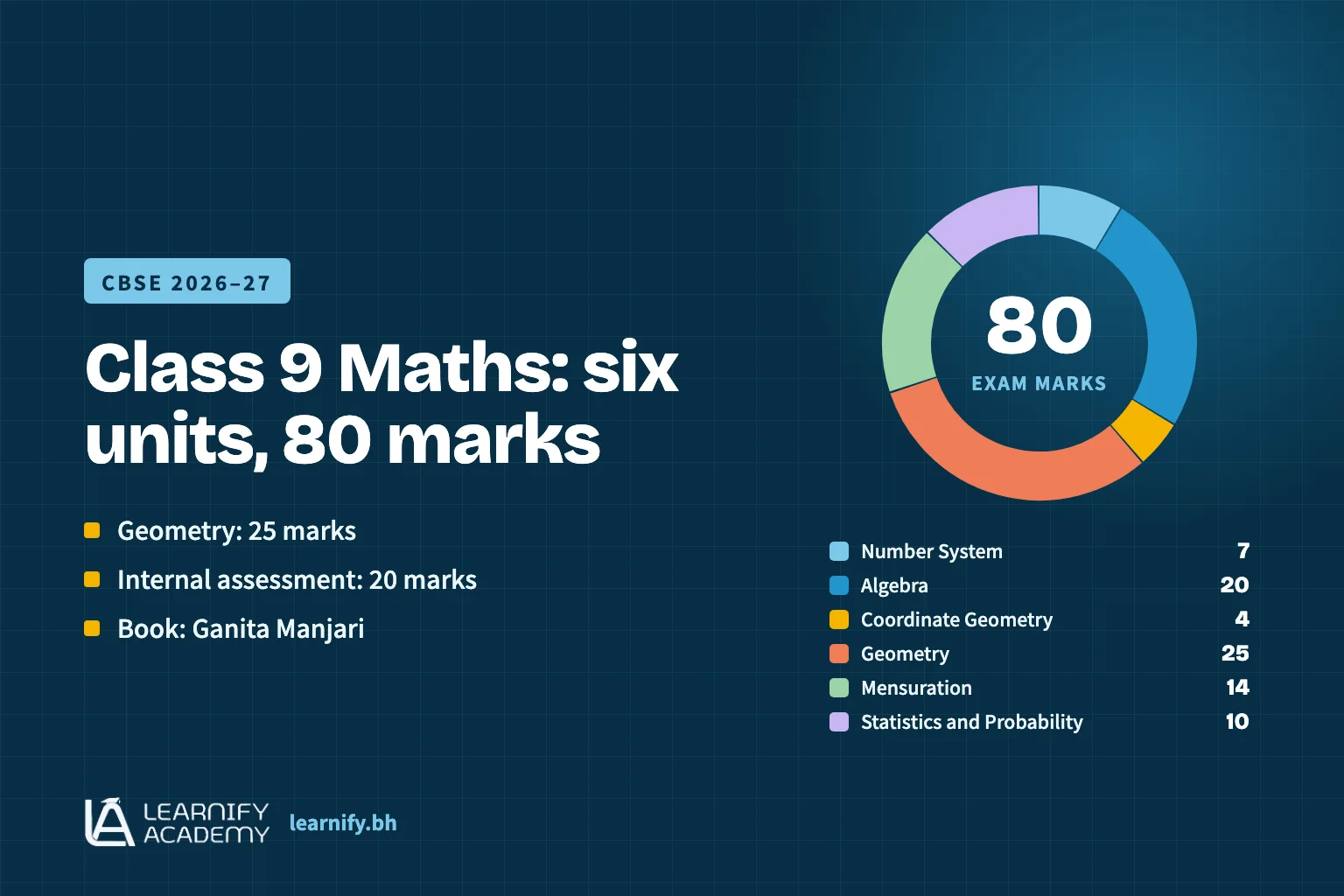
The CBSE Class 9 Maths syllabus for 2026–27 has six units in an 80-mark, three-hour school exam: Number System 7, Algebra 20, Coordinate Geometry 4, Geometry 25, Mensuration 14, and Statistics and Probability 10. Schools add 20 internal marks. The NCERT book is Ganita Manjari, in two parts (chapters 1–8 and 9–14), and an optional Advanced paper adds 25 marks.
What is in the CBSE Class 9 Maths syllabus for 2026–27?
The CBSE Class 9 Maths syllabus for 2026–27 has six units: Number System, Algebra, Coordinate Geometry, Geometry, Mensuration, and Statistics and Probability. They make up an 80-mark annual exam of three hours, conducted by the school, and schools add 20 marks of internal assessment. CBSE says the course has been redesigned in line with NEP 2020 and NCF-SE 2023, with a deliberate shift from rote learning to competency-based education.
| Unit | Chapters in CBSE’s course | Marks | Periods |
|---|---|---|---|
| I. Number System | Number System | 7 | 12 |
| II. Algebra | Introduction to Polynomials; Sequences and Progressions; Exploring Algebraic Identities; Linear Equations in Two Variables | 20 | 66 |
| III. Coordinate Geometry | Coordinate Geometry | 4 | 6 |
| IV. Geometry | Introduction to Euclid’s Geometry: Axioms and Postulates; Lines and Angles; Triangles – Congruence Theorems; 4-gons (Quadrilaterals); Circles | 25 | 69 |
| V. Mensuration | Area and Perimeter; Surface Area and Volume | 14 | 27 |
| VI. Statistics and Probability | Statistics; Introduction to Probability | 10 | 24 |
| Total | 80 |
Geometry and Algebra together carry 45 of the 80 marks, and CBSE allots them the most teaching periods, so they deserve the most regular practice at home. CBSE also reminds families that Classes IX and X form a composite course, so the subjects your child takes now are the ones they continue into Class 10.
What has changed from last year’s Class 9 Maths syllabus?
Quite a lot: the unit marks have shifted, and several topics have been added or moved into Class 9. The biggest changes are a new Sequences and Progressions chapter, a fuller treatment of linear equations, and probability returning to the annual exam.
| Unit | 2025–26 | 2026–27 |
|---|---|---|
| Number System(s) | 10 | 7 |
| Algebra | 20 | 20 |
| Coordinate Geometry | 4 | 4 |
| Geometry | 27 | 25 |
| Mensuration | 13 | 14 |
| Statistics (2025–26) / Statistics and Probability (2026–27) | 6 | 10 |
- Sequences and Progressions is new to Class IX. It covers arithmetic and geometric progressions, the nth term, the sum of the first n natural numbers, fractals and the Tower of Hanoi puzzle.
- Pairs of linear equations, solved by graphs, substitution and elimination, are now in the Class IX course. In 2026–27 these methods also appear in the Class X course that this year’s Class 10 students follow.
- Probability counts in the annual exam again. In 2025–26 it was assessed only formatively in Class IX; now it shares a 10-mark unit with Statistics.
- Statistics now asks students to answer a statistical question from data, use weighted averages and read stacked bar graphs. Last year’s Class IX statistics was bar graphs, histograms and frequency polygons.
- Mensuration and geometry bring in history and proof: Brahmagupta’s formula for a cyclic quadrilateral, Heron’s formula as its special case, arc length and sectors, and the medians of a triangle meeting in the ratio 2:1.
Which chapters are in Ganita Manjari, the Class 9 Maths book?
Ganita Manjari, NCERT’s new Class 9 Maths textbook, comes in two parts. Part I (first edition April 2026) has the eight chapters in the table, each shown with the CBSE unit its topics belong to. Part II (first edition August 2026) has chapters 9 to 14: Propositions and their Converses; How Quantities Combine: Understanding Data; The World of Algorithms; Quadrilaterals; Two Variables, One Line; and Math of Space: Surface Area and Volume.
| Chapter | What it covers | CBSE unit |
|---|---|---|
| 1. Orienting Yourself: The Use of Coordinates | The Cartesian plane, distance and midpoint | Coordinate Geometry |
| 2. Introduction to Linear Polynomials | Linear polynomials, patterns and graphs | Algebra |
| 3. The World of Numbers | Rational and irrational numbers, proofs of irrationality, the square root spiral | Number System |
| 4. Exploring Algebraic Identities | Visual proofs of identities, factorisation, simplifying expressions | Algebra |
| 5. I’m Up and Down, and Round and Round | Circles: chords, arcs, angles and cyclic figures | Geometry |
| 6. Measuring Space: Perimeter and Area | Plane figures and circles, derivation of formulas | Mensuration |
| 7. The Mathematics of Maybe: Introduction to Probability | Empirical and theoretical probability, tree diagrams | Statistics and Probability |
| 8. Predicting What Comes Next: Exploring Sequences and Progressions | Arithmetic and geometric progressions, recursive rules, fractals | Algebra |
Inside each chapter you will find short Think and Reflect questions, exercise sets, a chapter summary and end-of-chapter exercises. NCERT says questions and sections marked with an asterisk (*) are for enrichment and are not to be assessed or included in examinations, so your child can treat them as stretch work rather than exam revision. The book also has QR codes linking to extra resources. You can download every chapter from our Class 9 NCERT books page.
Which Class 9 Maths topics are in Ganita Manjari Part II?
Update, 27 September 2026: NCERT has said that no topics were removed from Class 9 Maths: concepts such as Lines and Angles now sit inside other chapters of Ganita Manjari. Read NCERT clarifies Class 9 Maths syllabus 2026–27.
Several chapters in CBSE’s course have no matching chapter in Part I. Part II covers most of them: Statistics (Chapter 10, How Quantities Combine: Understanding Data, with weighted averages and stacked bar charts), 4-gons (Chapter 12, Quadrilaterals), Linear Equations in Two Variables (Chapter 13, Two Variables, One Line) and Surface Area and Volume (Chapter 14). Introduction to Euclid’s Geometry, Lines and Angles and Triangles have no chapter of their own; NCERT says these ideas are taught inside other chapters, such as Chapter 9, Propositions and their Converses, and Chapter 12.
NCERT published Part II on its website at the end of September 2026. In September NCERT and CBSE said the final 2026–27 syllabus would follow in October; check CBSE’s 2026–27 curriculum page for the latest Class IX documents. Ask your child’s school when it plans to teach the Part II chapters.
CBSE’s prescribed books for Class IX Maths are the NCERT textbook, CBSE’s Guidelines for Mathematics Laboratory in Schools (Class IX), NCERT’s Laboratory Manual for the secondary stage, and NCERT’s exemplar problems for Class IX.
How is Class 9 Maths assessed in 2026–27?
Class 9 Maths is marked out of 100: an 80-mark annual exam of three hours, set and conducted by the school, and 20 marks of internal assessment. There is no CBSE Board exam in Class 9, so schools in Bahrain and elsewhere set their own exam dates.
| Type of question | Marks | Approx. weight |
|---|---|---|
| Remembering and understanding | 43 | 54% |
| Applying | 19 | 24% |
| Analysing, evaluating and creating | 18 | 22% |
| Component | Marks |
|---|---|
| Pen-paper test and multiple assessment (5 + 5) | 10 |
| Portfolio | 5 |
| Lab practical (activities from the prescribed books) | 5 |
CBSE’s scheme says schools hold three periodic assessments in each subject and use the average of the best two, and at least one of them must be competency-based, for example case analysis, data interpretation or open-ended problems. The portfolio is a small, selected collection of your child’s work showing progress over the year, marked against a rubric shared in advance. To pass a subject, CBSE requires at least 33%, which its scheme applies separately to the exam and the internal assessment.
What is the Class 9 Maths Advanced level, and is it compulsory?
Mathematics Advanced is an optional extra paper, not a replacement for the standard course. Every student studies the common syllabus and sits the 80-mark exam; a student who opts for Advanced also takes a 25-mark, one-hour paper at a higher level. Students can choose Advanced in Maths, Science, both or neither.
- CBSE’s Grade 9 Advanced material has six chapters: Sets, Logarithms, Relations and Functions, Coordinate Geometry, Combinatorics, and Exploring some more Progressions.
- In Class X the Advanced paper becomes a Board exam from 2027–28, with all questions testing higher-order thinking.
- A student who scores 50% or more gets a note on the marksheet that the Advanced Level has been cleared. The Advanced marks are not added to the overall total.
- The old Basic and Standard Maths papers are discontinued from 2026–27. Only students who are in Class X this year may still opt for Mathematics Basic.
Advanced suits a student who is comfortable with the standard course and enjoys harder problems. If your child is still building confidence in algebra or geometry, securing the 80-mark course first is the better use of time.
What kind of questions will Class 9 Maths have?
Expect more questions that ask students to explain and justify, not only calculate. CBSE’s learning outcomes for Class IX include proving that √2 and √3 are irrational, representing a floor plan on a grid using coordinates, estimating probability from experiments and data, solving the Tower of Hanoi puzzle, and following proof by contradiction in geometry.
Ganita Manjari’s own introduction says it emphasises competency-based learning and reasoning over rote procedures, and that it introduces formal reasoning and the beginnings of proof. In practice, a student who has memorised steps without understanding them will find the geometry proofs and the applying and analysing questions, about 46% of the paper, hard going.
Why does Class 9 Maths matter for the Class 10 Board exam?
Class 9 and Class 10 form one composite course, so gaps from this year carry straight into the Board year. Today’s Class 9 students are due to move to new NCERT Class 10 books, which NCERT says will be introduced from 2027–28, and they will sit the Class X Board exam in 2028.
NCERT’s advisory also asks teachers to make sure students’ prerequisite learning is addressed before starting the new syllabus. If fractions, negative numbers or simple equations from earlier classes are shaky, fix them early in Class 9 rather than in Class 10.
How can parents help a Class 9 student prepare for Maths?
- Keep the official documents. Save CBSE’s Class IX Maths curriculum PDF and the Ganita Manjari chapters, and tick off chapters as the school finishes them.
- Plan for Part II. Chapters 9 to 14 cover Quadrilaterals, Linear Equations in Two Variables, Surface Area and Volume, and Statistics. Ask when the school will teach them, and how it covers Lines and Angles and Triangles.
- Ask for reasons, not just answers. Have your child explain one solution aloud each week. It builds the justification skills the new course expects.
- Practise little and often. Algebra and Geometry carry 45 marks between them; short daily practice beats a long session before the exam.
- Use the prescribed extras. NCERT exemplar problems and the lab manual are on CBSE’s list, and lab activities count for 5 internal marks.
- Take the portfolio seriously. It is worth 5 marks and rewards steady, well-presented work across the year.
- Treat starred questions as enrichment. They are not examined, so they suit a confident student but should not replace core practice.
If your child would like structured help in Bahrain, our maths tuition follows the 2026–27 syllabus. For the Science side of Class 9, see our Class 9 Science syllabus guide.
FAQ
Questions parents ask
How many marks is the CBSE Class 9 Maths exam in 2026–27?
Class 9 Maths is marked out of 100. The annual exam is worth 80 marks and lasts three hours; it is set and conducted by the school, not by CBSE. The other 20 marks are internal assessment: 10 for pen-paper tests and multiple assessment, 5 for the portfolio and 5 for lab activities.
Is Ganita Manjari the only Class 9 Maths textbook?
Ganita Manjari is NCERT’s Class 9 Maths textbook for 2026–27, and CBSE prescribes the NCERT textbook. It comes in two parts, Part I (chapters 1 to 8) and Part II (chapters 9 to 14), both free on NCERT’s website. Lines and Angles and Triangles have no chapter of their own; NCERT says these ideas are taught inside other chapters, such as Chapters 9 and 12.
Is probability in the Class 9 Maths exam this year?
Yes. In 2026–27 Introduction to Probability is part of Unit VI, Statistics and Probability, worth 10 marks in the annual exam. In 2025–26 probability was assessed only formatively in Class IX. The new chapter covers empirical and theoretical probability, the probability scale, and tree diagrams and tables.
Is Maths Advanced compulsory in Class 9?
No. The standard Maths course and its 80-mark exam are compulsory for everyone. Mathematics Advanced is optional: an extra 25-mark, one-hour paper made up of higher-order questions. A score of 50% or more is noted on the marksheet, but the Advanced marks are not added to the student’s total.
Can my child take Maths Basic in Class 9?
No. CBSE has discontinued the Mathematics Basic and Standard examination scheme from 2026–27. There is now one common Maths course for everyone, with an optional Advanced paper on top. Only students who are in Class X in 2026–27 can still opt for Mathematics Basic, as they continue under the old scheme.
Which Class 9 Maths topics are new this year?
The main additions are Sequences and Progressions (arithmetic and geometric progressions), pairs of linear equations solved by substitution and elimination, and probability in the annual exam. Statistics now includes weighted averages and stacked bar graphs, and mensuration adds Brahmagupta’s formula and the area of a sector.
Sources
Official documents used for this article, checked on 24 September 2026. CBSE and NCERT can update them during the year, so confirm important dates and rules on cbse.gov.in or cbseacademic.nic.in before acting.
- CBSE Curriculum 2026–27: Mathematics, Class IX
- CBSE Secondary Curriculum 2026–27, Part 1 (scheme of studies and assessment)
- CBSE: Mathematics at Advanced Level (Optional), Grade 9, 2026–27
- CBSE Curriculum 2025–26: Mathematics, Classes IX–X (for comparison)
- CBSE Curriculum 2026–27: Mathematics, Class X
- NCERT: Ganita Manjari (Part I), prelims and contents
- NCERT: Ganita Manjari (Part II), prelims and contents
- NCERT: Ganita Manjari, Chapter 1
- NCERT: Textbooks PDF (Class 9 list)
- NCERT Advisory on new textbooks, 17 March 2026
Want expert help this school year?
Learnify Academy teaches CBSE students in person in Riffa and Segaya, Bahrain. Your child’s first class is free.