
NCERT guide · 2026–27
NCERT clarifies Class 9 Maths syllabus 2026–27: no topics removed, chapters reorganised
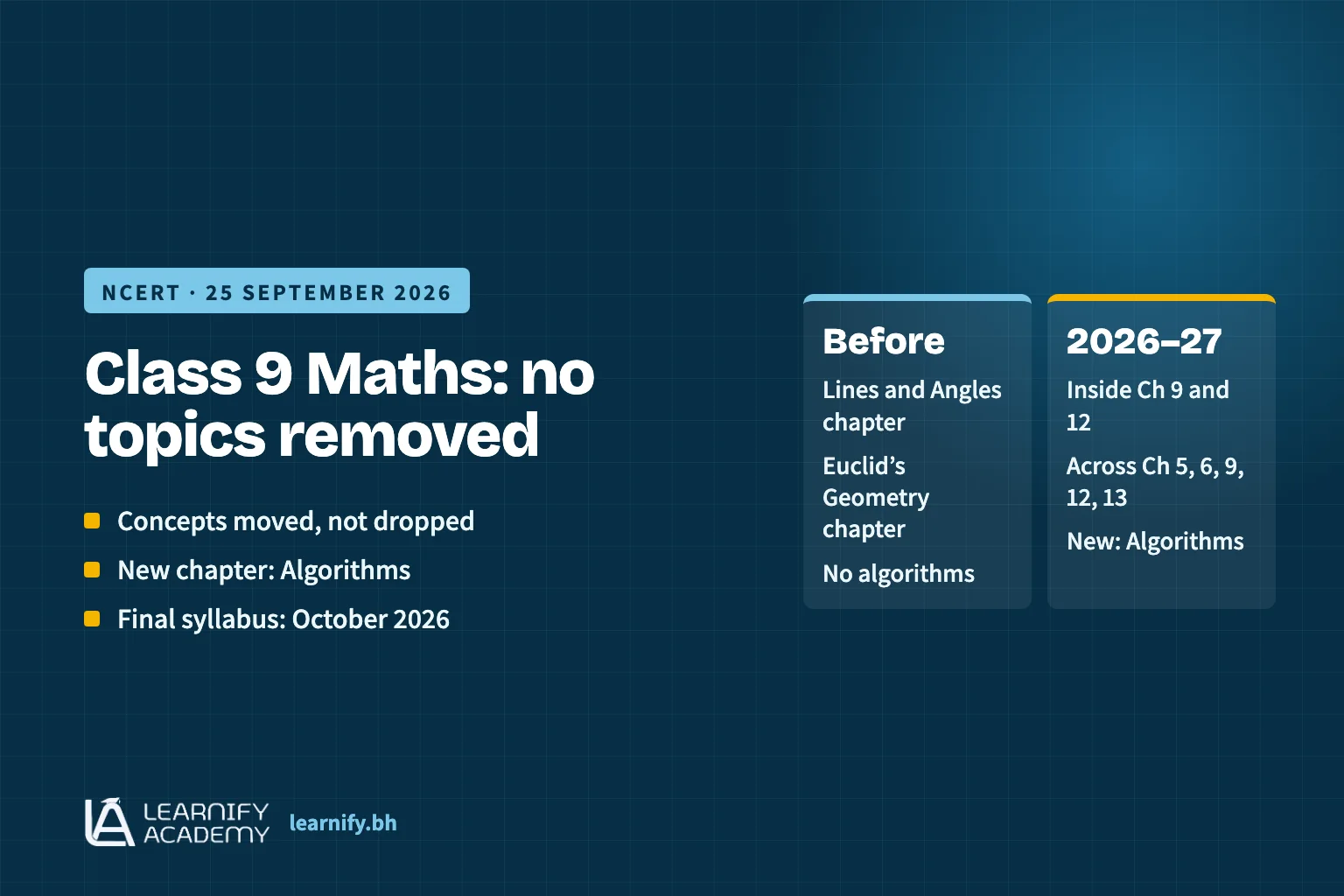
On 25 September 2026 NCERT said no topics have been removed from Class 9 Maths for 2026–27: concepts such as Lines and Angles now sit inside other chapters of Ganita Manjari, and the final syllabus comes in October. Here is what changed, chapter by chapter.
At a glance
- Clarified 25 September 2026, on NCERT’s official X account
- Topics removed None, says NCERT: concepts moved into other chapters
- Lines and Angles Inside Chapter 9 and Chapter 12 (Ganita Manjari Part II)
- Euclidean geometry Spread across Chapters 5, 6, 9, 12 and 13
- New topic Algorithms, with its own chapter
- Final syllabus October 2026, from NCERT and CBSE
Quick answer
No topics have been removed from Class 9 Maths for 2026–27, NCERT said on 25 September 2026. Concepts that seemed to be missing, such as Lines and Angles, have been folded into other chapters of the new textbook Ganita Manjari, mainly Chapter 9 (Propositions and their Converses) and Chapter 12 (Quadrilaterals). NCERT says the syllabus released recently was a draft; NCERT and CBSE will publish the final version in October 2026.
What did NCERT say about the Class 9 Maths syllabus?
After concerns that familiar topics had disappeared from the draft Class 9 Maths syllabus for 2026–27, NCERT posted a clarification on its official X account on 25 September 2026. Its main points, as reported by education news sites including the Free Press Journal:
- No topics were removed. Concepts that appeared to be missing have been integrated into other chapters.
- Judge the syllabus by its goals, not its chapter count. Under NEP 2020 and the National Curriculum Framework for School Education (NCF-SE) 2023, the course is built around curricular goals, competencies and learning outcomes. The textbook is one tool for reaching them, and how topics are grouped into chapters is a teaching choice.
- The syllabus released recently was a draft. It was shared to collect feedback from teachers, students, authors and experts. NCERT and CBSE will release the final version in October 2026.
- Algorithms were added on purpose, because of the growing importance of technology and artificial intelligence.
NCERT’s statement was an X post, not a circular. We have linked the news reports of it below; treat the final syllabus, when NCERT and CBSE publish it in October, as the document that counts.
Where did Lines and Angles and Euclid’s geometry go?
The old NCERT Class 9 book had separate chapters called Introduction to Euclid’s Geometry and Lines and Angles. The new book, Ganita Manjari, has neither as a chapter title, which is why parents and teachers asked whether they had been dropped. NCERT’s answer, concept by concept:
| Concept | Where it is now, according to NCERT |
|---|---|
| Lines and Angles | Chapter 9, Propositions and their Converses, and Chapter 12, Quadrilaterals, both in Part II. The basics were already taught in the Grade 6 book Ganita Prakash. |
| Euclidean geometry: polygons, circles, parallel lines and intersecting lines | Spread across Chapters 5, 6, 9, 12 and 13, instead of one separate chapter |
| Algorithms (new) | A chapter of its own: the mathematics behind algorithms, data structures and running-time efficiency |
In practice, this means geometry facts are now learnt where they are used: angle facts come up while proving statements and their converses, and again with quadrilaterals, rather than in a stand-alone chapter at the start of the year. Students who are shaky on basic angle facts can revise them from the Class 6 Ganita Prakash chapters.
Which chapters are in Ganita Manjari Part I and Part II?
Ganita Manjari comes in two parts with continuous chapter numbers: Part I has chapters 1 to 8, and Part II (first edition August 2026) has chapters 9 to 14. Both are on NCERT’s website, and the titles below are from each book’s contents page.
| Chapter | Title | Part |
|---|---|---|
| 1 | Orienting Yourself: The Use of Coordinates | I |
| 2 | Introduction to Linear Polynomials | I |
| 3 | The World of Numbers | I |
| 4 | Exploring Algebraic Identities | I |
| 5 | I’m Up and Down, and Round and Round | I |
| 6 | Measuring Space: Perimeter and Area | I |
| 7 | The Mathematics of Maybe: Introduction to Probability | I |
| 8 | Predicting What Comes Next: Exploring Sequences and Progressions | I |
| 9 | Propositions and their Converses | II |
| 10 | How Quantities Combine: Understanding Data | II |
| 11 | The World of Algorithms | II |
| 12 | Quadrilaterals | II |
| 13 | Two Variables, One Line | II |
| 14 | Math of Space: Surface Area and Volume | II |
Update, 1 October 2026: NCERT has now published Ganita Manjari Part II on its website. You can download every chapter of both parts free from our Class 9 Maths NCERT page.
Old chapters and new chapters: what matches what?
Most of the old Class 9 chapters have a clear home in the new book. This table matches them by topic. Only the rows marked NCERT come from NCERT’s statement; the rest are our reading of the chapter contents, and the final syllabus in October is the official word.
| Old chapter (2025–26 book) | In Ganita Manjari (2026–27) |
|---|---|
| Number Systems | Chapter 3, The World of Numbers |
| Polynomials | Chapter 2, Introduction to Linear Polynomials, and Chapter 4, Exploring Algebraic Identities |
| Coordinate Geometry | Chapter 1, Orienting Yourself: The Use of Coordinates |
| Linear Equations in Two Variables | Chapter 13, Two Variables, One Line |
| Introduction to Euclid’s Geometry | No separate chapter; Euclidean geometry is spread across Chapters 5, 6, 9, 12 and 13 (NCERT) |
| Lines and Angles | Chapters 9 and 12 (NCERT) |
| Triangles | No separate chapter; Chapter 12 uses midpoint and median properties of triangles, but NCERT has not said where congruence is taught, so check the final syllabus |
| Quadrilaterals | Chapter 12, Quadrilaterals (NCERT) |
| Circles | Chapter 5, I’m Up and Down, and Round and Round |
| Heron’s Formula | Chapter 6, Measuring Space: Perimeter and Area |
| Surface Areas and Volumes | Chapter 14, Math of Space: Surface Area and Volume |
| Statistics | Chapter 10, How Quantities Combine: Understanding Data |
Three chapters have no equivalent in the 2025–26 book: Probability (Chapter 7), Sequences and Progressions (Chapter 8) and Algorithms (Chapter 11).
Why is there an algorithms chapter in Class 9 Maths?
NCERT says that, with technology and artificial intelligence becoming more important, students need to understand the mathematical ideas behind algorithms, data structures and running-time efficiency, that is, how the number of steps a method takes grows as the problem gets bigger. It is maths about step-by-step procedures, not a coding course, and it builds the same logical habits as proofs.
What should Class 9 students in Bahrain do now?
CBSE schools in Bahrain follow the same CBSE curriculum and NCERT books as schools in India, so this clarification applies to them in full. In Class 9, the annual Maths exam (80 marks) and the 20 marks of internal assessment are set and marked by the school.
- Keep studying chapter by chapter. Nothing has been dropped, so skipping a topic because it has no chapter title of its own is a risk.
- Revise angle basics now. Chapters 9 and 12 assume the Lines and Angles facts from earlier grades.
- Follow your school’s plan. CBSE’s 2026–27 Class IX Maths curriculum, published earlier, still lists Euclid’s Geometry, Lines and Angles and Triangles in its Geometry unit (25 marks). Schools will align to the final syllabus when it comes out in October.
- Check again in October. We will update this article when NCERT and CBSE publish the final syllabus.
For the unit-wise marks and internal assessment, read our CBSE Class 9 Maths syllabus 2026–27 parent guide. If your child needs help with the new book, Learnify Academy teaches CBSE Grade 9 Maths in Riffa and Segaya.
FAQ
Questions parents ask
Has Lines and Angles been removed from Class 9 Maths in 2026–27?
No. NCERT said on 25 September 2026 that Lines and Angles concepts are now covered inside Chapter 9 (Propositions and their Converses) and Chapter 12 (Quadrilaterals) of Ganita Manjari Part II, building on the Grade 6 book Ganita Prakash.
Is Euclid’s geometry still part of Class 9 Maths?
Yes, according to NCERT. There is no separate chapter, but Euclidean geometry concepts such as polygons, circles, parallel lines and intersecting lines are spread across Chapters 5, 6, 9, 12 and 13.
When will the final Class 9 Maths syllabus for 2026–27 be released?
NCERT says the syllabus released recently was a draft for feedback, and that NCERT and CBSE will release the final version in October 2026.
How many chapters are there in Ganita Manjari Class 9?
Fourteen in two parts: Part I has chapters 1 to 8 and Part II has chapters 9 to 14. Both parts are free on NCERT’s website.
Why has NCERT added algorithms to Class 9 Maths?
NCERT says students need to understand the mathematical ideas behind algorithms, data structures and running-time efficiency because of the growing importance of technology and artificial intelligence.
Does this affect CBSE students in Bahrain?
Yes. CBSE schools in Bahrain use the same CBSE curriculum and NCERT textbooks as schools in India, so Class 9 students in Bahrain study the same Ganita Manjari chapters and will follow the same final syllabus.
Where can I download Ganita Manjari?
Both parts are free on NCERT’s website, and on our Class 9 Maths NCERT page with direct links to NCERT’s files.
Sources
Official documents and news reports used for this article, checked on 27 September 2026. CBSE and NCERT can update them during the year, so confirm important dates and rules on cbse.gov.in or cbseacademic.nic.in before acting.
- NCERT’s official X account (@ncert), post of 25 September 2026
- Free Press Journal: NCERT clarifies Grade 9 Maths syllabus, no topics dropped (25 September 2026)
- SelfStudys: NCERT clarifies Class 9 Maths syllabus 2026–27 (25 September 2026)
- FindMyCollege: NCERT clarifies no topics dropped from Class 9 Maths syllabus
- NCERT textbooks page (Ganita Manjari, Class 9), checked 1 October 2026
- NCERT: Ganita Manjari Part II, prelims and contents (First Edition, August 2026)
- CBSE Curriculum 2026–27: Mathematics, Class IX
Want expert help this school year?
Learnify Academy teaches CBSE students in person in Riffa and Segaya, Bahrain. Your child’s first class is free.