
NCERT guide · 2026–27
Ganita Manjari Part 2 released: a guide to Class 9 Maths Chapters 9 to 14
NCERT has published Ganita Manjari Part 2, the second half of the new Class 9 Maths textbook. Here are its six chapters, what each one teaches, the key results to learn, what is new compared with the old book, and where to download every chapter free.
At a glance
- Released End of September 2026, on ncert.nic.in
- First edition August 2026
- Chapters 6, numbered 9 to 14
- Length 148 pages of chapters
- Download Free PDFs and a 16.9 MB ZIP: all links
- Hindi medium Not yet on NCERT’s website
Quick answer
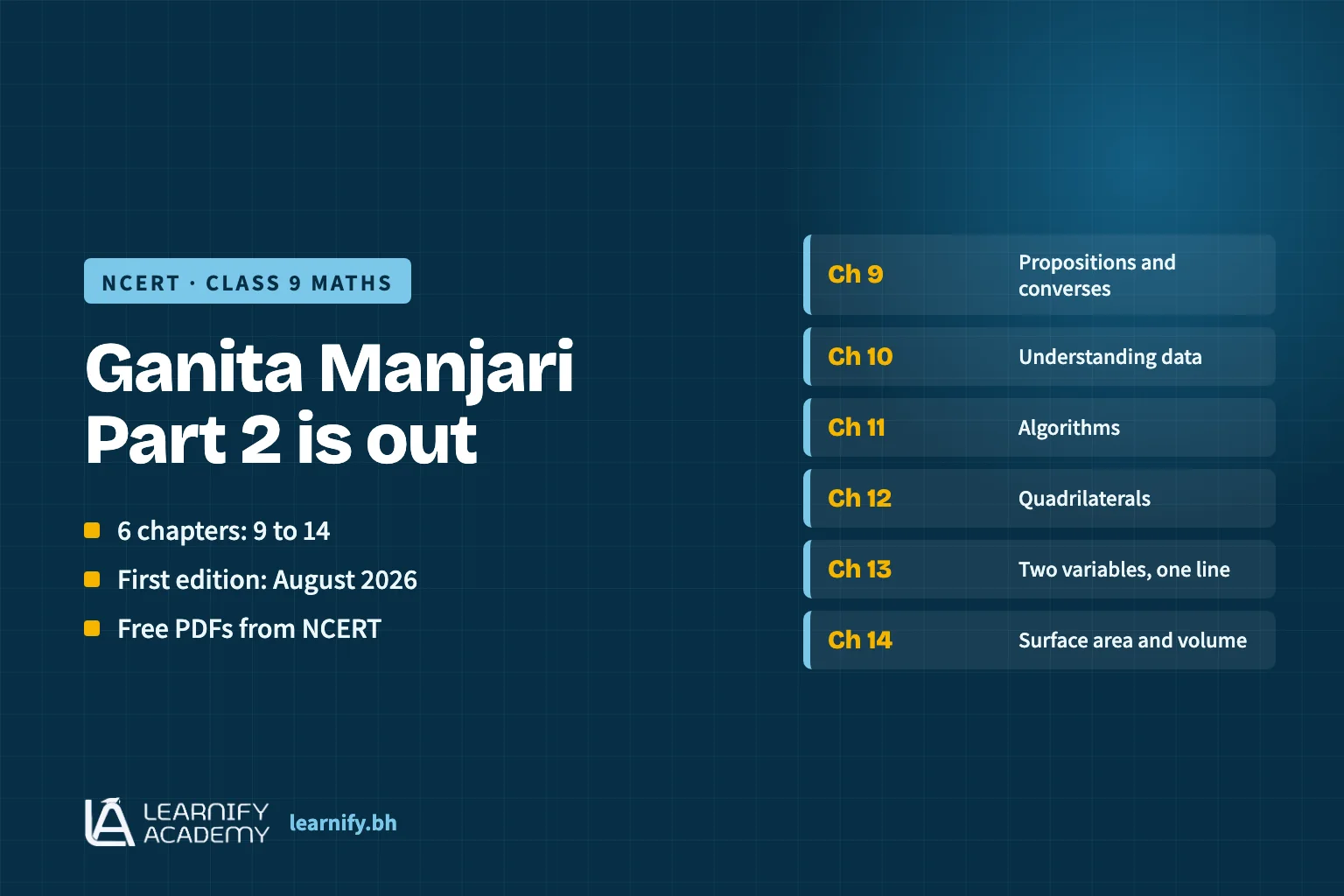
Yes. NCERT released Ganita Manjari Part 2 on its website at the end of September 2026 (first edition dated August 2026). It has six chapters, numbered 9 to 14: Propositions and their Converses; How Quantities Combine: Understanding Data; The World of Algorithms; Quadrilaterals; Two Variables, One Line; and Math of Space: Surface Area and Volume. All six chapters are free PDFs on ncert.nic.in.
Is Ganita Manjari Part 2 out?
Yes. NCERT added Ganita Manjari Part II to its textbook website at the end of September 2026, completing the new Class 9 Maths textbook for 2026–27. The book’s front pages give its first edition as August 2026. Part 1, with Chapters 1 to 8, has been available since April 2026.
Every chapter is a free, official PDF, and the whole of Part 2 is also available as one 16.9 MB ZIP file. We have listed every link, with file sizes, on our Ganita Manjari Part 2 download page. The Hindi-medium edition of Part 2 was not on NCERT’s website when we checked on 1 October 2026.
Which chapters are in Ganita Manjari Part 2?
Part 2 continues the chapter numbers from Part 1, so it runs from Chapter 9 to Chapter 14. The page numbers below are from the book’s contents page.
| Chapter | Title | Main ideas | Pages |
|---|---|---|---|
| 9 | Propositions and their Converses | Propositions, converses and counterexamples | 1–7 |
| 10 | How Quantities Combine: Understanding Data | Weighted averages, mixtures, stacked bar charts | 8–36 |
| 11 | The World of Algorithms | Algorithms, gcd, efficiency, Euclid’s algorithm | 37–50 |
| 12 | Quadrilaterals | Parallelograms, Midpoint Theorem, centroid, tiling | 51–84 |
| 13 | Two Variables, One Line | Linear equations, slope, pairs of equations | 85–122 |
| 14 | Math of Space: Surface Area and Volume | Cuboids, cylinders, cones, pyramids, spheres | 123–148 |
What will students learn in each chapter?
Chapter 9: Propositions and their Converses
A short chapter about how mathematicians reason. A proposition is a statement that is either true or false, and the converse of “if P then Q” is “if Q then P”. Students see that a true proposition can have a false converse (“if a number is a multiple of 6, it is a multiple of 3” is true; the converse is not), and learn to disprove a claim with a single counterexample. Examples come from triangles, quadrilaterals and numbers.
Chapter 10: How Quantities Combine: Understanding Data
This is the new statistics chapter. Its main tool is the weighted average: (w₁x₁ + w₂x₂ + … + wₙxₙ) ÷ (w₁ + w₂ + … + wₙ). Students use it to find an average of averages, the strength of a mixture, ratings and final marks built from assessments with different weights. The second half compares stacked and 100% stacked bar charts: a 100% stacked chart, like a pie chart, compares proportions rather than totals.
Chapter 11: The World of Algorithms
Entirely new to Class 9. An algorithm is a systematic, step-by-step procedure for solving a problem. Starting from adding numbers digit by digit, the chapter builds methods for the greatest common divisor (gcd), from listing every divisor to faster methods, and ends with Euclid’s algorithm. Students also learn to justify that an algorithm is correct and to count how many steps it takes as the input grows, which is the idea of efficiency behind modern computing.
Chapter 12: Quadrilaterals
The geometry chapter of Part 2. Key results to learn:
- A 4-gon is a parallelogram if its opposite sides are equal, or its opposite angles are equal, or its diagonals bisect each other, or one pair of opposite sides is equal and parallel.
- Midpoint Theorem: the segment joining the midpoints of two sides of a triangle is parallel to the third side and half its length, and its converse.
- Centroid: the three medians of a triangle meet at one point, which divides each median in the ratio 2 : 1.
- Joining the midpoints of any quadrilateral always gives a parallelogram (Varignon’s theorem), and the plane can be tiled with copies of any 4-gon.
Chapter 13: Two Variables, One Line
Linear equations in two variables, written ax + by + c = 0, and their graphs. Each equation has infinitely many solutions, and every solution is a point on its line. The chapter introduces slope and the slope-intercept form y = mx + d, then solves pairs of linear equations by substitution, elimination and graphs. A pair has one solution if a₁/a₂ ≠ b₁/b₂ (the lines intersect), none if a₁/a₂ = b₁/b₂ ≠ c₁/c₂ (parallel lines), and infinitely many if all three ratios are equal (the lines coincide).
Chapter 14: Math of Space: Surface Area and Volume
Surface area and volume of cuboids, cylinders, cones, pyramids, spheres and hemispheres, ending with “guesstimate” problems about real objects. The formulas from NCERT’s chapter summary:
| Solid | Surface area | Volume |
|---|---|---|
| Cuboid (length l, width w, height h) | 2(lw + wh + hl) | lwh |
| Cylinder (radius r, height h) | Curved: 2πrh; closed at both ends: 2πr(h + r) | πr²h |
| Cone (radius r, slant height l, height h) | Curved: πrl; total: πr(l + r) | ⅓πr²h |
| Sphere (radius r) | 4πr² | ⁴⁄₃πr³ |
What is new compared with the old Class 9 Maths book?
- Algorithms (Chapter 11) and propositions and converses (Chapter 9) have no equivalent chapter in the 2025–26 book.
- Statistics now centres on weighted averages and stacked bar charts instead of histograms and frequency polygons.
- Linear equations go further: slope, the slope-intercept form and solving pairs of equations, which the old books left to later grades.
- Quadrilaterals adds the centroid result, the midpoint quadrilateral and tiling to the familiar parallelogram theorems.
- Surface area and volume now includes pyramids.
There is still no separate chapter for Lines and Angles, Triangles or Euclid’s geometry. NCERT said on 25 September 2026 that no topics were removed and that these ideas are taught inside other chapters, such as 9 and 12. Read more in NCERT clarifies Class 9 Maths syllabus 2026–27.
How should Class 9 students study Part 2?
- Do the Think and Reflect questions. They are short checks of understanding built into every chapter.
- Finish every Exercise Set, then the End-of-Chapter Exercises, which mix ideas from the whole chapter.
- Treat starred (*) questions as stretch work. NCERT says questions and sections marked with an asterisk are for enrichment and are not assessed or included in examinations.
- Keep a formula sheet for Chapters 10, 13 and 14, and a list of theorems for Chapter 12.
- Practise proofs out loud. Chapters 9 and 12 reward clear “if… then…” reasoning, which carries straight into the Class 10 board years.
For the unit-wise marks and internal assessment, see our CBSE Class 9 Maths syllabus 2026–27 parent guide. NCERT and CBSE have said the final 2026–27 syllabus will be released in October 2026. In Bahrain, Learnify Academy teaches CBSE Grade 9 Maths from the new books in Riffa and Segaya.
FAQ
Questions parents ask
Is Ganita Manjari Part 2 released?
Yes. NCERT published Ganita Manjari Part II on its website at the end of September 2026. Its first edition is dated August 2026, and all six chapters can be downloaded free from our Part 2 download page.
How many chapters are in Ganita Manjari Part 2?
Six, numbered 9 to 14: Propositions and their Converses; How Quantities Combine: Understanding Data; The World of Algorithms; Quadrilaterals; Two Variables, One Line; and Math of Space: Surface Area and Volume.
Which chapter of Class 9 Maths has linear equations in two variables?
Chapter 13, Two Variables, One Line, in Ganita Manjari Part 2. It covers single equations, slope and the slope-intercept form, and pairs of linear equations solved by substitution, elimination and graphs.
Is statistics in Ganita Manjari Part 2?
Yes. Chapter 10, How Quantities Combine: Understanding Data, covers weighted averages and stacked and 100% stacked bar charts.
What is the algorithms chapter in Class 9 Maths about?
Chapter 11, The World of Algorithms, explains algorithms as step-by-step procedures. It builds methods for adding numbers and finding the greatest common divisor, ending with Euclid’s algorithm, and shows how to judge whether an algorithm is correct and efficient.
Are starred questions in Ganita Manjari asked in exams?
No. NCERT says questions and sections marked with an asterisk (*) are for enrichment and are not to be assessed or included in examinations.
Is Ganita Manjari Part 2 available in Hindi?
Not yet. On 1 October 2026 NCERT’s website had only Part 1 of the Hindi-medium edition. We will add Part 2 in Hindi to our download page when NCERT publishes it.
Sources
Official documents and news reports used for this article, checked on 1 October 2026. CBSE and NCERT can update them during the year, so confirm important dates and rules on cbse.gov.in or cbseacademic.nic.in before acting.
- NCERT textbooks page: Ganita Manjari PART-II (Class 9), checked 1 October 2026
- NCERT: Ganita Manjari Part II, front pages and contents (First Edition, August 2026)
- NCERT: Ganita Manjari Part II, complete book (ZIP)
- NCERT: Chapter 10, How Quantities Combine: Understanding Data
- NCERT: Chapter 13, Two Variables, One Line
- NCERT: Chapter 14, Math of Space: Surface Area and Volume
- Free Press Journal: NCERT clarifies Grade 9 Maths syllabus (25 September 2026)
Want expert help this school year?
Learnify Academy teaches CBSE students in person in Riffa and Segaya, Bahrain. Your child’s first class is free.