
CBSE guide · 2026–27
CBSE Class 12 Accountancy syllabus 2026–27: units, marks and project
What the 2026–27 CBSE Class 12 Accountancy syllabus covers, how its 100 marks are split, how the two Part B options differ, and what CBSE’s new sample paper shows about the 2027 paper.
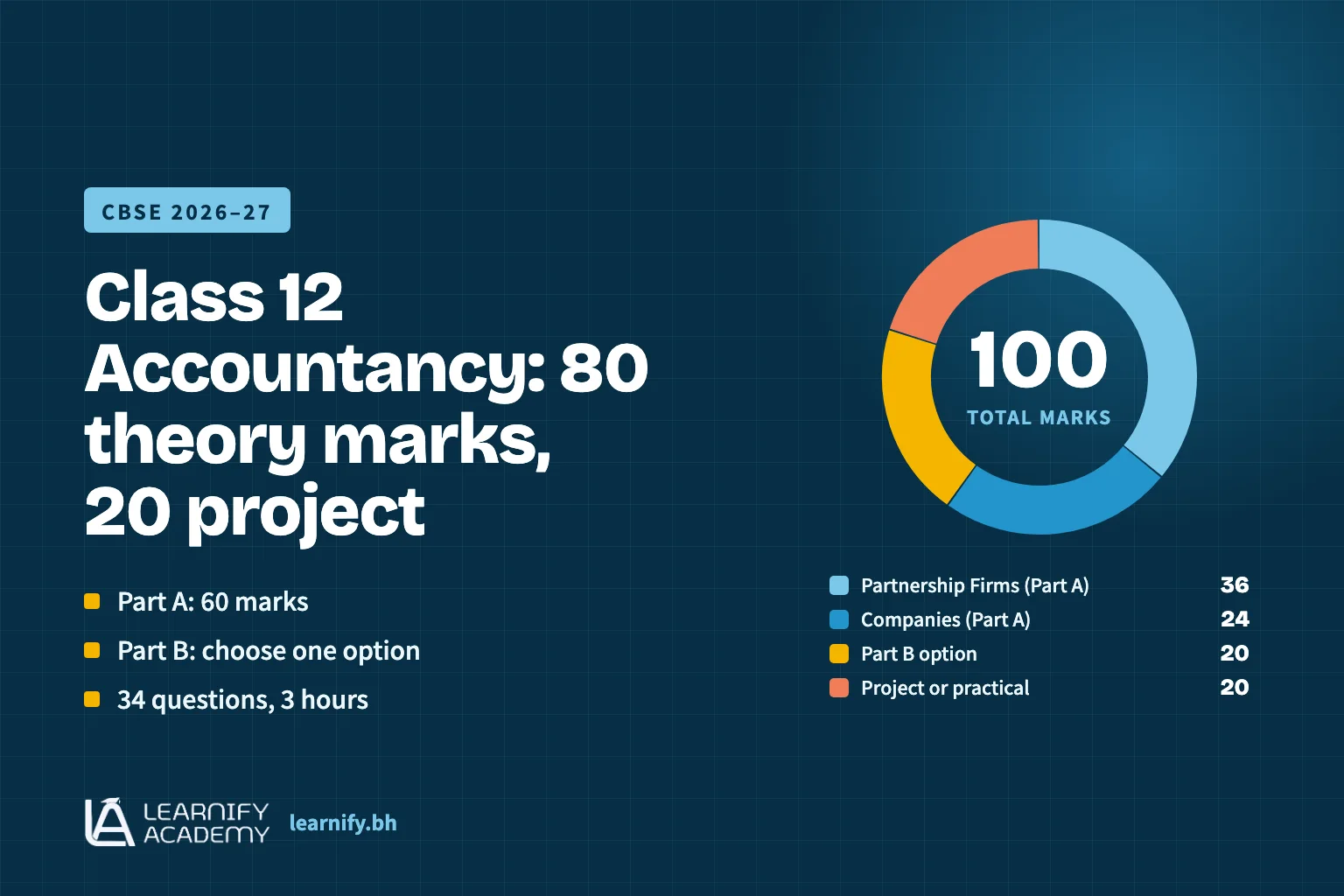
At a glance
- Subject code Accountancy (055)
- Theory paper 80 marks, 3 hours
- Part A (compulsory) Partnership Firms 36, Companies 24
- Part B (choose one) Financial Statement Analysis or Computerised Accounting, 20 marks
- Project or practical 20 marks: file 12, viva voce 8
- Sample paper 2026–27 34 questions; no change in design
Quick answer
The CBSE Class 12 Accountancy (055) syllabus for 2026–27 has an 80-mark, three-hour theory paper plus 20 marks of project or practical work. Part A, Partnership Firms (36) and Companies (24), is compulsory. For Part B (20 marks), students take either Financial Statement Analysis or Computerised Accounting.
What is in the CBSE Class 12 Accountancy syllabus 2026–27?
The CBSE Class 12 Accountancy syllabus 2026–27 has a compulsory Part A on partnership firms and companies, a Part B in which students choose Financial Statement Analysis or Computerised Accounting, and a Part C of project or practical work. The theory paper carries 80 marks and lasts three hours; the other 20 marks come from the project or practical.
| Part | Unit | Marks |
|---|---|---|
| A (compulsory) | Accounting for Partnership Firms | 36 |
| A (compulsory) | Accounting for Companies | 24 |
| B, option 1: Financial Statement Analysis | Analysis of Financial Statements | 12 |
| B, option 1: Financial Statement Analysis | Cash Flow Statement | 8 |
| B, option 2: Computerised Accounting | Computerised Accounting | 20 |
| C | Project work (option 1) or practical work (option 2): file 12, viva voce 8 | 20 |
| Total | Theory 80 + project or practical 20 | 100 |
CBSE prescribes NCERT’s Accountancy Part I and Part II for Class 12, plus NCERT’s Computerised Accounting System book for that option. The books are linked from the NCERT Class 12 textbooks page.
What does the Partnership Firms unit cover?
Accounting for Partnership Firms is the largest unit, worth 36 of the 80 theory marks, and it runs from forming a partnership to dissolving one.
- Partnership basics: features, the partnership deed, provisions of the Indian Partnership Act 1932 when there is no deed, and fixed versus fluctuating capital accounts.
- Profit and Loss Appropriation Account, including guarantee of profits, and past adjustments for interest on capital, interest on drawings, salary and profit-sharing ratio.
- Goodwill: meaning, nature, factors affecting it, and valuation by the average profit, super profit and capitalisation methods.
- Change in profit-sharing ratio among existing partners: sacrificing and gaining ratios, revaluation of assets and reassessment of liabilities, and treatment of reserves and accumulated profits.
- Admission, retirement and death of a partner, including goodwill as per AS 26, the retiring partner’s loan account, and the deceased partner’s share of profit and executor’s account.
- Dissolution of a firm: realisation account and related accounts, excluding piecemeal distribution, sale to a company and insolvency of partners.
CBSE’s notes for this unit: interest on a partner’s loan is a charge against profits, and on dissolution, tangible assets are taken at book value and intangible assets at nil when no realised value is given.
What does the Companies unit cover?
Accounting for Companies carries 24 marks and covers share capital and debentures.
- Share capital: features and types of companies, issue and allotment of equity and preference shares, over- and under-subscription, issue at par and at a premium, calls in advance and in arrears (excluding interest), and issue for consideration other than cash.
- The concepts of private placement, Employee Stock Option Plan (ESOP) and sweat equity.
- Forfeiture and re-issue of shares, and disclosure of share capital in the company balance sheet.
- Debentures: meaning and types, issue at par, at a premium and at a discount, issue for consideration other than cash, issue with terms of redemption, debentures as collateral security, and interest on debentures (TDS excluded).
- Writing off discount or loss on issue of debentures, first from Securities Premium Reserve if it exists and then from the Statement of Profit and Loss as a financial cost.
Should my child choose Analysis of Financial Statements or Computerised Accounting?
Both options are worth the same 20 theory marks and lead to a 20-mark project or practical, so the choice usually comes down to which option the school teaches and whether your child prefers analysing company accounts or working with spreadsheets and accounting software.
| Aspect | Financial Statement Analysis | Computerised Accounting |
|---|---|---|
| Theory marks | Analysis of Financial Statements 12, Cash Flow Statement 8 | Computerised Accounting 20 |
| Main topics | Company financial statements (Schedule III), comparative and common-size statements, accounting ratios, cash flow statement (indirect method) | Computerised accounting systems, spreadsheet uses in accounting, using an accounting system through to final accounts |
| Part C | Project: file 12, viva voce 8 | Practical work: file 12, viva voce 8 |
| NCERT book | Accountancy Part II | Computerised Accounting System |
Which accounting ratios are in the syllabus?
Four groups: liquidity (current and quick ratio); solvency (debt to equity, total asset to debt, proprietary, interest coverage, and debt to capital employed); activity (inventory, trade receivables, trade payables, fixed asset, net asset and working capital turnover); and profitability (gross profit, operating, operating profit, net profit and return on investment). Net profit ratio is calculated on profit both before and after tax.
What does the Computerised Accounting option cover?
Three areas: an overview of computerised accounting systems, including generic, specific and tailored software packages; accounting uses of spreadsheets, such as bank reconciliation, asset accounting, loan repayment schedules and ratio analysis, with graphs and charts; and using a computerised accounting system, from installation and codification of account heads to data entry, adjusting entries and final accounts.
What is the project work in Class 12 Accountancy?
For the Financial Statement Analysis option, the 20 marks come from one project on the financial statement analysis of a company, split into a project file (12 marks) and a viva voce (8 marks). The project covers any two of these aspects:
- Comparative and common-size financial statements
- Accounting ratios
- Segment reports
- Cash flow statements
For the Computerised Accounting option, the 20 marks are for practical work, split in the same way into a practical file (12 marks) and a viva voce (8 marks).
What is the Class 12 Accountancy paper pattern for 2027?
CBSE’s 2026–27 sample paper has 34 compulsory questions for 80 marks in three hours, and CBSE’s notification of 21 September 2026 says there is no change in the question paper design and assessment pattern for this session. Part A is compulsory; in Part B, students attempt only one option.
| Questions | Marks each | Part | Total marks |
|---|---|---|---|
| 1–16 | 1 | A | 16 |
| 17–20 | 3 | A | 12 |
| 21–22 | 4 | A | 8 |
| 23–26 | 6 | A | 24 |
| 27–30 | 1 | B | 4 |
| 31–32 | 3 | B | 6 |
| 33 | 4 | B | 4 |
| 34 | 6 | B | 6 |
| 1–34 (all compulsory) | 1 to 6 | A and B | 80 |
There is no overall choice, but two 3-mark, two 4-mark and two 6-mark questions have an internal choice. The 1-mark questions in the sample paper include multiple-choice and assertion-reason items.
| Type of question | Marks | Share |
|---|---|---|
| Remembering and understanding | 32 | 40% |
| Applying | 24 | 30% |
| Analysing, evaluating and creating | 24 | 30% |
The 2027 exam date for Accountancy had not been published when we checked on 24 September 2026; CBSE was then collecting schools’ lists of candidates for the Main Examinations 2027.
How does Class 12 Accountancy build on Class 11?
Class 12 builds on the Class 11 course, which in 2026–27 covers the theoretical framework (12 marks), the accounting process (44 marks) and financial statements of a sole proprietorship (24 marks), plus a 20-mark project. GST accounting stays in Class 11: CBSE’s curriculum says its accounting treatment is confined to the Class 11 syllabus.
It helps to revise weak Class 11 topics early, such as journal entries, ledger posting and final accounts with adjustments, because the Class 12 units ask students to prepare accounts such as revaluation, capital, current and realisation accounts and balance sheets.
Which NCERT chapters go with each unit?
NCERT’s 2026–27 reprints split the Class 12 theory across two books, and each chapter lines up with a CBSE unit.
| NCERT book | Chapters | CBSE unit |
|---|---|---|
| Accountancy Part I | Accounting for Partnership: Basic Concepts; Admission of a Partner; Retirement/Death of a Partner; Dissolution of Partnership Firm | Accounting for Partnership Firms |
| Accountancy Part II, chapters 1–2 | Accounting for Share Capital; Issue and Redemption of Debentures | Accounting for Companies |
| Accountancy Part II, chapters 3–6 | Financial Statements of a Company; Analysis of Financial Statements; Accounting Ratios; Cash Flow Statement | Part B, option 1 |
Plan revision from CBSE’s unit list. NCERT’s debentures chapter, for example, also covers several methods of redeeming debentures, while CBSE’s 2026–27 list for debentures centres on issue, collateral security, interest and writing off discount or loss. Check with the subject teacher before leaving out any section.
If your child would like support, Learnify runs CBSE Grade 12 classes in Riffa and CBSE classes in Segaya, Manama.
FAQ
Questions parents ask
How many marks is the Class 12 Accountancy project?
The project or practical is worth 20 of the 100 marks in 2026–27. With the Financial Statement Analysis option it is a project on a company’s financial statements; with Computerised Accounting it is practical work. In both cases CBSE splits the 20 marks into a file worth 12 marks and a viva voce worth 8.
Is GST in the Class 12 Accountancy syllabus?
No. CBSE’s 2026–27 Accountancy curriculum introduces basic GST calculations in Class 11 and states that the accounting treatment of GST is confined to the Class 11 syllabus. The Class 12 units are partnership firms, companies, and either financial statement analysis or computerised accounting.
Can a student answer both Part B options in the board exam?
No. The 2026–27 sample paper says Part B has two options, Analysis of Financial Statements and Computerised Accounting, and that students must attempt only one of them. Each option has questions 27 to 34 worth 20 marks, and the option also decides whether the student does the project or the practical work.
Has CBSE changed the Accountancy paper pattern for 2026–27?
No. CBSE’s notification of 21 September 2026, which released the 2026–27 sample papers, says there is no change in the question paper design and assessment pattern for the session, and that the passing criteria stay the same as in 2025–26. The Accountancy sample paper carries the same note.
When is the CBSE Class 12 Accountancy exam in 2027?
CBSE had not published the 2027 date sheet when we checked on 24 September 2026. Schools were then submitting their lists of candidates for the Main Examinations 2027. Check cbse.gov.in and your school’s notices for the confirmed date rather than relying on unofficial predictions.
Which cash flow statement method is in the 2026–27 syllabus?
Only the indirect method. The syllabus covers the meaning, objectives and benefits of a cash flow statement, cash and cash equivalents, classification of activities, and preparation as per AS 3 (Revised) by the indirect method, with adjustments for depreciation and amortisation, profit or loss on sale of assets, dividends and tax.
Sources
Official documents used for this article, checked on 24 September 2026. CBSE and NCERT can update them during the year, so confirm important dates and rules on cbse.gov.in or cbseacademic.nic.in before acting.
- CBSE Curriculum 2026–27: Accountancy (055), Classes XI–XII
- CBSE Sample Question Paper 2026–27: Accountancy (055), Class XII
- CBSE Class XII Sample Question Papers 2026–27 (index page)
- CBSE notification: Sample Question Papers for Classes X and XII, 2026–27 (21 September 2026)
- CBSE circular: Submission of LOC for Class X and XII Main Examinations 2026–27 (17 September 2026)
- CBSE main website, notices listing (checked 24 September 2026)
- NCERT Accountancy Part I, Class XII (reprint 2026–27), prelims and contents
- NCERT Accountancy Part II, Class XII (reprint 2026–27), prelims and contents
Want expert help this school year?
Learnify Academy teaches CBSE students in person in Riffa and Segaya, Bahrain. Your child’s first class is free.