
CBSE guide · 2026–27
CBSE Class 12 Physics syllabus 2026–27: unit weightage
Nine units, 14 chapters, a 70-mark theory paper and 30 practical marks. Here is the official CBSE Class 12 Physics syllabus for 2026–27, with unit weightage, the practical split and the paper pattern.
At a glance
- Subject Physics (code 042)
- Theory paper 70 marks, 3 hours
- Practical exam 30 marks, 3 hours
- Highest weightage EM Waves and Optics, 18 marks
- Syllabus size 9 units, 14 chapters
- 2026–27 sample paper 33 questions in five sections
Quick answer
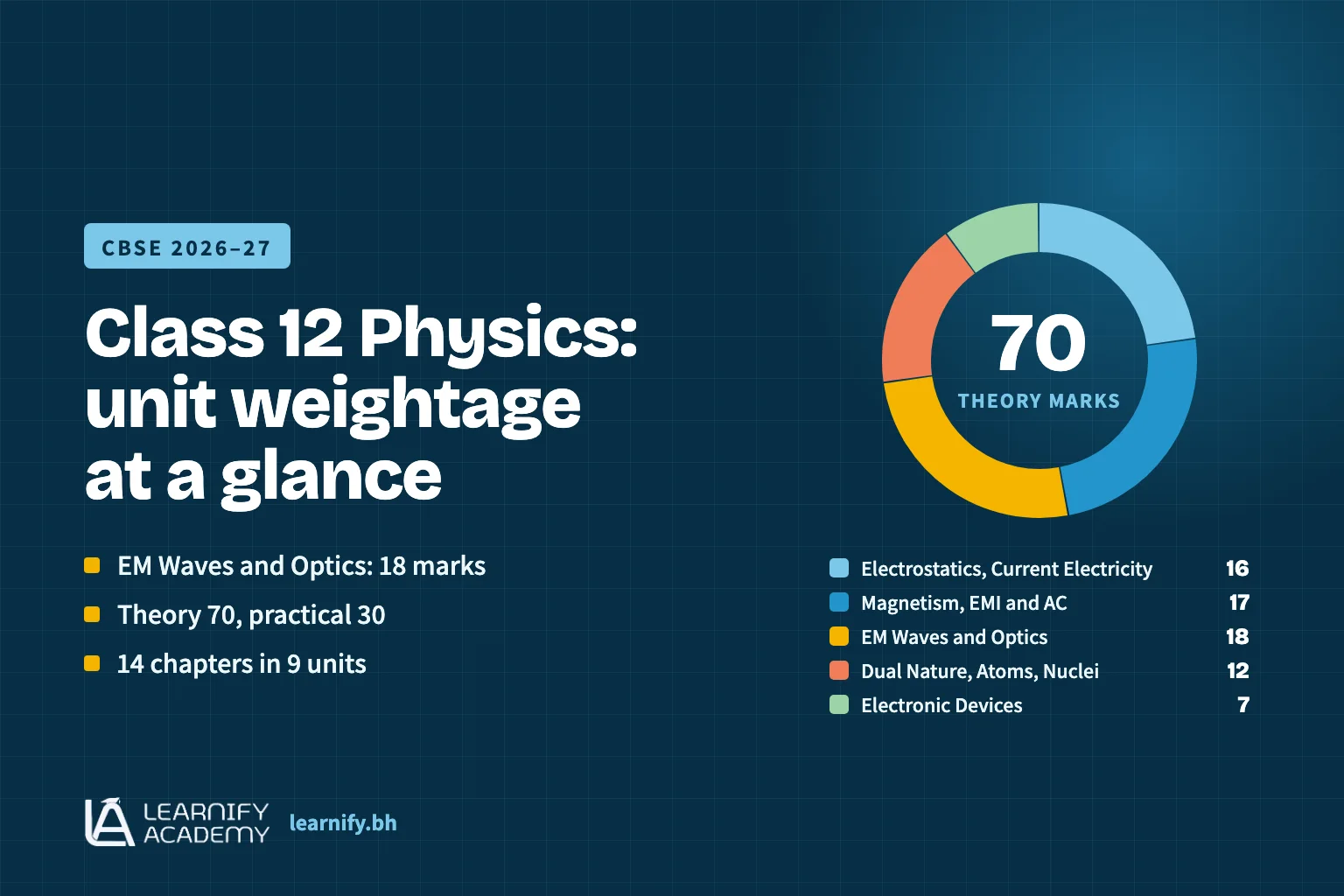
The CBSE Class 12 Physics syllabus for 2026–27 (code 042) has nine units and 14 chapters in a 70-mark theory paper. Marks are given for groups of units: Electrostatics and Current Electricity 16; Magnetism, Electromagnetic Induction and AC 17; EM Waves and Optics 18; Dual Nature, Atoms and Nuclei 12; Electronic Devices 7. Practicals add 30 marks.
What is in the CBSE Class 12 Physics syllabus 2026–27?
The CBSE Class 12 Physics syllabus 2026–27 has nine units and 14 chapters, examined in a three-hour theory paper of 70 marks, with a further 30 marks for the practical examination. It is set out in CBSE’s official Physics (code 042) curriculum for Classes XI–XII, released for the 2026–27 session on 1 April 2026, and the board examination covers the entire Class 12 syllabus.
CBSE asks every affiliated school to follow the prescribed curriculum strictly, so the weightage below applies in the same way to CBSE students in Bahrain and elsewhere in the GCC as in India.
Nothing of substance has changed since last year. Apart from the year labels, the 2026–27 Physics document matches the 2025–26 version, and CBSE’s notice on the 2026–27 sample papers confirms there is no change in the question paper design or assessment pattern.
What is the unit-wise weightage in Class 12 Physics 2026–27?
Electromagnetic Waves and Optics together carry the most, 18 marks, while Electronic Devices carries the least, 7 marks. CBSE gives marks for groups of units rather than for each unit separately, as the table shows.
| Units | Chapters | Marks |
|---|---|---|
| I. Electrostatics and II. Current Electricity | 1–3 | 16 |
| III. Magnetic Effects of Current and Magnetism and IV. Electromagnetic Induction and Alternating Currents | 4–7 | 17 |
| V. Electromagnetic Waves and VI. Optics | 8–10 | 18 |
| VII. Dual Nature of Radiation and Matter and VIII. Atoms and Nuclei | 11–13 | 12 |
| IX. Electronic Devices | 14 | 7 |
| Theory total | 14 chapters | 70 |
Put another way, the first seven chapters, from Electric Charges and Fields to Alternating Current, carry 33 of the 70 theory marks, and the three chapters of Units V and VI carry another 18.
Unit IX, Electronic Devices, has one chapter and 7 marks. The syllabus limits it to energy bands (qualitative ideas only), intrinsic and extrinsic semiconductors, the p-n junction, the diode’s I-V characteristics and the diode as a rectifier.
Which chapters are in each Physics unit?
The 14 chapters in the syllabus follow the 14 chapters of the NCERT Class 12 Physics textbook, with chapters 1–8 in Part I and chapters 9–14 in Part II.
| Unit | Chapters | NCERT book |
|---|---|---|
| I. Electrostatics | 1. Electric Charges and Fields; 2. Electrostatic Potential and Capacitance | Part I |
| II. Current Electricity | 3. Current Electricity | Part I |
| III. Magnetic Effects of Current and Magnetism | 4. Moving Charges and Magnetism; 5. Magnetism and Matter | Part I |
| IV. Electromagnetic Induction and Alternating Currents | 6. Electromagnetic Induction; 7. Alternating Current | Part I |
| V. Electromagnetic Waves | 8. Electromagnetic Waves | Part I |
| VI. Optics | 9. Ray Optics and Optical Instruments; 10. Wave Optics | Part II |
| VII. Dual Nature of Radiation and Matter | 11. Dual Nature of Radiation and Matter | Part II |
| VIII. Atoms and Nuclei | 12. Atoms; 13. Nuclei | Part II |
| IX. Electronic Devices | 14. Semiconductor Electronics: Materials, Devices and Simple Circuits | Part II |
Where the syllabus limits the depth
The detailed syllabus marks several topics as qualitative only or formula only, which helps students avoid learning derivations that are not required:
- Capacitors: energy stored in a capacitor is needed as a formula only, with no derivation.
- Magnetism: the straight solenoid and the bar magnet as an equivalent solenoid are treated qualitatively only.
- Alternating current: the LCR series circuit is covered using phasors only.
- Electromagnetic waves: their transverse nature is a qualitative idea only.
- Wave optics: for Young’s double slit experiment only the final expression for fringe width is needed, and the width of the central maximum in single-slit diffraction is qualitative only.
- Atoms: hydrogen line spectra are treated qualitatively only.
How are the 30 practical marks split in Class 12 Physics?
The three-hour, 30-mark practical examination gives the most weight to two experiments, 7 marks each, with the rest spread across the record, an activity, the project and a viva.
| Component | Marks |
|---|---|
| Two experiments, one from each section | 7 + 7 |
| Practical record (experiments and activities) | 5 |
| One activity from any section | 3 |
| Investigatory project | 3 |
| Viva on experiments, activities and project | 5 |
| Total | 30 |
The record submitted at the practical exam must include at least 8 experiments (4 from each section), at least 6 activities (3 from each section) and the report of the student’s investigatory project. Section A experiments include finding a resistance with a metre bridge and converting a galvanometer into a voltmeter or ammeter. Section B experiments include finding focal lengths of mirrors and lenses, the angle of minimum deviation for a prism and the I-V characteristic of a p-n junction diode.
Students with a visual impairment follow a separate two-hour, 30-mark scheme: 5 marks for identifying apparatus, 10 for a written test on the listed practicals, 5 for the practical record and 10 for the viva.
What is the Class 12 Physics question paper pattern for 2026–27?
CBSE’s 2026–27 Physics sample paper has 33 compulsory questions in five sections, for 70 marks in three hours. It was published on 21 September 2026 with the note that the question paper design and assessment pattern are unchanged for the session.
| Section | Questions | Type | Marks |
|---|---|---|---|
| A | Q1–16 | 12 multiple choice and 4 assertion-reason questions, 1 mark each | 16 |
| B | Q17–21 | 2 marks each | 10 |
| C | Q22–28 | 3 marks each | 21 |
| D | Q29–30 | Case study based, 4 marks each | 8 |
| E | Q31–33 | Long answer, 5 marks each | 15 |
| Total | 33 questions | 70 |
There is no overall choice, but internal choice is given in two questions in Section B, one in Section C and all three in Section E. Calculators are not allowed, and the paper supplies values of physical constants, such as the speed of light and Planck’s constant, for students to use.
What skills does the Physics theory paper test?
About 38% of the theory marks test remembering and understanding; the other 62% test applying, analysing, evaluating and creating.
| Type of question | Marks | Approximate percentage |
|---|---|---|
| Remembering and understanding | 27 | 38% |
| Applying | 22 | 32% |
| Analysing, evaluating and creating | 21 | 30% |
| Theory total | 70 | 100% |
| Practical | 30 | |
| Gross total | 100 |
CBSE describes this as a sample template: individual papers may vary internally, but the overall weightage given to each type of question stays the same.
Which NCERT books are prescribed for Class 12 Physics?
CBSE prescribes NCERT’s two-part Physics textbook for Class XII and NCERT’s Laboratory Manual of Physics for Class XII.
- Physics Part I, Class XII (NCERT): chapters 1–8, from Electric Charges and Fields to Electromagnetic Waves.
- Physics Part II, Class XII (NCERT): chapters 9–14, from Ray Optics and Optical Instruments to Semiconductor Electronics.
- Laboratory Manual of Physics for Class XII (NCERT): support for the practical work.
The curriculum adds that content shown in the NCERT textbooks as excluded for 2026–27 will not be tested by schools or assessed in the 2026–27 board examinations. The books are linked from our NCERT Class 12 textbooks page.
How should students plan Physics revision around the weightage?
Plan by marks, but keep every chapter in the plan. Chapters 1–7 carry 33 marks and chapters 8–10 another 18, so electricity, magnetism and optics together account for 51 of the 70 theory marks. The last four chapters carry 19 marks between them, which is still more than a quarter of the paper.
Because the practical exam carries 30 marks, it also helps to keep the record file, activities and investigatory project up to date through the year rather than completing them just before the exam. Families in Bahrain who want guided practice can find details on our physics tuition page.
FAQ
Questions parents ask
Which unit has the highest weightage in Class 12 Physics 2026–27?
Units V and VI together, Electromagnetic Waves and Optics, carry the highest weightage: 18 of the 70 theory marks. They cover three chapters: Electromagnetic Waves, Ray Optics and Optical Instruments, and Wave Optics. Next come Units III and IV (magnetism, electromagnetic induction and alternating current) with 17 marks, and Units I and II (electrostatics and current electricity) with 16.
Has the Class 12 Physics syllabus changed for 2026–27?
No. Apart from the year labels, the 2026–27 Physics curriculum matches the 2025–26 document, with the same nine units, 14 chapters, weightage and practical scheme. CBSE’s notification of 21 September 2026 on the sample papers also says there is no change in the question paper design and assessment pattern, and that passing criteria remain the same as in 2025–26.
How many marks are Class 12 Physics practicals worth?
Physics practicals carry 30 marks, alongside 70 for the theory paper, for a subject total of 100. The three-hour practical exam awards two experiments (7 marks each), the practical record (5), one activity (3), the investigatory project (3) and a viva (5). In CBSE’s list of subjects, Physics has no separate internal assessment column.
How many questions are in the CBSE Class 12 Physics paper?
The 2026–27 sample paper has 33 questions: 16 one-mark questions in Section A, five 2-mark questions in Section B, seven 3-mark questions in Section C, two 4-mark case studies in Section D and three 5-mark long answers in Section E. All questions are compulsory, with internal choice in some of them.
Are calculators allowed in the Class 12 Physics exam?
No. The general instructions in CBSE’s 2026–27 Physics sample paper say that calculators are not allowed. Instead, the paper lists values of physical constants such as the speed of light, the charge of an electron and Planck’s constant, so students should practise numerical questions with manual arithmetic and powers of ten.
Will content deleted from the NCERT Physics book be tested?
No. The 2026–27 Physics curriculum says content indicated in the NCERT textbooks as excluded for 2026–27 is not to be tested by schools and will not be assessed in the board examinations. Students should work from the current NCERT Class 12 books and the CBSE syllabus text rather than older guides that may include removed topics.
When is the CBSE Class 12 Physics exam in 2027?
The 2026–27 curriculum and sample paper do not give exam dates. CBSE announces the Class 12 date sheet, including the Physics paper, separately on its main website, cbse.gov.in, so rely on that notice rather than dates shared on social media. The weightage in this guide applies to the board examination for the 2026–27 session.
Sources
Official documents used for this article, checked on 24 September 2026. CBSE and NCERT can update them during the year, so confirm important dates and rules on cbse.gov.in or cbseacademic.nic.in before acting.
- CBSE Curriculum 2026–27 (Classes IX–XII), CBSE Academic
- CBSE Physics (042) curriculum, Classes XI–XII, 2026–27
- CBSE Introduction to Secondary Curriculum Part 2 (Classes XI–XII), 2026–27
- CBSE Circular Acad-14/2026: Release of CBSE Curriculum for 2026–27
- CBSE Notification (21 September 2026): Sample Question Papers for Classes X and XII, 2026–27
- CBSE Class XII Sample Question Papers and Marking Schemes, 2026–27
- CBSE Class XII Physics Sample Question Paper, 2026–27
- CBSE Physics (042) curriculum, Classes XI–XII, 2025–26 (for comparison)
- NCERT Physics Part II, Class XII: prelims and contents (includes Part I contents)
Want expert help this school year?
Learnify Academy teaches CBSE students in person in Riffa and Segaya, Bahrain. Your child’s first class is free.