
CBSE guide · 2026–27
Choosing a stream after Class 10 in Bahrain: Science, Commerce or Humanities
CBSE does not fix streams; it sets rules for combining subjects. Here is what the 2026–27 scheme of studies says, and how families in Bahrain can use it to choose Class 11 subjects.
At a glance
- Minimum subjects 5, with an optional 6th
- Compulsory language English or Hindi (Core or Elective)
- Course length Classes 11 and 12 form one composite course
- Maths options Mathematics (041) or Applied Mathematics (241), not both
- Changing a Class 12 subject Request before 15 July; CBSE approval needed
- Class 12 mark sheet Marks per subject; no aggregate or percentage
Quick answer
CBSE does not define Science, Commerce or Humanities streams. Its 2026–27 scheme of studies asks Class 11 students to take at least five subjects and keep them in Class 12: English or Hindi, a second language or academic elective, and three more electives. A stream is simply the combination your school offers.
What does choosing a stream after Class 10 mean in CBSE?
Choosing a stream after Class 10 means picking the Class 11 subjects your child will carry into the Class 12 board exams, because CBSE treats Classes 11 and 12 as one composite course. CBSE’s 2026–27 scheme of studies does not set fixed Science, Commerce or Humanities streams. It sets rules for combining subjects, and each school builds its options within those rules.
The curriculum sorts elective subjects into areas. These are the areas it describes and the subjects it names under each:
| Area (CBSE’s wording) | Subjects named |
|---|---|
| Sciences | Biology, Chemistry, Physics, Computer Science, Informatics Practices |
| Mathematics | Mathematics (041) or Applied Mathematics (241), any one |
| Business and commerce-based electives | Business Studies, Accountancy, Entrepreneurship, Economics |
| Humanities and Social Sciences | Geography, History, Economics, Home Science, Sociology, Fine Arts, Political Science |
| Visual, performing and creative arts | Dance, Drama, Music, Heritage Crafts, Fine Arts, Sculpture |
| Skill electives (Group S) | 43 subjects, such as Artificial Intelligence, Data Science and Information Technology |
In everyday use, ‘Science’ means a combination built on the science subjects, usually with Mathematics; ‘Commerce’ means one built on Accountancy, Business Studies and Economics; and ‘Humanities’ means one built on social science subjects. CBSE lists Economics under both commerce and humanities.
How many subjects does a CBSE Class 11 student take?
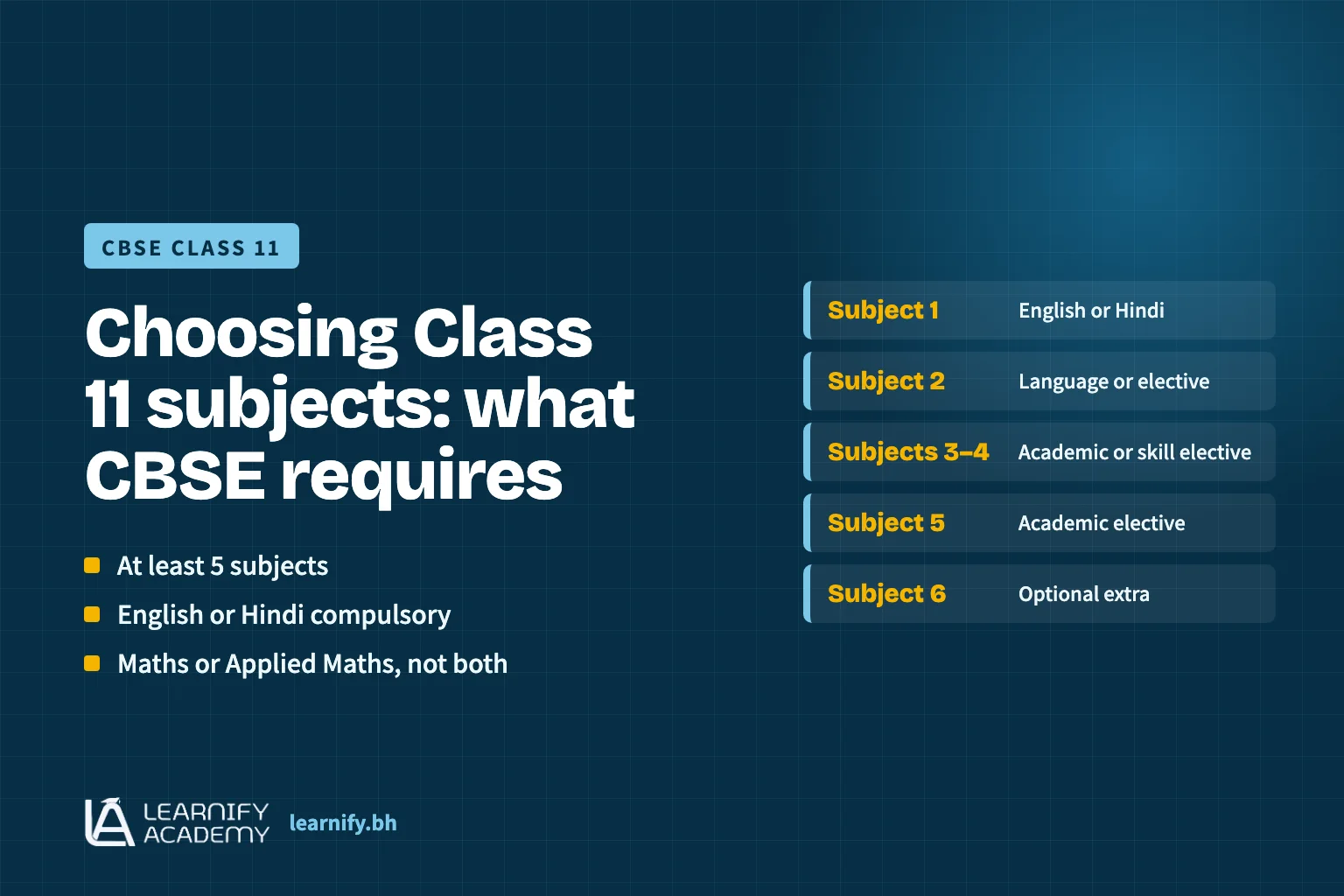
At least five. CBSE’s scheme of studies says students ‘can offer a minimum of 5 or more subjects in class XI’ and must continue the same subjects in Class 12. The subjects fill fixed slots:
| Slot | What can go in it |
|---|---|
| Subject 1 (compulsory) | English Core, English Elective, Hindi Core or Hindi Elective |
| Subject 2 (compulsory) | A second language from Group L, or an academic elective from Group A |
| Subjects 3 and 4 (compulsory) | An academic elective (Group A) or a skill elective (Group S) |
| Subject 5 (compulsory) | An academic elective from Group A |
| Subject 6 (optional) | One more elective or language from Group L or A |
| Subjects 7 to 9 (all regular students) | Health and Physical Education, Work Experience and General Studies, assessed in school |
Five rules shape every combination:
- English or Hindi must be one of the two languages, and a language cannot be taken at both Core and Elective level.
- Mathematics (041) and Applied Mathematics (241) cannot be taken together.
- Only one of Informatics Practices (065), Computer Science (083) and Information Technology (802) is allowed.
- Business Studies (054) cannot be combined with Business Administration (833).
- Skill electives can be taken alongside any subject, as long as the combination fits the scheme.
Group L includes English, Hindi and 34 other languages, among them Arabic, French, Malayalam, Tamil and Urdu. In practice, your child chooses from the subjects their own school is approved to offer, so the school’s list is the real menu.
Which Class 11 subjects have practicals or projects?
Physics, Chemistry, Biology, Computer Science, Informatics Practices, Geography and Psychology have 30-mark practicals, and Accountancy, Business Studies and Economics have 20 marks of practical or project work; Mathematics, Applied Mathematics, History, Political Science and Sociology use 20 marks of internal assessment instead.
| Subject (code) | Theory | Practical or project | Internal assessment |
|---|---|---|---|
| Physics (042) | 70 | 30 | None |
| Chemistry (043) | 70 | 30 | None |
| Biology (044) | 70 | 30 | None |
| Mathematics (041) | 80 | None | 20 |
| Applied Mathematics (241) | 80 | None | 20 |
| Computer Science (083) | 70 | 30 | None |
| Informatics Practices (065) | 70 | 30 | None |
| Accountancy (055) | 80 | 20 | None |
| Business Studies (054) | 80 | 20 | None |
| Economics (030) | 80 | 20 | None |
| History (027) | 80 | None | 20 |
| Political Science (028) | 80 | None | 20 |
| Geography (029) | 70 | 30 | None |
| Psychology (037) | 70 | 30 | None |
| Sociology (039) | 80 | None | 20 |
Should my child take Mathematics or Applied Mathematics?
Take Mathematics (041) if higher study in mathematics, engineering or the sciences is possible, and consider Applied Mathematics (241) for a commerce or social science path. CBSE calls the senior secondary stage a ‘launching stage’ from which Mathematics students go on to higher study in mathematics or to professional courses such as engineering, the physical and biological sciences, commerce or computer applications.
Applied Mathematics was added because, in CBSE’s words, the science-oriented Mathematics syllabus ‘may not be appropriate for the students who wish to pursue Commerce or Social Science-based subjects in university education’. Your child can take only one of the two.
| Course | Class 11 units (marks) |
|---|---|
| Mathematics (041) | Sets and Functions (23), Algebra (25), Coordinate Geometry (12), Calculus (8), Statistics and Probability (12); internal assessment (20) |
| Applied Mathematics (241) | Numbers, Quantification and Numerical Applications (10), Algebra (18), Calculus (12), Combinatorics and Probability (10), Descriptive Statistics (10), Basics of Financial Mathematics (15), Coordinate Geometry (5); internal assessment (20) |
What if my child took Mathematics Basic in Class 10?
They may still be allowed to take Mathematics (041). A CBSE circular of 27 May 2025 lets students who took Mathematics Basic (241) in Class 10 take Mathematics (041) in Class 11 from 2025–26 onward, if the head of school is satisfied they have ‘the aptitude and ability’ for it. It adds that once a subject is filled in the list of candidates, no later change is permitted, and that the relaxation will end once the new NCF-SE scheme of studies is implemented.
The 2026–27 curriculum replaces the Basic and Standard papers with one Mathematics course and an optional Advanced paper, starting with Class 9. Students in Class 10 in 2026–27 continue under the existing scheme and may still opt for Mathematics Basic. If that is your child, ask the school how it will apply the 2025 circular to Class 11 admissions in 2027–28.
Can my child change subjects later?
Only within limits. CBSE asks schools to counsel students to choose, in Class 11, the subjects they want to continue in Class 12, and it accepts a request to change a subject in Class 12 only if the request is made before 15 July of that academic session.
The school checks the reason, the student’s Class 11 performance, whether the new subject and a teacher are available, whether the school is affiliated for that subject and whether the combination is valid, then sends the request to CBSE’s regional office for approval.
The CBSE session runs from April to March. On 10 September 2026, CBSE told schools that Class 9 and Class 11 registration would ‘start shortly’ and asked for subject-wise registration as per the scheme of studies, so check the subject names and codes your school records for your child.
What do Science, Commerce and Humanities subjects lead to?
CBSE’s syllabus documents describe broad directions only; they do not set entry rules for universities or entrance exams. Beyond the Mathematics options above, this is what the 2026–27 subject documents say:
- Chemistry: students ‘opt for Chemistry with a purpose of pursuing their career in basic sciences or professional courses like medicine, engineering, technology’.
- Biology: the course aims for students to ‘be exposed to diverse careers in the life sciences’.
- Business Studies: aims to develop skills ‘to pursue higher education, world of work including self employment’.
- Geography and Political Science: Geography is ‘an entry point for the higher education’, and Political Science builds competencies ‘that prepare students for higher education’.
- Psychology: develops critical thinking skills ‘that are valuable in any field of study or career’.
Universities and entrance exams, whether in Bahrain, India or elsewhere, publish their own subject requirements, and these can change. Before fixing Class 11 subjects, read the current rules for the two or three courses your child is most seriously considering.
How should families in Bahrain decide?
Start with the combinations your child’s school actually offers for Class 11, then test each option against your child’s strengths, interests and the entry rules of the courses they might apply for.
- Ask the school early for its Class 11 subjects and combinations, including second-language and skill-elective options.
- Look at how your child copes with Class 10 Mathematics and Science work, not only at marks.
- Settle Mathematics or Applied Mathematics with the likely university path in mind, since your child cannot take both.
- Add a sixth subject only if the workload is manageable; a passed sixth subject can replace a failed main subject, provided English or Hindi stays among the main five.
- Ask the school counsellor about career guidance. In September 2026, CBSE briefed schools on Ministry of Education tools including the My Career Advisor app and Tamanna, an aptitude test for Classes 9 and 10.
- Keep the timeline in view: Class 10 students sit CBSE’s first board examination in February–March 2027, and the new session starts in April.
If your child would like support once the new subjects begin, Learnify runs CBSE Grade 11 classes in Riffa and CBSE classes in Segaya, Manama.
FAQ
Questions parents ask
Is Class 11 a CBSE board exam?
No. CBSE’s 2026–27 scheme says Class 11 assessment follows a pattern similar to the Class 12 board exam but is carried out at school level. Schools grade Class 11 on an absolute scale, from A1 for 91–100 marks down to D for 33–40 marks, with 32 or below marked ‘Essential Repeat’.
Can a student mix Science and Commerce subjects in Class 11?
In principle, yes. CBSE’s scheme lets students fill their elective slots with any valid Group A subjects, apart from a few barred pairs such as Mathematics with Applied Mathematics. A mix like Physics, Chemistry, Mathematics and Economics is therefore allowed by CBSE, but it is only possible if your school offers that combination.
Does the CBSE Class 12 mark sheet show a percentage?
No. CBSE issues a mark sheet cum certificate showing the marks in each subject separately, and its scheme of studies says no aggregate score or percentage is mentioned by the Board. Where a student passes six or seven subjects, the percentage is worked out according to the norms of the college or institution they apply to.
What is the benefit of taking a sixth subject?
It gives some protection. CBSE treats the first five subjects as main subjects, and if a student fails one of them, a passed sixth subject replaces it, provided English or Hindi remains among the main five. A sixth subject also adds workload, so weigh it against your child’s time and strengths before adding it.
Can my child change a subject in Class 12?
Only in limited cases. CBSE accepts a request to change a Class 12 subject only if it is made before 15 July of that session. The school checks the reason, the student’s Class 11 performance, and whether the subject and a teacher are available, then forwards the request to CBSE’s regional office for approval.
My child took Mathematics Basic in Class 10. Can they take Mathematics in Class 11?
Possibly. A CBSE circular of 27 May 2025 allows students who took Mathematics Basic (241) in Class 10 to take Mathematics (041) in Class 11 from 2025–26 onward, if the head of school is satisfied they have the aptitude and ability. The circular says this will end once the new NCF-SE scheme is implemented, so confirm with the school.
Sources
Official documents used for this article, checked on 24 September 2026. CBSE and NCERT can update them during the year, so confirm important dates and rules on cbse.gov.in or cbseacademic.nic.in before acting.
- CBSE Curriculum 2026–27, Introduction to Secondary Curriculum Part 2 (Classes XI–XII): scheme of studies
- CBSE Curriculum 2026–27, Introduction to Secondary Curriculum Part 1 (Classes IX–X)
- CBSE Curriculum 2026–27: Mathematics (041), Classes XI–XII
- CBSE Curriculum 2026–27: Applied Mathematics (241), Classes XI–XII
- CBSE Curriculum 2026–27: Chemistry (043)
- CBSE Curriculum 2026–27: Biology (044)
- CBSE Curriculum 2026–27: Business Studies (054)
- CBSE Curriculum 2026–27: Geography (029)
- CBSE Curriculum 2026–27: Political Science (028)
- CBSE Curriculum 2026–27: Psychology (037)
- CBSE circular CBSE/Coord/Maths-041-241/2025 (27 May 2025): Mathematics (041) in Class XI for Mathematics Basic students
- CBSE: Instructions and SOPs for change of subject(s) in Classes X and XII
- CBSE prior intimation of registration and LOC for 2026–27 (10 September 2026)
- CBSE circular: Submission of LOC for Class X and XII Main Examinations 2026–27 (17 September 2026)
- CBSE notification: Webinar on Career Guidance, My Career Advisor and Tamanna (15 September 2026)
Want expert help this school year?
Learnify Academy teaches CBSE students in person in Riffa and Segaya, Bahrain. Your child’s first class is free.