
CBSE guide · 2026–27
CBSE competency-based questions: what share of the paper, and how to prepare
CBSE says about half of each Class 10 and Class 12 board paper is competency-focused. Here is the official split for 2026–27, the question types to expect and how to prepare using CBSE’s own sample papers.
At a glance
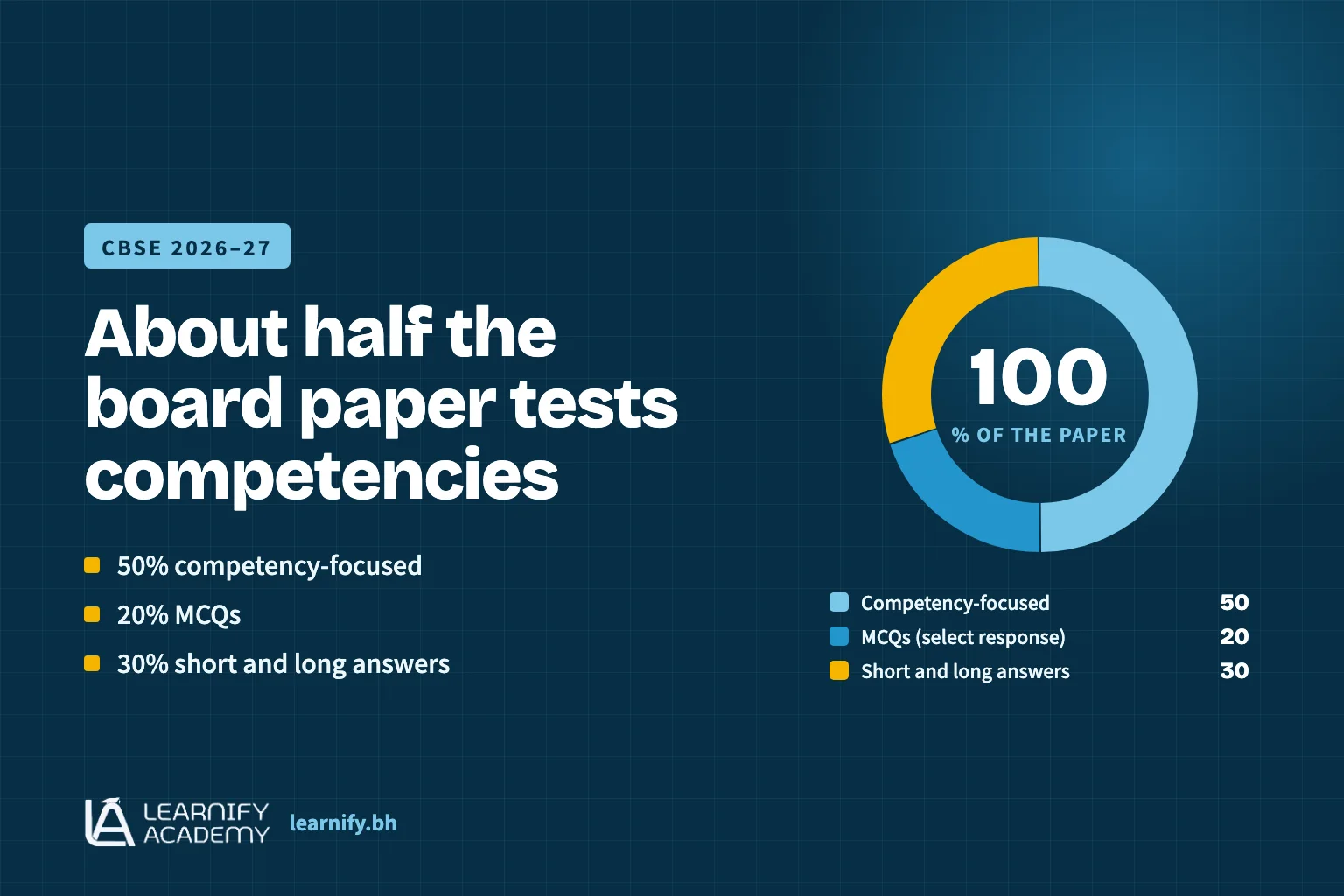
- Competency-focused questions About 50% of the paper
- Select-response questions (MCQs) 20%
- Short and long answers 30%
- Applies to Class 10 and Class 12 board theory papers
- Change for 2026–27 None: CBSE says the paper design is unchanged
- Official practice material CBSE 2026–27 sample papers and marking schemes
Quick answer
In 2026–27, about 50% of the questions in CBSE Class 10 and Class 12 board papers are competency-focused: case-based, source-based, integrated and application questions, which can also be set as MCQs. CBSE’s split is 50% competency-focused, 20% MCQs and 30% short and long answers, unchanged since 2024–25.
What share of the board paper do CBSE competency-based questions make up in 2026–27?
About half. CBSE competency-based questions make up approximately 50% of the questions in Class 10 and Class 12 board papers in 2026–27. CBSE’s 2026–27 secondary curriculum says ‘approximately 50% of the questions are competency-focused’, naming case-based, source-based, integrated, data interpretation, situational and application-oriented questions. The rest are MCQs and short or long answers.
CBSE’s formal split comes from Circular Acad-30/2024, which set it for the 2024–25 session:
| Type of question | Share | What CBSE includes |
|---|---|---|
| Competency-focused | 50% | MCQs, case-based questions, source-based integrated questions or any other type |
| Select response | 20% | MCQs |
| Constructed response | 30% | Short-answer and long-answer questions |
CBSE has not changed this since. Its July 2025 notification said the 2025–26 assessment scheme was ‘the same as in the academic session 2024-25’, and its notification of 21 September 2026 says: ‘There is no change in the question paper design and assessment pattern for the Academic Session 2026-27.’
Is the share the same in Class 10 and Class 12?
Yes, it is 50% in both. The difference is history: Classes 9 and 10 were already at 50% in 2023–24, while Classes 11 and 12 rose from 40% to 50% in 2024–25.
The documents also differ. The 2026–27 Class 9 and 10 curriculum states the 50% figure directly. The 2026–27 senior secondary curriculum does not print a percentage; it says the details of the paper design are ‘notified with the sample question paper’. For Class 12, the official record is therefore Circular Acad-30/2024, the two no-change notifications and the 2026–27 sample papers.
CBSE issues one curriculum and one set of sample papers to all its affiliated schools, so the same design applies to students in Bahrain and the rest of the GCC.
What types of competency-based questions appear in CBSE papers?
Case-based, source-based and assertion-reason questions are the most visible, but CBSE’s definition also covers MCQs and ‘any other type’, so competency-focused questions can appear anywhere in the paper, not only in the case-study section. The 2026–27 sample papers show where the case-based questions sit:
| Paper | Case or source-based questions | Other formats |
|---|---|---|
| Class 10 Mathematics Standard | Section E: 3 case study-based questions, 4 marks each | 18 MCQs and 2 assertion-reason questions in Section A; 2-, 3- and 5-mark answers |
| Class 10 Science | 4-mark questions built on an experiment, graph or real-life scenario in each of the Biology, Chemistry and Physics sections | MCQs, assertion-reason; 2-, 3- and 5-mark answers |
| Class 10 Social Science | Case-based questions with three sub-questions, 4 marks each, answers up to 100 words | MCQs, map work (5 marks); 2-, 3- and 5-mark answers |
| Class 12 Physics | Section D: 2 case study-based questions, 4 marks each | 12 MCQs and 4 assertion-reasoning questions; 2-, 3- and 5-mark answers |
| Class 12 Chemistry and Biology | Section D: 2 case-based questions, 4 marks each | 16 one-mark questions; 2-, 3- and 5-mark answers |
| Class 12 Mathematics | Section E: 3 case study-based questions, 4 marks each | 18 MCQs and 2 assertion-reason questions; 2-, 3- and 5-mark answers |
What these formats look like in practice:
- Case or source-based: a short passage, data table, graph or real-life scenario, followed by linked sub-questions.
- Assertion-reason: two statements; students decide whether each is true and whether the reason explains the assertion.
- Application MCQs: a new situation rather than a textbook line, such as the 2026–27 Class 10 Maths question that asks which equation could pair with x – y = 6 to give the solution (5, –1).
- Data and maps: reading graphs and tables and, in Social Science, locating features on a map.
A closer look at one set of case studies
In the 2026–27 Class 10 Mathematics Standard sample paper, each case study has three sub-parts worth 1, 1 and 2 marks. The contexts are everyday ones: a company’s sanitiser sales (linear equations), a circular garden with two tangents (circles) and a class’s test scores (statistics). The mathematics is standard textbook content; the skill being tested is turning the situation into that mathematics.
How much of each paper tests application and analysis?
It varies by subject. Alongside the 50% rule, each 2026–27 syllabus has a ‘typology of questions’ table that spreads the theory marks across thinking skills:
| Paper | Remembering and understanding | Applying | Analysing, evaluating and creating |
|---|---|---|---|
| Class 10 Mathematics Standard | 54% | 24% | 22% |
| Class 10 Mathematics Basic | 75% | 15% | 10% |
| Class 10 Science | 50% | 30% | 20% |
| Class 12 Physics | 38% | 32% | 30% |
| Class 12 Mathematics | 55% | 25% | 20% |
Class 10 Social Science leans further towards higher-order skills than any paper in the table: 40 of its 80 marks go to analysing, evaluating and creating, with 5 more for map skills. Science uses slightly different labels (knowledge and understanding; application; formulate, analyse, evaluate and create), shown here in the matching columns.
There is no overall choice in these papers, but internal choices are provided in some questions. The 2026–27 syllabuses put internal choice at approximately 33% in Class 10 Science and 33% in Class 12 Mathematics.
How can students prepare for competency-based questions?
Start with CBSE’s own material. The 2026–27 sample papers and marking schemes for Class 10 and Class 12 were announced on 21 September 2026, and CBSE says sample papers should be used in teaching ‘with an overall focus on promoting the application of concepts in real-life’. A practical routine:
- Secure the concept in NCERT first. Competency questions still test the prescribed syllabus; CBSE’s curriculum says the competencies assessed come from ‘the prescribed syllabus and textbooks’.
- Attempt one sample paper untimed, then mark it with the marking scheme. The scheme shows how marks split inside an answer, for example ‘(0.5+0.5)’, where two half-mark points make up one mark.
- Read the stem slowly. Mark what is given, what is asked and any data in a table, graph or map before answering.
- Drill one format at a time, for example a week of case-based sets, then assertion-reason, then data questions, before mixing them.
- Write to the word limit. The 2026–27 Class 10 Social Science paper asks for no more than 40 words for 2-mark answers, 60 for 3-mark answers, 120 for 5-mark answers and 100 for case-based questions.
- Finish with full timed papers that mix all question types, as the board paper does.
Common slips in case-based answers
- Answering from memory instead of using the data given in the case.
- Writing at length for a 1-mark sub-part and running short of time for the 2-mark part.
- Leaving out units or the final statement in numerical answers.
- Attempting both alternatives of an internal choice: the instructions ask students to attempt only one.
For more practice, CBSE’s academic website still hosts older material: question banks for Class 10 (English, Mathematics and Science) and Class 12, Additional Practice Questions for 2021–22 to 2023–24, and competency-based test items for Classes 6 to 10 on its CBE Resources page. These are not labelled for 2026–27 and some use older formats (the Class 10 Science question bank asks students to ‘answer any four questions’ from each case study), so check each chapter against the 2026–27 syllabus first.
Our important questions by grade and Class 10 Science quick revision pages can support chapter-wise practice alongside CBSE’s papers.
Do schools test competencies in internal assessment too?
Yes, in Classes 9 and 10. The 2026–27 secondary curriculum says three periodic assessments are held in each subject, the average of the best two counts, and at least one must be ‘competency-based and application-oriented’, using tasks such as case analysis, data interpretation and problem-solving. Students therefore meet the same skills in school tests well before the board exam.
Periodic assessment is one part of the 20 internal assessment marks in each main Class 10 subject; the other 80 marks come from the board paper. Class 10 NCERT books are listed on our Class 10 NCERT textbooks page.
FAQ
Questions parents ask
What percentage of CBSE Class 10 questions are competency-based in 2026–27?
About 50%. CBSE’s 2026–27 secondary curriculum says approximately half the questions are competency-focused, such as case-based, source-based, integrated, data interpretation and application questions. The remaining questions are MCQs and short or long answers. CBSE’s formal split is 50% competency-focused, 20% MCQs and 30% constructed-response questions.
Is the competency-based share different for Class 12?
No. Class 12 has the same 50/20/30 split. It rose from 40% to 50% in 2024–25 under Circular Acad-30/2024. CBSE then said the 2025–26 assessment scheme was the same as in 2024–25, and its notification of 21 September 2026 says there is no change in paper design for 2026–27.
Are competency-based questions only in the case study section?
No. CBSE defines competency-focused questions as MCQs, case-based questions, source-based integrated questions or any other type, so they can appear across the paper. In the 2026–27 sample papers you will also find assertion-reason items and application-style MCQs in Section A, not only case studies.
Where can I find the 2026–27 CBSE sample papers and marking schemes?
On CBSE’s academic website, cbseacademic.nic.in, under Sample Question Paper, SQP 2026–2027, with separate pages for Class X and Class XII. CBSE announced them in a notification dated 21 September 2026. Each subject has a sample paper and a marking scheme, and some subjects also have Hindi versions.
Are old CBSE question banks still useful?
Yes, for extra practice, used with care. CBSE’s older question banks and Additional Practice Questions for 2021–22 to 2023–24 are still online, but they are not labelled for 2026–27 and some use older formats. Check each question’s chapter against the 2026–27 syllabus and use the current sample paper for the exam pattern.
How many case-based questions are in the Class 10 Maths paper?
In the 2026–27 Mathematics Standard sample paper there are three case study-based questions in Section E (questions 36 to 38), each worth 4 marks, so 12 of the 80 theory marks. An internal choice is given in the 2-mark sub-parts of those questions.
Sources
Official documents used for this article, checked on 24 September 2026. CBSE and NCERT can update them during the year, so confirm important dates and rules on cbse.gov.in or cbseacademic.nic.in before acting.
- CBSE Secondary Curriculum 2026–27, Part 1 (introduction and assessment)
- CBSE Senior Secondary Curriculum 2026–27 (introduction and assessment)
- CBSE Circular Acad-30/2024: Assessment and Evaluation Practices for 2024–25 (3 April 2024)
- CBSE Notification: Sample Question Papers for 2025–26 (30 July 2025)
- CBSE Notification: Sample Question Papers for 2026–27 (21 September 2026)
- CBSE Class X Sample Question Papers and Marking Schemes 2026–27
- CBSE Class XII Sample Question Papers and Marking Schemes 2026–27
- CBSE Class X Mathematics syllabus 2026–27
- CBSE Class X Science syllabus 2026–27
- CBSE Class X Social Science syllabus 2026–27
- CBSE Class XII Physics syllabus 2026–27
- CBSE Class XII Mathematics syllabus 2026–27
- CBSE Question Bank pages (Class X and Class XII)
- CBSE Additional Practice Questions
- CBSE CBE Resources: Assessment
Want expert help this school year?
Learnify Academy teaches CBSE students in person in Riffa and Segaya, Bahrain. Your child’s first class is free.