
CBSE guide · 2026–27
CBSE Class 10 Science syllabus 2026–27: chapters and marks
The official CBSE Class 10 Science syllabus for 2026–27: unit marks, NCERT chapters, the topics taught but kept out of the board paper, the 14 practicals and how the exam is set.
At a glance
- Board exam 80 marks, 3 hours
- Internal assessment 20 marks, including 5 for practical work
- Units 5 units covering the 13 NCERT chapters
- Heaviest units Chemical Substances and World of Living, 25 each
- Sample paper 39 questions: Biology, Chemistry and Physics sections
- Not in the board paper Periodic Classification, Evolution, motor, electromagnetic induction, generator
Quick answer
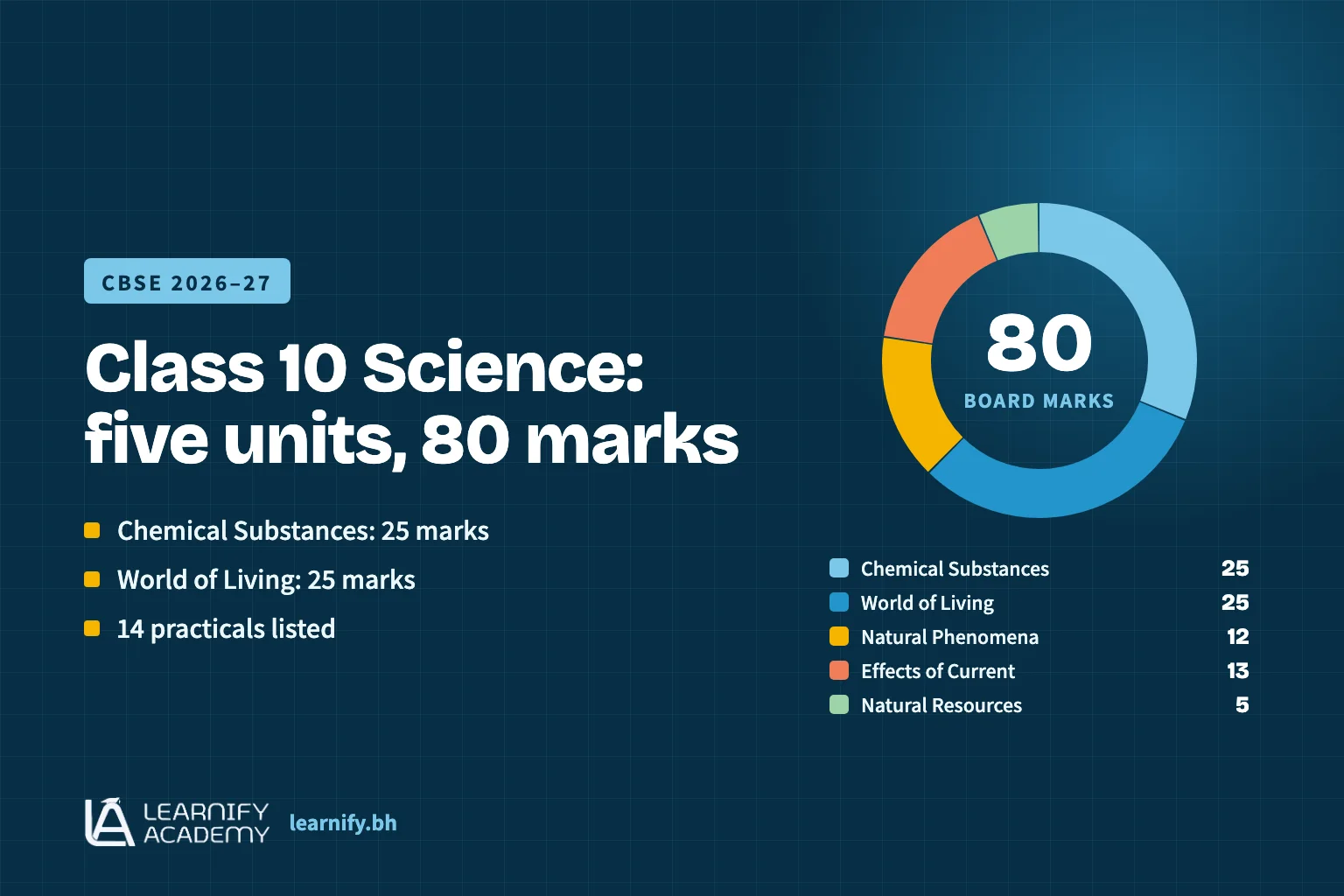
The CBSE Class 10 Science syllabus for 2026–27 has five units worth 80 board-exam marks: Chemical Substances 25, World of Living 25, Natural Phenomena 12, Effects of Current 13 and Natural Resources 5. Schools add 20 internal assessment marks. Periodic Classification, Evolution, and the motor, electromagnetic induction and generator are assessed only in school.
What is in the CBSE Class 10 Science syllabus 2026–27?
The CBSE Class 10 Science syllabus 2026–27 (subject code 086) has five units that carry 80 marks in the board exam, and the school adds 20 marks of internal assessment, for a total of 100. In Classes 9 and 10, science is taught as one integrated subject that, in CBSE’s words, “combines Biology, Chemistry, Physics, and Earth Science”.
The board exam is based on this prescribed syllabus for every CBSE school, including those in Bahrain and across the GCC. The 2026–27 version also lists three topic groups that are taught and assessed in school but kept out of the board paper, which is the most important detail for families to understand this year.
How many marks does each unit carry in Class 10 Science?
Chemical Substances and World of Living carry 25 marks each, so together they make up 50 of the 80 board-exam marks. This is the course structure in CBSE’s 2026–27 Science curriculum:
| Unit | Unit name | Marks |
|---|---|---|
| I | Chemical Substances: Nature and Behaviour | 25 |
| II | World of Living | 25 |
| III | Natural Phenomena | 12 |
| IV | Effects of Current | 13 |
| V | Natural Resources | 5 |
| Theory total | 80 | |
| Internal assessment | 20 | |
| Grand total | 100 |
The unit marks are the same as in 2025–26, and CBSE’s notice of 21 September 2026 says there is no change in the question paper design and assessment pattern for 2026–27.
Which chapters are in each unit of Class 10 Science?
The examined syllabus covers all 13 chapters of the NCERT Class 10 Science textbook, the first book on CBSE’s prescribed list. The copy on the NCERT website is marked “Reprint 2026-27”.
| Unit (marks) | NCERT chapters | Key syllabus content |
|---|---|---|
| I Chemical Substances: Nature and Behaviour (25) | 1 Chemical Reactions and Equations; 2 Acids, Bases and Salts; 3 Metals and Non-metals; 4 Carbon and its Compounds | Types of chemical reactions, oxidation and reduction; acids, bases and the pH scale; reactivity series, ionic compounds and corrosion; covalent bonds, nomenclature, ethanol and ethanoic acid, soaps and detergents |
| II World of Living (25) | 5 Life Processes; 6 Control and Coordination; 7 How do Organisms Reproduce?; 8 Heredity | Nutrition, respiration, transport and excretion; nervous system, reflex action and hormones; reproduction and reproductive health; Mendel’s laws and sex determination |
| III Natural Phenomena (12) | 9 Light – Reflection and Refraction; 10 The Human Eye and the Colourful World | Spherical mirrors and lenses, mirror and lens formulae, power of a lens; the human eye and defects of vision; prism, dispersion and scattering of light |
| IV Effects of Current (13) | 11 Electricity; 12 Magnetic Effects of Electric Current | Ohm’s law, resistivity, series and parallel resistors, heating effect, electric power; magnetic field of a conductor, coil and solenoid, Fleming’s left-hand rule, AC and DC, domestic circuits |
| V Natural Resources (5) | 13 Our Environment | Ecosystem, environmental problems, ozone depletion, waste and its solutions, biodegradable and non-biodegradable substances |
You will find the textbook and the other Class 10 NCERT books on our Class 10 NCERT textbooks page. CBSE also prescribes NCERT’s Laboratory Manual and Exemplar Problems for Class X, its own Assessment of Practical Skills in Science for Class X, and its new Reading Material for Science, Class X (2026-27).
Which Class 10 Science topics are not in the board exam?
Three topic groups are in the 2026–27 syllabus but “will be assessed only formatively”, which means they count towards school-based assessment and not the board paper:
- Periodic Classification of Elements (Unit I): Döbereiner’s triads, Newlands’ law of octaves, Mendeléev’s periodic table and the modern periodic table.
- Evolution (Unit II): acquired and inherited traits, speciation, evolution and classification, tracing evolutionary relationships, fossils, evolution by stages and human evolution.
- Motor, electromagnetic induction and electric generator (Unit IV).
CBSE has issued Reading Material for Class X (2026-27) containing the NCERT text for these topics. The syllabus suggests that students read them and prepare a brief write-up for their portfolio, and says schools may give credit through periodic assessment or the portfolio.
Heredity is still examined. Mendel’s laws and sex determination are listed in the Unit II content, and the 2026–27 sample paper has a 4-mark question on Mendel’s pea-plant crosses. A note for teachers at the end of the syllabus groups “Heredity and Evolution” together, so ask your child’s science teacher if anything is unclear.
What smaller limits apply to the examined chapters?
- pH scale: the definition relating to logarithm is not required.
- Mirror formula and lens formula: derivations are not required.
- Scattering of light: the colour of the sun at sunrise and sunset is excluded.
- Ethanol and ethanoic acid: properties and uses only.
- Information in the boxes of NCERT textbooks is not assessed in the year-end exam.
What practicals are in the Class 10 Science syllabus?
The syllabus lists 14 experiments, to be done alongside the theory lessons, and practical work carries 5 of the 20 internal assessment marks:
- Finding the pH of dilute hydrochloric acid, dilute NaOH, dilute ethanoic acid, lemon juice, water and dilute hydrogen carbonate solution, and studying how HCl and NaOH react with litmus, zinc and solid sodium carbonate (Unit I).
- Performing and classifying combination, decomposition, displacement and double displacement reactions (Unit I).
- Observing the action of zinc, iron, copper and aluminium on their sulphate solutions and arranging the metals in decreasing order of reactivity (Unit I).
- Studying how the potential difference across a resistor depends on the current, finding its resistance and plotting a graph between V and I (Unit IV).
- Finding the equivalent resistance of two resistors in series and in parallel (Unit IV).
- Preparing a temporary mount of a leaf peel to show stomata (Unit II).
- Showing experimentally that carbon dioxide is given out during respiration (Unit II).
- Studying acetic acid (ethanoic acid): its odour, solubility in water, effect on litmus and reaction with sodium hydrogen carbonate (Unit I).
- Comparing the cleaning capacity of a soap sample in soft and hard water (Unit I).
- Finding the focal length of a concave mirror and of a convex lens, using a distant object (Unit III).
- Tracing the path of a ray of light through a rectangular glass slab for different angles of incidence (Unit III).
- Studying binary fission in Amoeba and budding in yeast and Hydra with prepared slides (Unit II).
- Tracing the path of rays of light through a glass prism (Unit III).
- Identifying the parts of the embryo of a dicot seed such as pea, gram or red kidney bean (Unit II).
For short recaps of the theory behind these experiments, see our Grade 10 Science quick revision notes.
How are the 20 internal assessment marks split in Class 10 Science?
Internal assessment in Class 10 Science has four equal parts of 5 marks each:
| Component | Marks |
|---|---|
| Periodic Assessment | 5 |
| Multiple Assessment | 5 |
| Portfolio | 5 |
| Subject Enrichment (Practical Work) | 5 |
| Total | 20 |
CBSE’s 2026–27 guidelines ask schools to hold three periodic assessments in each subject and count the average of the best two. Internal assessment is conducted only once, before the main exam, and CBSE has said it cannot be improved later because it is a yearlong exercise. This makes steady work on the portfolio and practical record through the year worth the effort.
What does the Class 10 Science question paper look like?
The board paper is 80 marks and three hours, and CBSE’s 2026–27 sample paper has 39 questions in three sections, one each for Biology, Chemistry and Physics:
| Section | Subject | Questions | Marks |
|---|---|---|---|
| A | Biology | 1 to 16 | 30 |
| B | Chemistry | 17 to 29 | 25 |
| C | Physics | 30 to 39 | 25 |
| Total | 39 | 80 |
The section totals are the sum of the marks printed against each question, and they line up with the syllabus: Biology covers Units II and V (25 + 5 marks), Chemistry covers Unit I (25) and Physics covers Units III and IV (12 + 13). Every section runs from 1-mark multiple-choice and assertion-reason questions to a 5-mark long answer, with a 4-mark case-based question in each, and some questions offer an internal choice.
The curriculum sets the competency mix for the whole paper:
| Competency | Weightage |
|---|---|
| Demonstrate knowledge and understanding | 50% |
| Application of knowledge and concepts | 30% |
| Formulate, analyse, evaluate and create | 20% |
Question types include objective and very short answers, assertion-reason, short and long answers, and source-based, case-based, passage-based or integrated questions, with an internal choice in about 33 per cent of the paper.
What has changed in Class 10 Science for 2026–27?
The examined content, unit marks, list of practicals and question paper design are the same as in 2025–26. Three things are different:
- Periodic Classification, Evolution, and the motor, electromagnetic induction and generator now appear in the Class 10 syllabus as school-assessed topics, backed by CBSE’s new Class X reading material. The 2025–26 Class 10 syllabus did not list them.
- The second 5 marks of internal assessment, shown as periodic assessment in 2025–26, are now called Multiple Assessment.
- Looking ahead, CBSE’s curriculum adds an optional Science Advanced paper of 25 marks and one hour for Class 10 from 2027–28. It does not apply to students in Class 10 this year.
If your child is in Class 9 this year, our Class 9 Science syllabus guide covers the new course. For steady help through Class 10, our science tuition in Bahrain follows this syllabus.
FAQ
Questions parents ask
How many chapters are in the Class 10 Science syllabus for 2026–27?
The examined syllabus covers all 13 chapters of the NCERT Class 10 Science textbook, from Chemical Reactions and Equations to Our Environment. CBSE also lists three extra topic groups (Periodic Classification of Elements; Evolution; and the electric motor, electromagnetic induction and generator) that are taught and assessed in school but are not part of the board exam.
Is Periodic Classification of Elements in the Class 10 board exam?
No. For 2026–27, CBSE lists Periodic Classification of Elements among topics that will be assessed only formatively, so it is not part of the board paper. Students read it from CBSE’s Class X reading material, and schools may give credit for it through periodic assessment or the portfolio.
Which unit carries the most marks in Class 10 Science?
Two units share the top spot with 25 marks each: Chemical Substances: Nature and Behaviour, which covers NCERT chapters 1 to 4, and World of Living, which covers chapters 5 to 8. Effects of Current carries 13 marks, Natural Phenomena 12 and Natural Resources 5, making 80 board-exam marks in all.
How many practicals are there in Class 10 Science?
The 2026–27 syllabus lists 14 experiments, covering pH and acid-base reactions, types of reactions, reactivity of metals, Ohm’s law, resistors in series and parallel, stomata, respiration, acetic acid, soap in hard water, focal length, the glass slab and prism, reproduction slides and dicot seed embryos. Practical work carries 5 of the 20 internal assessment marks.
Is the Class 10 Science paper divided into Biology, Chemistry and Physics?
Yes, in CBSE’s 2026–27 sample paper. It has 39 questions in three sections: Section A is Biology, Section B is Chemistry and Section C is Physics. Adding the marks shown against each question gives 30, 25 and 25 marks respectively, which matches the unit weightages in the syllabus.
Has the Class 10 Science syllabus changed for 2026–27?
The examined content, unit marks, practicals and paper design are the same as in 2025–26. What is new is that three topic groups (Periodic Classification, Evolution, and motor, electromagnetic induction and generator) are listed for school-based assessment only, and one internal assessment component is now called Multiple Assessment.
Sources
Official documents used for this article, checked on 24 September 2026. CBSE and NCERT can update them during the year, so confirm important dates and rules on cbse.gov.in or cbseacademic.nic.in before acting.
- CBSE Curriculum 2026–27: Science, Class X (code 086)
- CBSE Reading Material, Science, Class X (2026-27)
- CBSE Secondary Curriculum 2026–27, Part 1: initial pages (scheme of studies and assessment)
- CBSE Class X Sample Question Paper 2026–27: Science (086)
- CBSE notification on Sample Question Papers for 2026–27 (21 September 2026)
- CBSE Curriculum 2025–26: Science, Classes IX–X (for comparison)
- NCERT Science Textbook for Class X, contents (Reprint 2026-27)
- CBSE notification: Two Board Examinations in Class X from 2026 (25 June 2025)
- CBSE circular: LOC for Class X Second Board Examination 2026 (17 March 2026)
Want expert help this school year?
Learnify Academy teaches CBSE students in person in Riffa and Segaya, Bahrain. Your child’s first class is free.