
CBSE guide · 2026–27
CBSE Class 9 Science syllabus 2026–27: units, marks and chapters for parents in Bahrain
The official CBSE Class 9 Science syllabus for 2026–27: four units worth 80 marks, the chapters of NCERT’s new book Exploration, the 13 practicals, the 20 internal marks and the optional Advanced level.
At a glance
- Annual exam 80 marks, 3 hours, set by the school in Class IX
- Internal assessment 20 marks: four parts of 5 marks each
- Textbook NCERT Exploration, 13 chapters (Chapter 1 is not in any exam unit)
- Biggest unit World of Living, 27 marks
- Practicals 13 experiments listed by CBSE
- Advanced level Optional extra paper: 25 marks, 1 hour, not added to the total
Quick answer
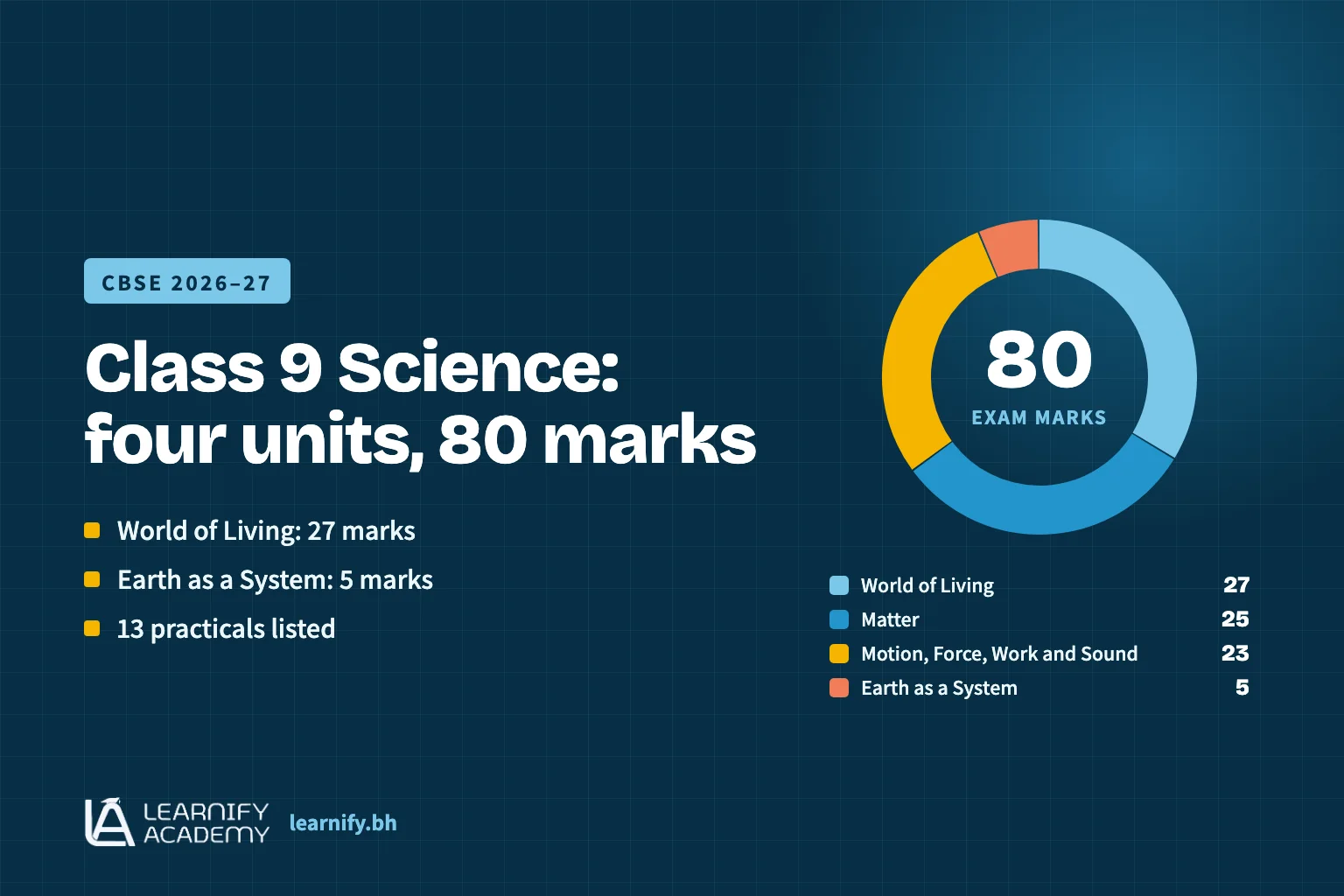
The CBSE Class 9 Science syllabus for 2026–27 has four units worth 80 marks in a school-based annual exam: World of Living 27, Matter 25, Motion, Force, Work and Sound 23, and Earth as a System 5. Schools add 20 internal marks. Teaching follows NCERT’s new 13-chapter book, Exploration, and an optional Advanced paper adds 25 marks.
What is in the CBSE Class 9 Science syllabus 2026–27?
The CBSE Class 9 Science syllabus 2026–27 is a new, integrated course built around NCERT’s new textbook, Exploration. CBSE says Science in Grades 9–10 is taught using an integrated approach that combines Biology, Chemistry, Physics and Earth Science, so the chapters are no longer grouped by branch of science. Instead, CBSE sets four units and tells schools which chapters of Exploration belong to each.
This is the first year of the new course. CBSE brought in the NCF-SE 2023 scheme of studies in Class IX from 2026–27, and NCERT’s Exploration was first published in April 2026. For families at CBSE schools in Bahrain and across the GCC, that means older guides, question banks and even last year’s school notes may not match what your child is now studying.
CBSE prescribes four books: the NCERT Science textbook for Class IX, CBSE’s Assessment of Practical Skills in Science – Class IX, NCERT’s Laboratory Manual – Science – Class IX, and NCERT’s Exemplar Problems Class IX. You can read every chapter of Exploration free on our Class 9 Science NCERT books page.
How many marks does each unit carry in Class 9 Science?
World of Living carries the most marks, 27 out of 80, followed by Matter at 25, Motion, Force, Work and Sound at 23, and Earth as a System at 5. The annual exam is 3 hours long. In Class IX it is a school-based exam, so your child’s school sets the paper and the dates; the Board exam in Science comes in Class X.
| Unit | Exploration chapters | Marks |
|---|---|---|
| I World of Living | 2 Cell: The Building Block of Life; 3 Tissues in Action; 11 Reproduction: How Life Continues; 12 Patterns in Life: Diversity and Classification | 27 |
| II Matter – Its Nature and Behaviour | 5 Exploring Mixtures and their Separation; 8 Journey Inside the Atom; 9 Atomic Foundations of Matter | 25 |
| III Motion, Force, Work and Sound | 4 Describing Motion Around Us; 6 How Forces Affect Motion; 7 Work, Energy, and Simple Machines; 10 Sound Waves: Characteristics and Applications | 23 |
| IV Earth as a System | 13 Earth as a System: Energy, Matter, and Life | 5 |
| Annual exam total | 80 | |
| Internal assessment | 20 | |
| Grand total | 100 |
Chapter 1, ‘Exploration: Entering the World of Secondary Science’, is not listed in any of CBSE’s four exam units. NCERT describes it as an introduction to scientific language, experiments and how science connects with other subjects. It is still worth reading, because those skills run through the whole book.
Which topics are in each Class 9 Science chapter?
CBSE’s syllabus uses short topic headings that differ slightly from NCERT’s chapter titles, which confuses many parents. The table below matches them and lists the key concepts CBSE names, with the number of teaching periods CBSE suggests for each.
| Ch. | CBSE heading | Key concepts (from CBSE) | Periods |
|---|---|---|---|
| 2 | Cell | Discovery of the cell; plant and animal cells; prokaryotic and eukaryotic cells; organelles; permeability of cell membranes; cell division and cancer; recent advances in cell biology | 12 |
| 3 | Tissues | Levels of organisation; meristematic and permanent plant tissues; epithelial, connective, muscular and nervous tissues; musculoskeletal system and its care | 13 |
| 11 | Reproduction | Asexual and sexual reproduction; flowers, pollination, fertilisation and seed dispersal; human reproductive systems; reproductive health and hygiene | 13 |
| 12 | Diversity | Why we classify; the five kingdoms; major divisions of plants and animals; binomial nomenclature; viruses | 12 |
| 5 | Exploring Mixtures and their Separation | Homogeneous and heterogeneous mixtures; solutions, suspensions and colloids; concentration (mass by mass, mass by volume, volume by volume); crystallisation, distillation, paper chromatography, sublimation, centrifugation, coagulation | 12 |
| 8 | Structure of an Atom | Thomson, Rutherford and Bohr models; electron distribution for the first 18 elements; valency; atomic and mass number; isotopes and isobars | 14 |
| 9 | Atoms and Molecules | Laws of conservation of mass and constant proportion; Dalton’s atomic theory; ionic and covalent compounds; writing formulae; molecular and formula unit mass | 14 |
| 4 | Motion | Displacement, velocity, acceleration; position–time and velocity–time graphs; equations of motion by the graphical method; uniform circular motion | 13 |
| 6 | Force and Laws of Motion | Balanced and unbalanced forces; friction; Newton’s three laws of motion | 13 |
| 7 | Work, Energy and Simple Machines | Work; work–energy theorem; kinetic and potential energy; conservation of energy; power; pulley, inclined plane and lever with mechanical advantage | 13 |
| 10 | Sound | Production and propagation of sound as a longitudinal wave; wavelength, frequency, time period, amplitude, intensity and speed; pitch and loudness; echo, reverberation and echolocation | 11 |
| 13 | Earth as a System: Energy, Matter & Life | The Earth’s spheres as one system; solar radiation and differential heating; winds and breezes; water, carbon, nitrogen and oxygen cycles; human impact on the Earth system | 12 |
Notice the gap between time and marks for Earth as a System: CBSE suggests 12 periods, as many as for Cell, but the unit carries only 5 marks. It is new, it links closely to Geography, and it is easy to score once the cycles and the idea of differential heating are clear, so it should not be skipped.
What has changed from last year’s Class 9 Science syllabus?
Almost everything has changed, because the old four units and the old NCERT book have been replaced. Here is how the course structure compares with CBSE’s 2025–26 Class IX syllabus.
| 2025–26 unit | Marks | 2026–27 unit | Marks |
|---|---|---|---|
| Matter – Its Nature and Behaviour | 25 | Matter – Its Nature and Behaviour | 25 |
| Organization in the Living World | 22 | World of Living | 27 |
| Motion, Force and Work | 27 | Motion, Force, Work and Sound | 23 |
| Food; Food Production | 6 | Earth as a System | 5 |
- Not in the 2026–27 Class IX course: Gravitation, Floatation (thrust, pressure and Archimedes’ principle), Food Production, and states of matter from the old ‘Matter in Our Surroundings’ chapter.
- New in Class IX: Reproduction, Diversity and classification, separation techniques and concentration of solutions, simple machines and mechanical advantage, and the Earth as a System chapter.
- Assessment: the 80 + 20 split and the four internal parts of 5 marks each are the same as last year, but the practical list has been rewritten to match the new chapters.
- New option: an Advanced level in Science, explained below.
What practicals are in the Class 9 Science syllabus?
CBSE lists 13 practicals for Class IX and says they should be done alongside the related theory lessons, not saved for the end of the year. Each is linked to a chapter of Exploration.
- Chemistry (Ch. 5, 9): preparing a true solution, a suspension and a colloid and telling them apart (including Tyndall effect); separating mixtures with a separating funnel, paper chromatography, sublimation and coagulation; verifying the law of conservation of mass.
- Biology (Ch. 2, 3, 11, 12): stained temporary mounts of onion peel or Rhoeo leaf and cheek cells; identifying plant tissues and muscle fibres from slides; budding in yeast and Hydra and spore formation in bread mould; parts of a bisexual flower; identifying specimens such as Spirogyra, moss, fern, Amoeba, earthworm and starfish.
- Physics (Ch. 4, 6, 7, 10): conservation of energy with a simple pendulum; speed of a pulse along a string or slinky; mechanical advantage of a lever; Newton’s second law with a trolley, pulley and hanging masses; distance–time and velocity–time graphs using an inclined plane.
How are the 20 internal assessment marks split in Class 9 Science?
The 20 internal marks are split into four equal parts of 5 marks each, all run by the school through the year.
| Component | Marks |
|---|---|
| Periodic Assessment | 5 |
| Multiple Assessment | 5 |
| Portfolio | 5 |
| Subject Enrichment (Practical Work) | 5 |
| Total | 20 |
These marks reward steady work: a complete practical record, a neat portfolio and regular class tests. They are also the easiest 20 marks to protect, so check your child’s practical file and portfolio every few weeks rather than at the end of term.
What does the Class 9 Science question paper look like?
CBSE’s design for the 80-mark paper sets 50% of marks for knowledge and understanding, 30% for applying concepts, and 20% for questions that ask students to formulate, analyse, evaluate and create. Question types include very short answer and objective questions, assertion–reasoning, short answer, long answer, and source-based or case-based questions, with an internal choice in about 33% of the paper.
CBSE’s sample paper notification of 21 September 2026 covers Classes X and XII only, so there is no official Class IX Science sample paper to practise from yet. The end-of-chapter exercises in Exploration are the best guide: NCERT says teachers are encouraged to use questions similar to those in its ‘Revise, Reflect, Refine’ sections for evaluation.
What is Science at Advanced level in Class 9, and is it compulsory?
No, the Advanced level is optional. From 2026–27, CBSE offers Science and Mathematics at two levels. Every student studies the standard course and sits the common 80-mark exam. Students who opt for Advanced also take an additional 25-mark, one-hour exam at a higher level, based on extra content that CBSE has published.
CBSE’s Science at Advanced Level book for Grade 9 has ten chapters: Measurement; Understanding Motion through Experience; Newton’s Laws of Motion; The Geometry of Power (advanced simple machines); Work and Energy; Structure of Atom; Chemical Bonding; Mixtures and Separation of Mixtures; Microscope and Microscopy; and Engineering Life: Miracles in Biotechnology.
- The Advanced marks are not added to the overall total.
- A score of 50% or more is recorded on the marksheet as ‘The Advanced Level has been successfully cleared’ (CBSE says this wording is tentative). Below that, the marksheet does not mention the Advanced level.
- There is no separate internal assessment for Advanced.
- In Class X, the Science Advanced paper becomes a Board exam from 2027–28, with all questions set at a higher-order thinking level.
Advanced suits students who are already comfortable with the standard course and enjoy harder problems. Since the marks do not count towards the total, a student who is struggling with the main syllabus gains more by strengthening it first. Ask your child’s school how and when it is teaching the Advanced content.
How should my child prepare for Class 9 Science?
Start with Exploration itself, chapter by chapter, and keep practicals and the portfolio up to date as you go. A simple routine that follows the syllabus works well:
- Read each chapter and answer the ‘Pause and Ponder’ questions after every section before moving on. The book has an answer key at the back.
- Do every ‘Revise, Reflect, Refine’ exercise at the end of the chapter, since NCERT points teachers to these for evaluation.
- In Motion, Force and Work, practise the numericals every week and draw position–time and velocity–time graphs by hand. CBSE expects students to derive the equations of motion by the graphical method.
- In Chemistry, learn the symbols, electron distribution and valency of the first 18 elements early; formula writing and molecular mass depend on them.
- In Biology, practise labelled diagrams of cells, tissues, the flower and the reproductive systems, and learn the five kingdoms with examples.
- For Earth as a System, draw flow charts of the water, carbon, nitrogen and oxygen cycles, as CBSE’s learning outcomes suggest.
- Revise the previous chapters every few weeks. Class IX and X form one composite course, so Class IX work is the base for the Class X Board exam.
If your child would like support with a particular unit, our science tuition page explains how our Grade 9 classes follow this syllabus. For Maths, see our Class 9 Maths syllabus guide.
FAQ
Questions parents ask
How many chapters are in the CBSE Class 9 Science syllabus for 2026–27?
NCERT’s Class 9 Science book, Exploration, has 13 chapters. CBSE places 12 of them (Chapters 2 to 13) in its four exam units: World of Living, Matter, Motion, Force, Work and Sound, and Earth as a System. Chapter 1, an introduction to secondary science, is not listed in any exam unit.
Is the Class 9 Science exam a board exam?
No. In Class IX, the 80-mark, three-hour Science exam is a school-based annual exam, so the school sets the paper and the dates. The remaining 20 marks come from internal assessment. The Science Board exam is taken at the end of Class X.
Are Gravitation and Floatation in Class 9 Science for 2026–27?
No. Gravitation and Floatation were part of CBSE’s 2025–26 Class IX syllabus, but they do not appear in the 2026–27 Class IX course structure or chapter list. The new Motion, Force, Work and Sound unit covers motion, Newton’s laws, work, energy, simple machines and sound.
Is Science at Advanced level compulsory in Class 9?
No. The Advanced level is optional. All students study the standard course and take the common 80-mark exam. Students who choose Advanced sit an additional 25-mark, one-hour exam. Those marks are not added to the total, but a score of 50% or more is noted on the marksheet.
How are the 20 internal marks in Class 9 Science given?
CBSE splits them into four parts of 5 marks each: Periodic Assessment, Multiple Assessment, Portfolio, and Subject Enrichment (Practical Work). The school awards these through the year, so a complete practical record and portfolio matter as much as class tests.
Which books does CBSE prescribe for Class 9 Science?
CBSE lists four: the NCERT Science textbook for Class IX (Exploration), CBSE’s Assessment of Practical Skills in Science for Class IX, NCERT’s Laboratory Manual for Science Class IX, and NCERT’s Exemplar Problems for Class IX. Exploration is also available in Hindi as Anveshan.
Is there a CBSE sample paper for Class 9 Science 2026–27?
Not yet. CBSE’s notification of 21 September 2026 released sample papers for Classes X and XII only. Until a Class IX paper appears, the ‘Revise, Reflect, Refine’ exercises in Exploration are the best practice, because NCERT encourages teachers to use similar questions for evaluation.
Sources
Official documents used for this article, checked on 24 September 2026. CBSE and NCERT can update them during the year, so confirm important dates and rules on cbse.gov.in or cbseacademic.nic.in before acting.
- CBSE Science (086), Class IX, 2026–27
- CBSE Science at Advanced Level (Optional), Grade 9, 2026–27
- CBSE Secondary Curriculum Part 1 (Class IX) 2026–27: initial pages
- CBSE Science, Classes IX–X, 2025–26 (previous syllabus)
- NCERT Exploration, Textbook of Science for Grade 9: prelims and contents
- NCERT textbooks (Class 9 list)
- CBSE Circular Acad-14/2026: Release of CBSE Curriculum for 2026–27
- CBSE Notification, 21 September 2026: Sample Question Papers for Classes X and XII, 2026–27
Want expert help this school year?
Learnify Academy teaches CBSE students in person in Riffa and Segaya, Bahrain. Your child’s first class is free.