CBSE guide · 2026–27
CBSE Class 10 board exam study plan: month by month to the 2027 exam
A practical month-by-month plan from October 2026 to the 2027 CBSE Class 10 board exam, built on the official 2026–27 syllabus, sample papers and marking schemes, with a table you can pin on the wall.
At a glance
- First board exam February–March 2027 (compulsory)
- 2027 date sheet Not announced as of 24 September 2026
- Second exam May, optional, up to three subjects
- Marks per main subject 80 board paper + 20 internal assessment
- Official practice CBSE 2026–27 sample papers and marking schemes
Quick answer
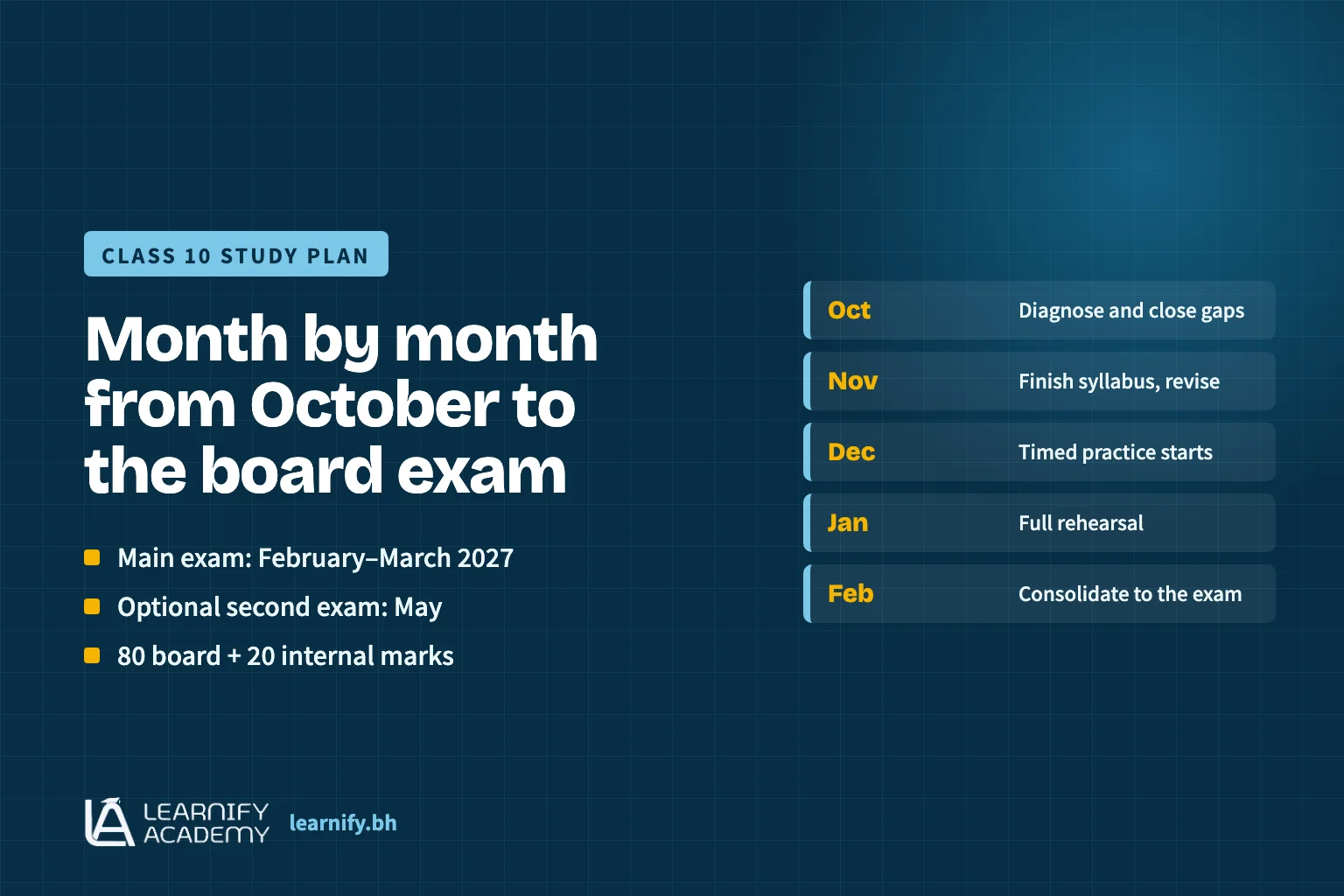
Plan backwards from February 2027. CBSE says the compulsory first board exam will be held in February–March 2027, though the date sheet was not out as of 24 September 2026. Finish new chapters by November, revise in December, sit full timed CBSE sample papers in January and keep February for light revision and rest.
When is the 2027 CBSE Class 10 board exam?
CBSE says the compulsory first Class 10 board exam will be held during February–March 2027, but it had not published the 2027 date sheet as of 24 September 2026. Its two-exam scheme says the main exam begins from mid-February and an optional second exam is held in May. This Class 10 board exam study plan is therefore built month by month rather than around exact dates.
For reference only, the 2026 main exam ran from 17 February to 11 March. When the 2027 date sheet is released on cbse.gov.in, write the actual paper dates onto the plan below.
Both exams cover the full syllabus, and internal assessment happens once, before the main exam. Treat February–March as the exam that counts: in 2026 CBSE asked schools to advise students to use the second exam ‘only in dire need’.
What does the 2026–27 Class 10 syllabus weigh?
Each main subject has an 80-mark board paper and 20 marks of internal assessment conducted by the school. The unit weights below, from CBSE’s 2026–27 syllabus documents, show where revision time pays off.
| Subject | Board paper (80 marks) | Internal assessment (20 marks) |
|---|---|---|
| Mathematics | Algebra 20, Geometry 15, Trigonometry 12, Statistics and Probability 11, Mensuration 10, Number Systems 6, Coordinate Geometry 6 | Pen-paper test and multiple assessment 10, portfolio 5, lab practical 5 |
| Science | Chemical Substances 25, World of Living 25, Effects of Current 13, Natural Phenomena 12, Natural Resources 5 | Periodic assessment 5, multiple assessment 5, portfolio 5, practical work 5 |
| Social Science | History, Geography, Political Science and Economics, 20 marks each, with map questions in History and Geography | Pen-paper test 5, multiple assessment 5, project 5, portfolio 5 |
| English Language and Literature | Reading 20, Writing and Grammar 20, Literature 40 | Includes listening and speaking assessment (5 marks) |
Science topics not in the board paper: the 2026–27 syllabus keeps Periodic Classification of Elements, Evolution, and Motor, Electromagnetic Induction and Electric Generator in the course, but says they ‘will be assessed only formatively’, that is, in school rather than in the board exam. Information in the boxes of the NCERT textbook is also not assessed in the year-end exam.
Two more points for this batch. CBSE’s 2026–27 curriculum confirms that Class 10 students of 2026–27 ‘may opt for Mathematics Basic’, and the new three-language rules do not apply to them, so they continue with two languages. The prescribed books are the NCERT titles listed in each syllabus; see our Class 10 NCERT textbooks page.
What is the month-by-month Class 10 board exam study plan?
The plan runs in five stages, diagnose, finish, revise, rehearse and consolidate, with a sixth only if a second exam is needed. Adjust the pace to your child’s school, which sets its own teaching schedule, pre-boards and internal assessment deadlines.
| Month | Main goal | What to do | CBSE or NCERT resource |
|---|---|---|---|
| October 2026 | Diagnose and close gaps | Attempt each subject’s 2026–27 sample paper once without a timer; list weak chapters; keep pace with school teaching; mark the Science topics assessed only in school | 2026–27 syllabus; sample papers |
| November 2026 | Finish the syllabus; first revision | Complete remaining chapters with the school; revise Maths and Science chapter by chapter; solve NCERT and exemplar questions; keep practicals and portfolio up to date | NCERT textbooks; NCERT Exemplar |
| December 2026 | Second revision; start timed practice | One timed paper per subject each week, marked with the marking scheme; keep an error log; practise Social Science maps and English writing tasks | Sample papers and marking schemes |
| January 2027 | Full rehearsal | Two or three full timed papers per subject; answer Science in three sections and Social Science in four; finish internal assessment work by school deadlines; treat pre-boards as real exams | Sample papers; school pre-boards |
| February 2027 to the exam | Consolidate | Short daily revision of formulas, reactions, diagrams, dates and maps; a timed paper every few days; fit the plan to the official date sheet; protect sleep | 2027 date sheet, when released |
| March to May 2027, only if needed | Decide on the second exam | After the April result, choose up to three subjects to improve, register through the school and revise their full syllabus for May | School notice on second-exam registration |
Put school dates on the same wall chart. Internal assessment is conducted by schools, and CBSE’s own circulars refer to schools holding pre-board examinations, so those dates will vary from school to school.
What should a typical study week look like?
A steady weekly rhythm is easier to keep than long catch-up sessions. A simple pattern to adapt to your child’s timetable:
- School days: revise that day’s school topics, then one focus subject in rotation (Maths, Science, Social Science, English, second language).
- Every day: 20 to 30 minutes of mixed questions from earlier chapters, plus 10 minutes on the error log.
- Maths: a little every day rather than one long session a week.
- From December: one full timed paper at the weekend, marked the same day with the CBSE marking scheme.
- Rest: one lighter half-day each week, and regular sleep.
How should students use CBSE sample papers and marking schemes?
In stages, starting now. CBSE announced the 2026–27 sample papers and marking schemes on 21 September 2026 and says there is no change in the question paper design this year. Its curriculum says they are released in advance ‘to support transparency and effective preparation’.
- October: attempt each subject’s sample paper without a timer to find weak chapters.
- Same week: mark it with the marking scheme, which shows the points examiners look for and how marks split within an answer.
- December onwards: repeat the paper under exam timing, then use school mock and pre-board papers.
- Every week: re-attempt wrong questions from the error log a week after first getting them wrong.
- Throughout: practise case-based and source-based questions regularly, since CBSE’s 2026–27 curriculum says approximately 50% of board questions are competency-focused.
In Science and Social Science, practise answering in the right section. For the 2026 exams CBSE told schools that the Science answer book must be divided into three sections (Biology, Chemistry, Physics) and Social Science into four (History, Geography, Political Science, Economics), and that mixed answers ‘will not be evaluated’. The 2026–27 sample papers keep these sections, so use the same layout in every mock test.
For chapter-wise practice between full papers, our important questions by grade and Class 10 Science quick revision pages can help.
What should parents check during the board year?
- The details sent to CBSE. Schools submit the list of candidates for the first exam between 24 September and 21 October 2026 (with a late fee until 30 October). CBSE then allows corrections to name, date of birth or subjects only from 2 to 4 November 2026, through a data verification slip, so check spellings and the Maths Standard or Basic choice with the school.
- Internal assessment. It is worth 20 marks in each main subject, is completed before the main exam and cannot be improved in the second exam.
- Sleep and calm. CBSE’s Parenting Calendar 2026–27 describes sleep as ‘a non-negotiable academic strategy’ and says that the day before an exam a child ‘needs calm more than they need last-minute input’.
- School notices. In Bahrain and the rest of the GCC, as in India, schools handle registration, admit cards and second-exam entries, so read school circulars closely.
If you would like structured support through the year in Riffa or Segaya, our Grade 10 page has the details.
What if the February–March exam does not go to plan?
The optional second exam in May lets passed and eligible students improve up to three subjects out of Science, Mathematics, Social Science and languages, and the better of the two performances counts. It covers the full syllabus of each subject taken, so decide soon after the April result. In 2026 the main result came on 15 April, and the window to enter or withdraw from the second exam ran from 16 to 20 April.
FAQ
Questions parents ask
When should a Class 10 student finish the syllabus?
Aim to finish new chapters by November so that December and January are free for revision and full timed papers. Your school’s teaching pace and pre-board dates will shape this, so line the plan up with the school calendar. CBSE’s compulsory first board exam is due in February–March 2027.
How many sample papers should a Class 10 student solve?
Quality matters more than number. Solve CBSE’s 2026–27 sample paper for each subject at least twice, once untimed in October and once timed from December, and mark it with the official marking scheme each time. Then add your school’s mock and pre-board papers in December and January.
Is the 2027 CBSE Class 10 date sheet out?
Not as of 24 September 2026. CBSE’s 2026–27 LOC circular says the first board exam will be held during February–March 2027, and the two-exam scheme places the optional second exam in May. Follow cbse.gov.in and your school’s notices for the official date sheet, then fit this plan to the paper dates.
Which Science topics are not in the 2027 board paper?
The 2026–27 syllabus keeps Periodic Classification of Elements, Evolution, and Motor, Electromagnetic Induction and Electric Generator in the course but assesses them only formatively in school, not in the board exam. Information in the NCERT textbook’s boxes is also not assessed in the year-end exam. Check the full syllabus on cbseacademic.nic.in.
Can my child still choose Maths Basic in 2026–27?
Yes. CBSE’s 2026–27 curriculum says Class 10 students of 2026–27 continue under the existing scheme and may opt for Mathematics Basic, although the Standard and Basic scheme is being discontinued for later batches. Between the first and second exams, a student may also switch between Mathematics Standard and Mathematics Basic.
Should my child plan for the May second exam from the start?
No. Treat February–March as the real exam. The second exam is for improving up to three subjects if needed, and in 2026 CBSE asked schools to advise students to use it only in dire need. It covers the full syllabus again, so a strong first attempt saves a second round of revision.
Sources
Official documents used for this article, checked on 24 September 2026. CBSE and NCERT can update them during the year, so confirm important dates and rules on cbse.gov.in or cbseacademic.nic.in before acting.
- CBSE circular: Submission of LOC for Class X and XII Main Examinations 2026–27 (17 September 2026)
- CBSE Notification: Two Board Examinations in Class X from 2026 (25 June 2025)
- CBSE circular: LOC for Class X Second Board Examination 2026 (17 March 2026)
- CBSE circular: LOC for Class X Second Board Examination 2026, with FAQs (15 April 2026)
- CBSE Press Release: Class X Second Board Examination Results 2026 (18 July 2026)
- CBSE Notice: Post-result facilities, Class X 2026 (5 August 2026)
- CBSE: Guidance to Class X students for Board examinations (9 December 2025)
- CBSE Press Release: Guidelines on the three-language policy (29 June 2026)
- CBSE Parenting Calendar 2026–27
- CBSE Secondary Curriculum 2026–27, Part 1 (introduction and assessment)
- CBSE Class X Mathematics syllabus 2026–27
- CBSE Class X Science syllabus 2026–27
- CBSE Class X Social Science syllabus 2026–27
- CBSE Class X English Language and Literature syllabus 2026–27
- CBSE Notification: Sample Question Papers for 2026–27 (21 September 2026)
- CBSE Class X Sample Question Papers and Marking Schemes 2026–27
Want expert help this school year?
Learnify Academy teaches CBSE students in person in Riffa and Segaya, Bahrain. Your child’s first class is free.