
Bahrain guide · 2026–27
How to choose a tuition centre in Bahrain: a parent checklist
Eight checks to make before you pay a tuition centre in Bahrain, from curriculum and teachers to trial classes, progress reports and the Ministry of Education licence.
At a glance
- Licence for educational centres Ministry of Education (private educational institution licence)
- Legal basis Legislative Decree No. (25) of 1998
- Ministry contact Licensing and Follow-up of Private Schools Directorate
- CBSE Class 9 in 2026–27 New NCERT books (Ganita Manjari, Exploration, Kaveri)
- CBSE Class 10 in 2026–27 Existing NCERT books continue
Quick answer
To choose a tuition centre in Bahrain, check that it teaches your child’s exact curriculum and this year’s books, that a specialist teaches each subject, that batches are small enough for questions, that you can attend a trial class, and that progress is reported in writing. Also ask how the centre is licensed.
How do you choose a tuition centre in Bahrain?
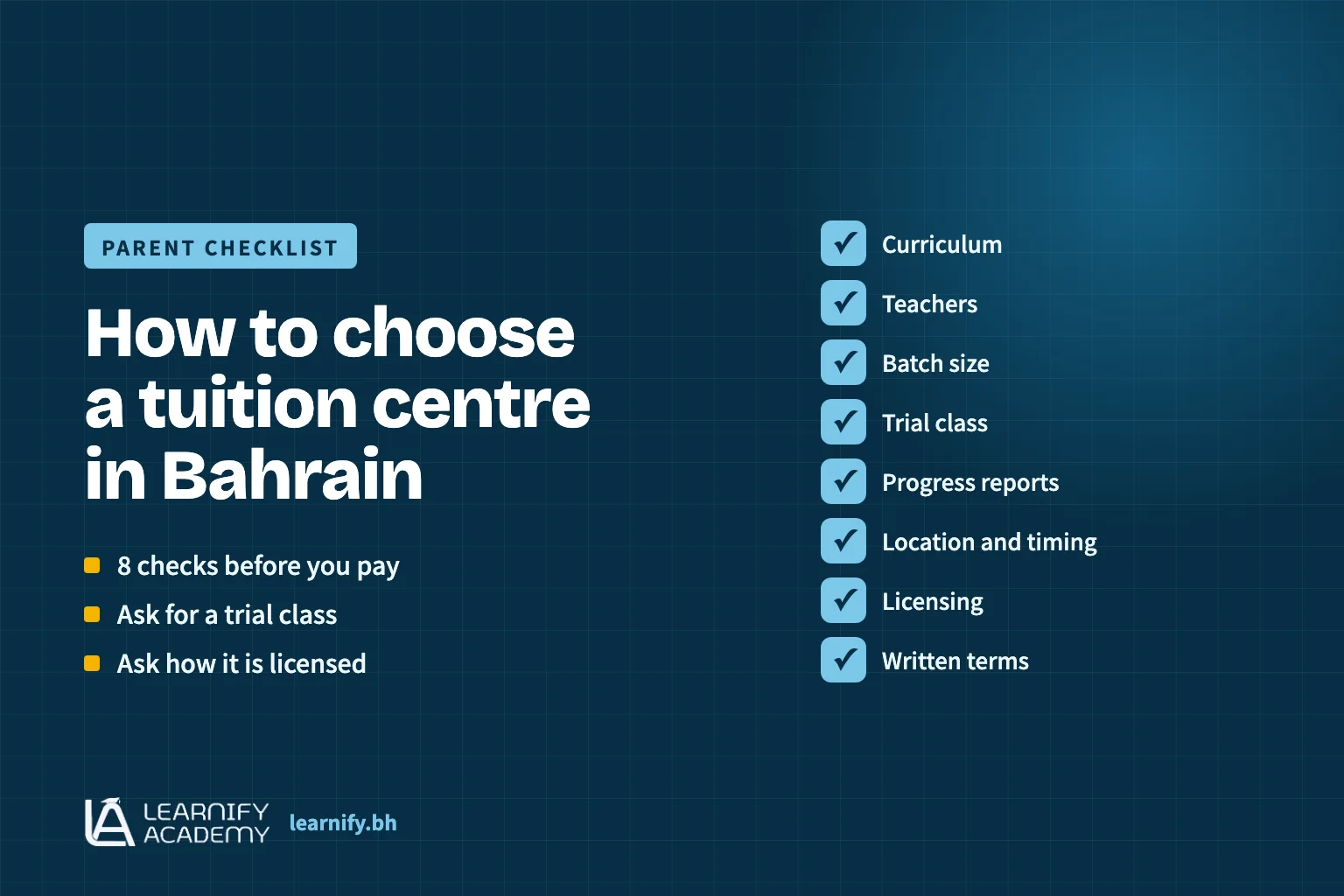
To choose a tuition centre in Bahrain well, check the same eight things at every centre you consider, and decide on what you see in a real class rather than on adverts. Take this list with you when you visit.
- Curriculum: it teaches your child’s board, class and this year’s textbooks.
- Teachers: each subject is taught by someone who knows it well, especially from Class 9.
- Batch size: small enough for every child to ask questions and have work checked.
- Trial class: your child can attend a real class before you pay.
- Progress: you get regular, written feedback linked to school tests.
- Location and timing: the journey and class times fit your family’s week.
- Licensing: the centre can tell you how it is licensed, and by whom.
- Terms: fees, missed-class rules and refunds are clear and in writing.
Does the centre teach your child’s curriculum and this year’s books?
Curriculum match comes first, because a centre that is strong in one board may be weak in another. Ask which boards and classes it teaches, which textbooks it uses for your child’s class this year, and whether its tests follow your school’s pattern. If you are still comparing boards, our CBSE vs ICSE vs IGCSE guide explains the differences.
For CBSE families, 2026–27 brings changes that quickly show whether a centre is up to date:
- Class 9 has new NCERT books, including Ganita Manjari for Maths, Exploration for Science and Kaveri for English (see the Class 9 NCERT books).
- Class 10 keeps the existing NCERT books this year; NCERT says new Class 10 and 11 books come from 2027–28.
- Class 9 Maths and Science now have an optional Advanced level, and CBSE is discontinuing the Basic and Standard Maths split, which only this year’s Class 10 can still take.
For IGCSE, ask which exam board and syllabus the centre prepares students for, and check that it matches your child’s school.
Who will teach your child, and in which subject?
Ask who will actually teach your child, not only who runs the centre. From Class 9 the work becomes more specialised, so look for a teacher who knows each subject well rather than one person covering everything. In Classes 11 and 12, NCERT’s framework offers Physics, Chemistry and Biology as separate subjects, so a separate specialist for each makes sense.
Useful questions: What is the teacher’s own subject background? How long have they taught this class and board? Will the same teacher stay all year, and who covers when they are away? For board classes, also ask how often students write full papers under timed conditions and get them marked.
How many students are in each batch?
Ask for the maximum batch size, and whether batches are grouped by class and board. A number on its own tells you little. What matters is whether every child is asked questions, gets homework checked and can ask for help without waiting.
Mixed batches, such as Class 9 and 10 together or CBSE and IGCSE students in one room, are harder to teach well, so ask how the teacher handles them. If your child is quiet, watch in the trial class whether the teacher draws them in. Ask, too, whether your child can move to another batch if the level or timing does not suit.
Can your child attend a trial class before you pay?
A trial class is the most reliable way to judge a centre, so ask for one before paying any fees. Sit in if you can, or ask your child afterwards: Was the topic from their current syllabus? Did the teacher check understanding or only lecture? Were questions welcome? Did your child leave with notes or practice work?
Learnify, for example, lets new families book a free trial class at its Riffa and Segaya classes (see the contact page).
How will you know if your child is improving?
Ask how progress is measured and shared before you enrol. A clear answer includes regular tests in your school’s format, marked work your child brings home, a written update at a set interval and a conversation before school exams.
Agree on a starting point as well. A short test in the first weeks, compared with recent school marks, lets you see real movement rather than impressions. Share your child’s school test papers with the teacher too, so lessons target actual mistakes rather than general revision. If nothing has changed after a term, ask the centre what it will do differently.
Is the location and timing practical for your family?
Because tuition comes on top of a full school day, the journey matters as much as the teaching. In Bahrain, time the trip at the hour you would actually travel, check where you can park or drop off safely, and ask whether class times fit around school, activities and family routines.
For younger children, ask who supervises them before and after class. For older students, ask how the timetable changes in the weeks before school and board exams. If two centres seem equally good, a shorter and more predictable journey is often the better choice, because a tired child learns less.
Is the tuition centre licensed?
Ask the centre directly how it is licensed. Bahrain’s National Portal lists a Ministry of Education service, ‘Request a license to establish a private educational institution’, and says it covers ‘private schools or educational centers’. The service falls under Legislative Decree No. (25) of 1998 on private educational and training establishments, and the portal names the Ministry’s Licensing and Follow-up of Private Schools Directorate as the contact.
The Ministry’s own advice on choosing a private school is to start by ensuring the school is officially licensed by the Ministry of Education. It is fair to ask a tuition centre the same things: which licence it holds, which authority issued it, and whether you can see it. If you need to confirm details, the portal lists the directorate’s email as dir.private.ed@moe.gov.bh.
What are the warning signs to watch for?
A few answers should make you pause, whatever a centre’s reputation:
- Promises of guaranteed marks or ranks. No centre can guarantee a result, and a promise like this says more about the marketing than the teaching.
- No trial class, or pressure to pay for a full term or year before your child has attended.
- Vague answers about who teaches which subject, or frequent changes of teacher.
- Batches that mix several classes or boards with no plan for handling them.
- Reluctance to put fees, refunds and missed-class rules in writing.
- No written feedback, or feedback that never mentions specific topics.
One warning sign is not always a reason to walk away, but two or three together usually are.
What should you agree in writing before paying fees?
Before paying, ask for these points in writing:
- Fees per month or term, and exactly what they include, such as classes, tests and materials.
- What happens if your child misses a class, or if the centre cancels one.
- The notice period and refund policy if you decide to stop.
- Class days and times, and any changes before exams.
- How the centre will contact you, and whom to call with a concern.
A centre that answers these questions clearly before you pay is more likely to communicate clearly once your child has started.
FAQ
Questions parents ask
Does Bahrain’s Ministry of Education license educational centres?
Bahrain’s National Portal lists a Ministry of Education service to license private educational institutions, and says it covers ‘private schools or educational centers’, under Legislative Decree No. (25) of 1998. The simplest check is to ask a tuition centre which licence it holds and which authority issued it, and to see it before you enrol.
How can I check a tuition centre’s licence?
Ask the centre to show its licence and tell you which authority issued it. For private educational institutions, Bahrain’s National Portal names the Ministry of Education’s Licensing and Follow-up of Private Schools Directorate as the contact, with the email dir.private.ed@moe.gov.bh, so you can confirm details there if anything is unclear.
What should I look for in a trial class?
Check that the lesson matches your child’s current syllabus and textbook, that the teacher checks understanding with questions rather than only lecturing, and that students feel able to ask for help. Afterwards, ask your child whether they understood more than before, and whether they would be comfortable asking this teacher a question.
Is group tuition or one-to-one tuition better?
Neither is always better. Small groups add discussion and a steady pace, while one-to-one lessons can suit a child with specific gaps or low confidence. Whichever you choose, the checks are the same: a teacher who knows the subject, a clear plan, regular tests and written feedback you can act on.
What should CBSE Class 9 tuition cover in 2026–27?
It should follow the new NCERT Class 9 books, such as Ganita Manjari for Maths, Exploration for Science and Kaveri for English, and CBSE’s 2026–27 course structure. If your child is taking the optional Mathematics Advanced or Science Advanced level, ask whether the centre also covers CBSE’s Advanced material.
How often should a tuition centre report progress?
Agree a rhythm before you enrol. A sensible minimum is a short written update each month, marked tests after each chapter and a conversation before school exams. What matters most is that feedback is specific: which topics are secure, which are weak, and what the teacher will do next.
Sources
Official documents used for this article, checked on 24 September 2026. CBSE and NCERT can update them during the year, so confirm important dates and rules on cbse.gov.in or cbseacademic.nic.in before acting.
- Bahrain National Portal: Request a license to establish a private educational institution (Ministry of Education)
- Ministry of Education, Bahrain: Private Education
- Ministry of Education, Bahrain: Frequently Asked Questions (Private Schools)
- NCERT Advisory on Introduction of New Textbooks and Syllabi, 17 March 2026
- NCERT: Textbooks PDF (Class 9 list)
- CBSE Secondary Curriculum 2026–27, Part 1 (Scheme of Studies)
- NCERT Grade 9 Syllabus, Part 2 (Science, Mathematics, Social Science)
Want expert help this school year?
Learnify Academy teaches CBSE students in person in Riffa and Segaya, Bahrain. Your child’s first class is free.