
CBSE guide · 2026–27
CBSE Class 10 Maths syllabus 2026–27: chapters and unit marks
The official CBSE Class 10 Maths syllabus for 2026–27, explained for parents: the seven units and their marks, the chapters in each, internal assessment and how the Standard and Basic papers are set.
At a glance
- Board exam 80 marks, 3 hours
- Internal assessment 20 marks
- Units 7 units covering the 14 NCERT chapters
- Heaviest unit Algebra, 20 marks
- Textbook NCERT Mathematics, Class X
- Change from 2025–26 None in units, marks or topics
Quick answer
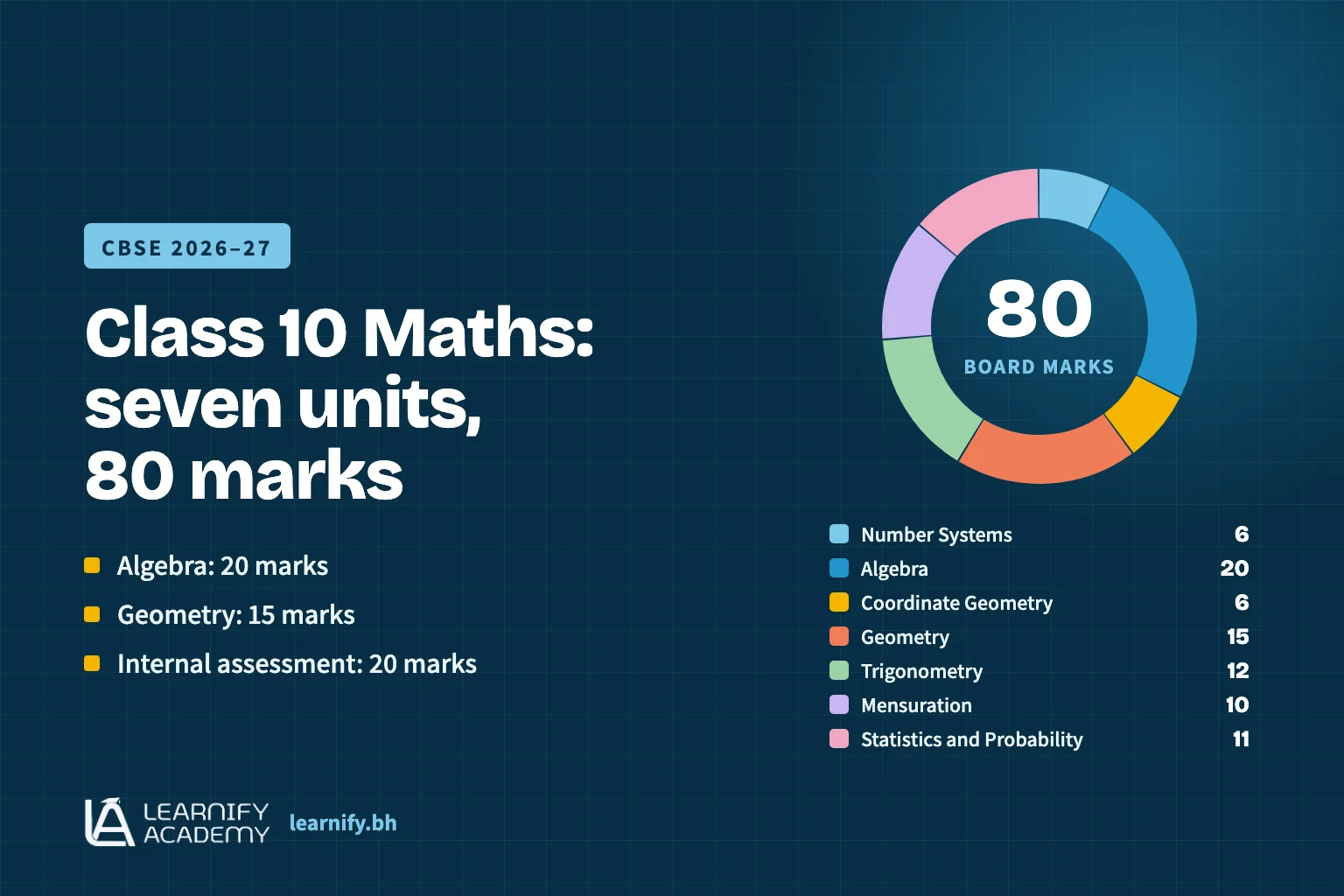
The CBSE Class 10 Maths syllabus for 2026–27 has seven units worth 80 board-exam marks: Number Systems 6, Algebra 20, Coordinate Geometry 6, Geometry 15, Trigonometry 12, Mensuration 10, and Statistics and Probability 11. Schools add 20 internal assessment marks. Standard (041) and Basic (241) share this syllabus but sit different question papers.
What is in the CBSE Class 10 Maths syllabus 2026–27?
The CBSE Class 10 Maths syllabus 2026–27 has seven units that carry 80 marks in the board exam, and the school adds 20 marks of internal assessment, making 100 in all. CBSE publishes a single syllabus for Mathematics Standard (code 041) and Mathematics Basic (code 241), so every Class 10 student studies the same content, whichever paper they will sit.
The board exam is set on this document for every CBSE school, whether your child studies in Bahrain, elsewhere in the GCC or in India. The syllabus pairs each topic with the competencies students should show, in line with what it calls “a deliberate shift from rote learning to competency-based education”. CBSE says that about half of the questions in its board papers are now competency-focused, such as case-based and application-oriented items.
The document sets out every topic in three columns: the content to be taught, the competencies students should develop, and an explanation of what they should be able to do, for example “Find the zeros of polynomial graphically and algebraically”. Reading the explanation column is a quick way to see what a board question on that topic can ask.
How many marks does each unit carry in Class 10 Maths?
Algebra carries the most marks, 20 out of 80, followed by Geometry with 15 and Trigonometry with 12. This is the course structure printed in CBSE’s 2026–27 Mathematics curriculum:
| Unit | Unit name | Marks |
|---|---|---|
| I | Number Systems | 6 |
| II | Algebra | 20 |
| III | Coordinate Geometry | 6 |
| IV | Geometry | 15 |
| V | Trigonometry | 12 |
| VI | Mensuration | 10 |
| VII | Statistics and Probability | 11 |
| Total | 80 |
Algebra, Geometry and Trigonometry together account for 47 of the 80 marks, so these three units deserve the largest share of practice time. The other four units carry 33 marks between them.
Nothing has changed for Class 10 this year. The units, marks and topics are the same as in the 2025–26 syllabus, and CBSE’s notice of 21 September 2026 says there is no change in the question paper design and assessment pattern for 2026–27.
Which chapters are in each unit of Class 10 Maths?
The seven units cover all 14 chapters of the NCERT Class 10 Mathematics textbook, which is the textbook CBSE prescribes. The NCERT chapter order is slightly different from the unit order, so the chapter numbers are shown below. Trigonometry spans two chapters: the identities sit in Chapter 8, and heights and distances have their own chapter, Chapter 9.
| Unit (marks) | Topics in the CBSE syllabus | NCERT chapter |
|---|---|---|
| I Number Systems (6) | Real numbers: Fundamental Theorem of Arithmetic; irrationality of √2, √3, √5 | 1 Real Numbers |
| II Algebra (20) | Polynomials: zeros and their relationship with coefficients | 2 Polynomials |
| II Algebra (20) | Pair of linear equations in two variables: graphical and algebraic methods | 3 Pair of Linear Equations in Two Variables |
| II Algebra (20) | Quadratic equations: factorisation, quadratic formula, nature of roots | 4 Quadratic Equations |
| II Algebra (20) | Arithmetic progressions: nth term and sum of first n terms | 5 Arithmetic Progressions |
| III Coordinate Geometry (6) | Distance formula; section formula (internal division) | 7 Coordinate Geometry |
| IV Geometry (15) | Triangles: similarity and the Basic Proportionality Theorem | 6 Triangles |
| IV Geometry (15) | Circles: tangents | 10 Circles |
| V Trigonometry (12) | Trigonometric ratios, standard angles and identities | 8 Introduction to Trigonometry |
| V Trigonometry (12) | Heights and distances | 9 Some Applications of Trigonometry |
| VI Mensuration (10) | Areas of sectors and segments of a circle | 11 Areas Related to Circles |
| VI Mensuration (10) | Surface areas and volumes of combinations of solids | 12 Surface Areas and Volumes |
| VII Statistics and Probability (11) | Mean, median and mode of grouped data | 13 Statistics |
| VII Statistics and Probability (11) | Classical probability of simple events | 14 Probability |
The copy of the textbook on the NCERT website is marked “Reprint 2026-27”. CBSE also prescribes NCERT’s Mathematics Exemplar Problems for Class X, NCERT’s Laboratory Manual in Mathematics for the secondary stage and CBSE’s own Guidelines for Mathematics Laboratory in Schools for Class X. You will find the textbook and the other Class 10 NCERT books on our Class 10 NCERT textbooks page.
Which topics have limits in the Class 10 Maths syllabus?
Several topics have clear limits written into the 2026–27 syllabus, and knowing them helps students focus their revision:
- Quadratic equations: real roots only, found by factorisation or the quadratic formula.
- Triangles: students prove the Basic Proportionality Theorem; its converse and the similarity criteria are stated without proof.
- Circles: students prove two theorems, that the tangent at any point is perpendicular to the radius through the point of contact, and that tangents drawn from an external point are equal.
- Trigonometric identities: “only simple identities”, built on sin²A + cos²A = 1.
- Heights and distances: no more than two right triangles, and angles of elevation or depression of only 30°, 45° and 60°.
- Areas of segments: central angles of 60°, 90° and 120° only.
- Surface areas and volumes: combinations of any two of cubes, cuboids, spheres, hemispheres and right circular cylinders or cones.
- Statistics: mean, median and mode of grouped data, with bimodal situations avoided.
How is internal assessment for Class 10 Maths split?
Internal assessment is worth 20 marks in three parts, and the split is identical for Standard and Basic:
| Component | Marks |
|---|---|
| Pen-paper tests and multiple assessment (5 + 5) | 10 |
| Portfolio | 5 |
| Lab practical (activities from the prescribed books) | 5 |
| Total | 20 |
CBSE’s 2026–27 guidelines for Classes 9 and 10 ask schools to hold three periodic assessments in each subject and count the average of the best two, with at least one of them competency-based and application-oriented. Under the two-board-exam policy, internal assessment is conducted only once, before the main exam, and CBSE has said there is no facility to improve these marks later because internal assessment is a yearlong exercise.
CBSE describes a portfolio as “a curated collection of student work” that can include written work, projects, reflections and presentations, while multiple assessment can use quizzes, oral presentations, discussions, experiments, projects and other varied tasks. The 5 lab practical marks come from lab activities done from the prescribed books.
What does the Class 10 Maths question paper look like?
Both Maths papers are 80 marks and three hours long, and CBSE’s 2026–27 sample papers for Standard and Basic use the same layout of 38 questions in five sections:
| Section | Questions | Question type | Marks |
|---|---|---|---|
| A | 1 to 20 | 18 multiple-choice and 2 assertion-reason, 1 mark each | 20 |
| B | 21 to 25 | Very short answer, 2 marks each | 10 |
| C | 26 to 31 | Short answer, 3 marks each | 18 |
| D | 32 to 35 | Long answer, 5 marks each | 20 |
| E | 36 to 38 | Case-study based, 4 marks each | 12 |
| Total | 38 | 80 |
There is no overall choice, but there is an internal choice in two questions each in Sections B, C and D, and in the 2-mark parts of the Section E case studies. Calculators are not allowed, and π is taken as 22/7 unless a question says otherwise. In the Basic paper, each Section E case study is split into sub-parts worth 1, 1 and 2 marks.
How do the Standard and Basic papers differ?
They differ in the kind of thinking each paper rewards. The curriculum sets these weightages:
| Type of question | Standard (041) | Basic (241) |
|---|---|---|
| Remembering and understanding | 43 marks (54%) | 60 marks (75%) |
| Applying | 19 marks (24%) | 12 marks (15%) |
| Analysing, evaluating and creating | 18 marks (22%) | 8 marks (10%) |
| Total | 80 marks | 80 marks |
Basic puts three-quarters of its marks on remembering and understanding, while Standard gives 37 marks to applying, analysing, evaluating and creating. The 2026–27 curriculum says the Basic and Standard scheme is being discontinued, although Class 10 students in 2026–27 continue under it and may still opt for Basic. From 2027–28, Class 10 will have one common Mathematics paper plus an optional 25-mark Mathematics Advanced paper, the two-level structure that starts in Class 9 this year (see our Class 9 maths guide).
When are the 2027 Class 10 Maths board exams?
CBSE had not published the 2027 date sheet when this article was written on 24 September 2026. Its circular on the List of Candidates for 2026–27 says the first board examination will be held in February–March and is mandatory for all Class 10 candidates.
Under the two-board-exam policy, a second exam is held in May for students who want to improve their performance in up to three of Science, Mathematics, Social Science and languages. Both exams are conducted on the full syllabus for the year. The list of candidates for the second exam is filled only after the first exam is over, so families do not need to decide about a May attempt now.
How can students use the syllabus well this year?
Students can treat the syllabus as a checklist for the whole year:
- Give practice time roughly in proportion to unit marks, starting with Algebra, Geometry and Trigonometry.
- Before starting each chapter, read its explanation column in the syllabus so your child knows what they will be expected to do.
- Attempt CBSE’s 2026–27 sample paper for the level your child will sit, and check answers against the official marking scheme, which shows how marks are split within each answer.
- Use the NCERT Exemplar, which CBSE lists as a prescribed book, for harder questions, and our important questions by grade for quick checks.
- Keep lab activities and the portfolio up to date, since together they carry 10 of the 20 internal marks.
If your child would like regular support through the year, our maths tuition in Bahrain is built around this syllabus.
FAQ
Questions parents ask
How many chapters are in the CBSE Class 10 Maths syllabus 2026–27?
The syllabus is organised into seven units, and together they cover all 14 chapters of the NCERT Class 10 Mathematics textbook, from Real Numbers to Probability. The copy on the NCERT website is marked Reprint 2026-27. The Class 10 units, marks and topics are exactly the same as in the 2025–26 syllabus.
Is the syllabus different for Maths Standard and Maths Basic?
No. CBSE publishes one Class 10 Mathematics syllabus for both codes, 041 (Standard) and 241 (Basic), and the internal assessment is the same. Only the board paper changes: Basic gives 75 per cent of its marks to remembering and understanding questions, while Standard gives 54 per cent and puts more weight on application and reasoning.
Which unit carries the most marks in Class 10 Maths?
Algebra, with 20 of the 80 board-exam marks. It covers polynomials, pairs of linear equations in two variables, quadratic equations and arithmetic progressions. Geometry (15 marks) and Trigonometry (12 marks) come next, so these three units together are worth 47 marks, well over half of the paper.
Has the Class 10 Maths syllabus changed for 2026–27?
No. The units, marks and topics for Class 10 are the same as in the 2025–26 syllabus, and CBSE’s notice of 21 September 2026 confirms there is no change in the question paper design or assessment pattern. The major curriculum changes this year are in Class 9, which now has an optional Advanced level in Mathematics and Science.
Are calculators allowed in the Class 10 Maths board exam?
No. CBSE’s 2026–27 sample question papers for both Mathematics Standard and Mathematics Basic state that the use of calculators is not allowed. The same instructions ask students to take π as 22/7 wherever it is needed, unless the question itself states a different value.
Is the syllabus for the second board exam in May the same?
Yes. CBSE’s two-exam policy says both examinations are conducted on the full syllabus meant for the year, and the scheme of examinations stays the same. The first exam, from mid-February, is compulsory, while the second, in May, lets eligible students improve their performance in up to three subjects, including Maths.
Sources
Official documents used for this article, checked on 24 September 2026. CBSE and NCERT can update them during the year, so confirm important dates and rules on cbse.gov.in or cbseacademic.nic.in before acting.
- CBSE Curriculum 2026–27: Mathematics, Class X (codes 041 and 241)
- CBSE Secondary Curriculum 2026–27, Part 1: initial pages (scheme of studies and assessment)
- CBSE Class X Sample Question Paper 2026–27: Mathematics Standard (041)
- CBSE Class X Sample Question Paper 2026–27: Mathematics Basic (241)
- CBSE Class X sample papers and marking schemes 2026–27 (index page)
- CBSE notification on Sample Question Papers for 2026–27 (21 September 2026)
- CBSE Curriculum 2025–26: Mathematics, Classes IX–X (for comparison)
- NCERT Mathematics Textbook for Class X, contents (Reprint 2026-27)
- CBSE notification: Two Board Examinations in Class X from 2026 (25 June 2025)
- CBSE circular: Submission of List of Candidates for Class X and XII, 2026–27 (dated 17 September 2026)
- CBSE circular: LOC for Class X Second Board Examination 2026 (17 March 2026)
- CBSE examination circulars (list checked 24 September 2026)
Want expert help this school year?
Learnify Academy teaches CBSE students in person in Riffa and Segaya, Bahrain. Your child’s first class is free.