School boards guide · 2026–27
CBSE vs ICSE vs IGCSE: how the three boards compare, for parents in Bahrain
A fact-checked comparison of CBSE, ICSE/ISC and Cambridge IGCSE for families in Bahrain and the Gulf, using only what each board publishes: exams, grading, subject rules and where each is offered locally.
At a glance
- CBSE Central Board of Secondary Education, India; board exams in Class 10 and Class 12
- ICSE / ISC CISCE, India; ICSE in Class 10, ISC in Class 12
- Cambridge IGCSE Cambridge International (University of Cambridge); ages 14 to 16
- Subject grades CBSE: A1 to E by rank; IGCSE: A* to G
- Pass mark per subject CBSE: 33%; IGCSE: grades A* to G are passes
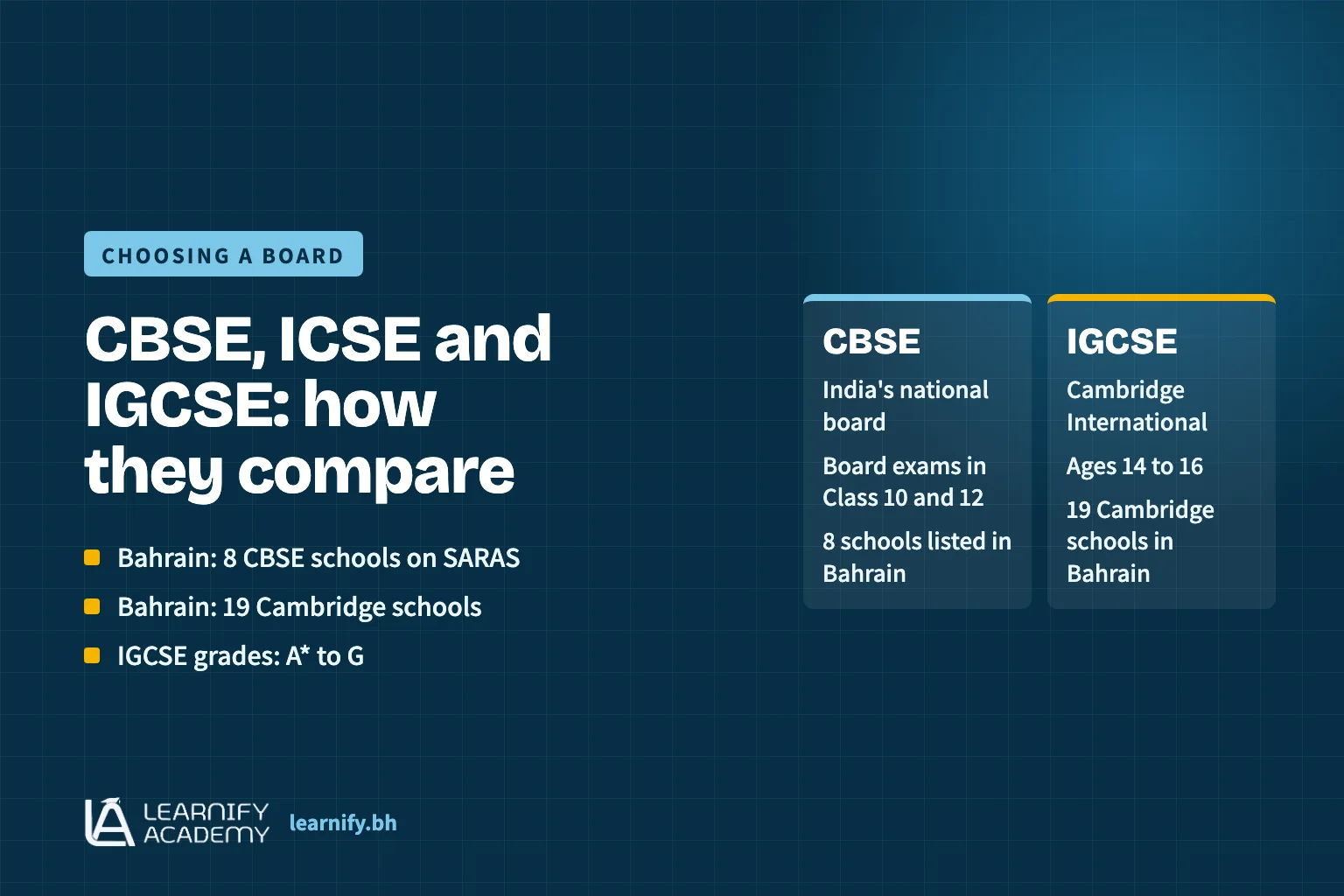
- Listed in Bahrain (24 Sep 2026) 8 CBSE schools (SARAS); 19 Cambridge schools (Cambridge finder)
Quick answer
CBSE, ICSE and IGCSE are run by three separate bodies. CBSE is India’s Central Board of Secondary Education; ICSE (Class 10) and ISC (Class 12) are run by CISCE, another Indian council; IGCSE is Cambridge International’s qualification for 14 to 16 year olds. In Bahrain, CBSE lists 8 affiliated schools and Cambridge 19.
What is the difference between CBSE, ICSE and IGCSE?
The main difference between CBSE, ICSE and IGCSE is who sets the course and the exams. CBSE and CISCE (which runs ICSE and ISC) are Indian boards with board exams at the end of Class 10 and Class 12. Cambridge IGCSE is an international qualification taken subject by subject, which Cambridge describes as its qualification for 14 to 16 year olds.
This guide uses only what each board publishes, checked on 24 September 2026. Fees, pass rates and rankings, which the boards do not publish, are left out.
| CBSE | ICSE / ISC | Cambridge IGCSE | |
|---|---|---|---|
| Run by | Central Board of Secondary Education, India | Council for the Indian School Certificate Examinations (CISCE), India | Cambridge International, part of the University of Cambridge |
| Main exams | Class 10 (two board exams from 2026) and Class 12 | ICSE at the end of Class 10; ISC at the end of Class 12 | IGCSE, graded subject by subject, for ages 14 to 16; exams in June and November |
| How subjects are graded | Marks, plus grades A1 to E awarded by rank among passed candidates | Set out in CISCE’s current regulations (ask the school) | Grades A* to G (some syllabuses graded 9 to 1); U means ungraded |
| Subject choice | Fixed core in Class 10; at least five subjects in Class 11 and 12 | Compulsory and optional subject groups set by CISCE each exam year | Over 70 subjects, including 30 languages, offered in any combination |
| Listed in Bahrain | 8 schools on CBSE’s SARAS directory | Not confirmed: cisce.org could not be reached from Bahrain | 19 schools in Cambridge’s school finder |
Who runs CBSE, ICSE and IGCSE?
Each board is a separate organisation with its own syllabus, exam rules and certificates.
CBSE
CBSE’s own history page traces the board to the Board of High School and Intermediate Education, Rajputana, set up in 1929. The name Central Board of Secondary Education was given in 1952, and the board was reconstituted on 1 July 1962. Schools abroad follow the same 2026–27 curriculum, with a few stated exceptions such as the language rule below.
ICSE and ISC (CISCE)
ICSE (at the end of Class 10) and ISC (at the end of Class 12) are conducted by the Council for the Indian School Certificate Examinations (CISCE), a separate Indian board. CISCE publishes its ICSE and ISC rules in yearly regulations on cisce.org. That site could not be opened from Bahrain when we checked on 24 September 2026, so this guide does not list ICSE or ISC rules; ask the school for CISCE’s current regulations.
Cambridge IGCSE
Cambridge International says it is part of the University of Cambridge and offers education for ages 3 to 19, with over 10,000 Cambridge schools in 160 countries. Cambridge IGCSE was first examined in June 1988, after first teaching in September 1986. Cambridge says it aligns IGCSE standards with the GCSE taken in England. After IGCSE, its pathway continues with the Advanced stage, Cambridge International AS & A Level.
How do the Class 10 and Class 12 exams work on each board?
CBSE and CISCE examine at the end of Class 10 and Class 12; IGCSE is examined subject by subject at the end of the course.
CBSE
Classes 9 and 10 form one composite course, as do Classes 11 and 12, so students should choose subjects in Class 9 and Class 11 that they will continue. From 2026, Class 10 has two board exams: the first, in February–March, is compulsory; the second, in May, is optional and lets passed, eligible students try to improve up to three subjects from Science, Mathematics, Social Science and languages. Both cover the full syllabus. Most major subjects carry 80 marks for the board exam and 20 for internal assessment.
ICSE and ISC
ICSE is taken at the end of Class 10 and ISC at the end of Class 12. Subject rules, internal assessment and any improvement exams are set out in CISCE’s regulations for each exam year, so check the current version with the school.
Cambridge IGCSE
Cambridge says IGCSE assessment takes place at the end of the course and can include written, oral, coursework and practical assessment. In many subjects there is a choice between Core and Extended papers, so students of different abilities can sit the same subject. Exams run twice a year, in June and November, with results in August and January.
How are CBSE, ICSE and IGCSE graded?
Each board grades differently, and the CBSE scale in particular is widely misquoted. CBSE’s Class 10 and Class 12 board grades are not fixed mark bands: in subjects where more than 500 candidates pass, CBSE ranks all passed candidates and gives the top eighth A1, the next eighth A2, and so on down to D2, with E meaning Essential Repeat. The fixed bands often quoted online (A1 for 91–100 and so on) are the school-level scale CBSE sets for Class 9 and Class 11, where A1 is 91–100 and D is 33–40.
| Board | Pass rule | Grades |
|---|---|---|
| CBSE Class 10 | At least 33% in a subject | A1, A2, B1, B2, C1, C2, D1, D2 by rank (each an eighth of passed candidates); E = Essential Repeat |
| CBSE Class 12 | 33% (separately in theory and practical, per CBSE’s February 2025 exam FAQ) | Same rank-based A1 to E scale; mark sheet shows marks in each subject, with no aggregate or percentage |
| Cambridge IGCSE | No overall pass; each subject is graded | A* (highest) to G are passing grades; U = ungraded. Some syllabuses use 9 (highest) to 1 |
For families who may return to India, Cambridge’s India guidance says the Association of Indian Universities recognises passes in five Cambridge IGCSE or O Level subjects, including English Language, as equivalent to Standard 10, and that IGCSE results in India show a percentage uniform mark next to each grade.
Which board offers more subject choice?
IGCSE offers the most freedom: Cambridge lists over 70 subjects, including 30 languages, which schools can offer in any combination. CBSE’s course is more structured, with compulsory subjects in Class 10 and wider choice in Classes 11 and 12.
CBSE in 2026–27
- Class 10 (2026–27): two languages, Mathematics (Standard or Basic), Science and Social Science with board exams, plus optional subjects such as a skill subject.
- Class 9 (2026–27): a third language (R3) is now compulsory, assessed only in school, and must be passed for the Class 10 certificate. CBSE schools abroad, including in Bahrain, may offer one compulsory native Indian language instead of the two required in India.
- From 2027–28, Class 10 students can add optional Mathematics Advanced and Science Advanced papers (25 marks, 1 hour), and the Standard/Basic Mathematics split is being phased out.
- Classes 11–12: at least five subjects, one of which must be English or Hindi; ‘streams’ are just the combinations each school offers.
ICSE and ISC
CISCE sets compulsory and optional subject groups for ICSE and ISC in its regulations for each exam year; ask the school for the current subject list.
Cambridge IGCSE
Cambridge sets no compulsory core: the school decides which subjects it offers and how many each student takes, so ask for the school’s list.
Which boards are available in Bahrain?
CBSE and Cambridge schools are both listed for Bahrain in their boards’ own directories; we could not confirm an ICSE or ISC school, because CISCE’s website could not be reached from Bahrain. Bahrain’s Ministry of Education says private schools offer ‘a variety of national and international curricula’; its private education page showed 81 private schools and 90,810 students in private schools when we checked on 24 September 2026, and it licenses and inspects them through its Directorate of Private Schools Licensing and Follow-Up.
| Board | Official directory | Result for Bahrain |
|---|---|---|
| CBSE | SARAS (saras.cbse.gov.in), State: Foreign Schools, District: Bahrain | 8 affiliated schools, all at Senior Secondary level |
| CISCE | cisce.org | Not checked: the site could not be opened from Bahrain on 24 September 2026 |
| Cambridge | Find a Cambridge school (cambridgeinternational.org), location: Bahrain | 19 Cambridge schools; the finder does not say which of them teach IGCSE |
Cambridge’s list includes schools such as The British School of Bahrain, St Christopher’s School and Nadeen School, and one school, Al Noor International School, appears in both the CBSE and Cambridge directories.
Always check a school against the board’s own directory and the Ministry of Education’s Educational Institutions Finder before you enrol. A ‘Cambridge school’ may offer only some Cambridge stages, so ask which qualifications it enters students for.
How do I choose between CBSE, ICSE and IGCSE for my child?
Choose the board that fits where your child is likely to study next and the schools open to you; none of the boards’ own documents ranks them. These questions help:
- Where is your family likely to be in three to five years? If a move to India or another country is possible, check how schools and universities there treat each qualification. Cambridge’s India guidance, for example, explains how IGCSE results are used for Indian admissions.
- Which schools can you actually get a place at in Bahrain, and which boards do they offer at Class 10 and Class 12 level?
- How does your child learn best? IGCSE offers more subject choice and, in some subjects, coursework; CBSE and CISCE set a common course with board exams in Class 10 and Class 12.
- Will your child change boards? The natural points are the start of Class 9 or Class 11, because CBSE treats Classes 9–10 and 11–12 as composite courses.
If your child is at a CBSE school and needs support in the board years, Learnify runs CBSE tuition for Grades 5 to 12 in Riffa, and IGCSE tuition as well.
FAQ
Questions parents ask
Which is better: CBSE, ICSE or IGCSE?
None of the boards’ own documents claims that one board is better than the others. The better choice is the board that suits your child’s next step and the schools open to you. An Indian board keeps the Class 10 and Class 12 board exam route, while IGCSE offers wider subject choice. Check how each qualification is treated wherever your child may study next.
How many CBSE and IGCSE schools are there in Bahrain?
On 24 September 2026, CBSE’s SARAS directory listed 8 CBSE-affiliated schools in Bahrain, all at Senior Secondary level, and Cambridge’s ‘Find a Cambridge school’ tool listed 19 Cambridge schools in Bahrain. Cambridge’s list does not say which schools teach IGCSE, so ask each school. We could not confirm any ICSE or ISC school in Bahrain, because CISCE’s website was not reachable from Bahrain when we checked.
Is a CBSE A1 grade always 91 to 100 marks?
No. In the Class 10 and Class 12 board exams, CBSE awards grades by rank: the top eighth of passed candidates in a subject get A1, the next eighth A2, and so on to D2, with E meaning Essential Repeat. The fixed bands (A1 for 91 to 100 down to D for 33 to 40) are CBSE’s school-level scale for Class 9 and Class 11.
What is the pass mark in CBSE and IGCSE?
CBSE requires at least 33% in a subject; for Class 12, CBSE’s February 2025 exam FAQ says 33% separately in theory and practical. Cambridge IGCSE has no pass mark as such: grades A* to G are passing grades in each subject. For ICSE and ISC, check CISCE’s current regulations with the school.
Is IGCSE recognised in India?
Yes, according to Cambridge’s India guidance: the Association of Indian Universities recognises passes in five Cambridge IGCSE or O Level subjects, including English Language, as equivalent to Standard 10. IGCSE results for candidates in India show a percentage uniform mark next to each grade, which Indian schools and colleges can use. Admission to a particular school or course still depends on that institution’s own rules.
Does my child need a third language in a CBSE school in Bahrain?
Yes, from Class 9 in 2026–27. CBSE has made a third language (R3) compulsory from Classes 6 and 9, assessed only in school, and passing it is needed for the Class 10 certificate. CBSE schools abroad may offer one compulsory native Indian language instead of the two required in India, so ask your school which languages it offers.
Sources
Official documents used for this article, checked on 24 September 2026. CBSE and NCERT can update them during the year, so confirm important dates and rules on cbse.gov.in or cbseacademic.nic.in before acting.
- CBSE: History of the Board
- CBSE Curriculum 2026–27, Secondary Part 1 (Classes IX–X): scheme of studies, assessment and grading
- CBSE Curriculum 2026–27, Secondary Part 2 (Classes XI–XII): scheme of studies, assessment and grading
- CBSE notification: Two Board Examinations in Class X from 2026 (25 June 2025)
- CBSE circular: Submission of LOC for Class X and XII Main Examinations 2026–27 (17 September 2026)
- CBSE: Question answers with Controller of Examinations (February 2025)
- CBSE SARAS: List of Affiliated Schools (Foreign Schools, Bahrain), checked 24 September 2026
- Cambridge International: Cambridge IGCSE
- Cambridge International: Cambridge IGCSE qualification
- Cambridge International: Cambridge IGCSE curriculum
- Cambridge International: Cambridge IGCSE grading choice (A*–G or 9–1)
- Cambridge International: About us
- Cambridge International: Find a Cambridge school (location: Bahrain), checked 24 September 2026
- Cambridge International: Frequently asked questions, recognition and acceptance in India (2025)
- Bahrain Ministry of Education: Private Education
- Bahrain Ministry of Education: Educational Institutions Finder
Want expert help this school year?
Learnify Academy teaches CBSE students in person in Riffa and Segaya, Bahrain. Your child’s first class is free.